Adventurous couple travel across GCC states on motorcycle

1 / 3
Mir Shakeel Ur Rahman from Hyderabad and Amal Ahmed from Jeddah started biking together 6 years ago after their marriage. (Supplied)
2 / 3
3 / 3
Mir and Amal’s 24-day trip stands as a powerful testament to their devotion, determination, and love for an adventurous journey.  (Supplied)
Short Url
Updated 20 June 2025
Follow

Adventurous couple travel across GCC states on motorcycle

  • Driven by faith and adventure, the couple traveled thousands of miles in 24 days, enduring long hours on the road, all to reach their target

JEDDAH: Two Jeddah-based Indian-Saudi bikers have covered a distance of 6,218 kilometers across the Gulf Cooperation Council region on their motorcycles. 

Driven by faith and adventure, the couple traveled thousands of miles, crossing the GCC borders — Saudi Arabia, UAE, Oman and Bahrain — and enduring long hours on the road, all to reach their target.

Their 24-day trip stands as a powerful testament to their devotion, determination, and love for an adventurous journey. 

Mir Shakeel Ur Rahman from Hyderabad and Amal Ahmed from Jeddah started biking together 6 years ago after their marriage. It has been a journey of self-discovery, shared interest and passion that has made their biking experience more surreal.

The couple have rode across Saudi Arabia to Makkah, Jazan, Abha, Hail, Riyadh, Dammam, and Al-Ahsa to promote Saudi tourism, but this time, the duo decided to go on an epic adventure across the GCC states. “We were excited to start the journey and tackle a route new to us,” said Shakeel.


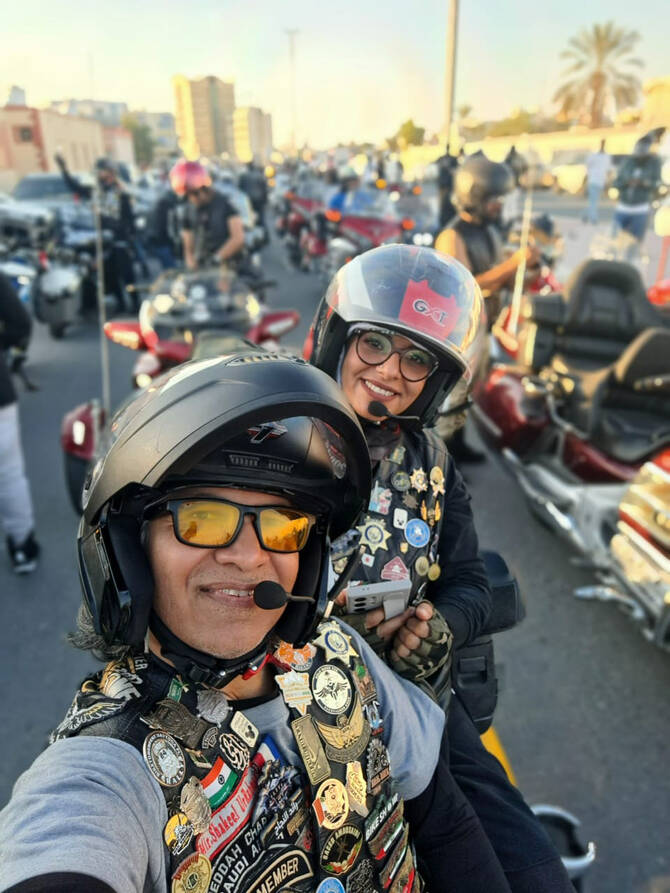
Mir and Amal taking timeout for a selfie along the road. (Supplied)

For Shakeel and Ahmed, this journey is about much more than reaching and discovering new destinations. It is also about the motorcycle friends they have met and respect.

“Actually this journey was aimed to visit our dear friends and celebrate with them their national days. We really wanted to attend Oman’s national day, UAE’s national days and Bike Week in Bahrain.”

The couple officially left Jeddah at the end of November 2024 to Makkah followed by Taif before riding through Riyadh from where they crossed the border over to Abu Dhabi.

During their stay in Riyadh, the couple met with a number of motorcyclists from all regions of the Kingdom as well as riders from Iraq, and Bahrain. They also participated in the celebration held at the Embassy of the Sultanate of Oman to mark the 54th Omani National Day.


Mir and Amal at the UAE border. (Supplied)

“On our way to the border of UAE from Riyadh, it was not as easy as we expected because of the sandy weather we faced, but we managed to get through with the great help we received from the Saudi patrol officers who kept us safe all the way,” added Shakeel.

Once they reached Abu Dhabi, the couple contacted Sheikh Suhail Bin Hasher Al-Maktoum, widely known as the “Father of All Bikers” in the UAE who invited them to celebrate the UAE’s 53rd National Day along with other motorcyclists from all over the world at his farm.

“It was a great night with Sheikh Suhail who gathered all bikers from all over the world, it was also a great opportunity to exchange our deep relations with our friends while celebrating the UAE’s national day. Actually, we were surrounded by people who were trying their best to help us in any way they can to make our journey safe,” said Ahmed.


The couple with Sheikh Suhail Bin Hasher Al-Maktoum in Abu Dhabi. (Supplied)

Keen to take things further, the pair continued their journey to Oman. Shakeel found riding through Oman particularly enjoyable, from exploring the historic Nizwa Fort and Souq to venturing into the surrounding mountains.

“It was a truly a new experience. It allowed us to explore Oman’s diverse landscapes, immerse ourselves in its rich history, and create lasting memories,” he said.

His wife stated that visiting Oman’s iconic Jebel Akhdar — the Green Mountain — was probably the highlight of their journey.

She added: “Our Omani motorcycle friends also were extremely generous with us all the time we were there; they took us on tours to various parts of Oman and also were very helpful in maintaining our bikes.”

After enjoying their stay for few days in Oman, they rode toward Bahrain and attended the annual Bahrain Bike Week, which featured various activities like motorcycle races, concerts, and street festivals.

“We had wonderful days and the event was filled with energy, passion, and the love for two wheels,” said Shakeel.

While they had reached their final destination, they were informed by KALAM’s World Record that they had officially set the record for the longest motorcycle expedition as a couple.

“It was a great news for us to be recognized by KALAM’s World Record which is an organization that celebrates achievements across various fields. We are extremely happy and I am dedicating this achievement for my wife. We are looking forward to receive this award on Sept. 16, 2025,” said Shakeel.

The couple have no intention of settling down and are already planning their next adventure.


Saudi tourism minister urges governments to ease travel barriers amid global tensions

Updated 22 January 2026
Follow

Saudi tourism minister urges governments to ease travel barriers amid global tensions

  • Tourism Minister Ahmed Al-Khateeb said visa restrictions and connectivity were major hurdles disrupting global movement, urging more frequent flights to smaller destinations
  • Panel examined key challenges facing the $10 trillion global travel industry, including rising geopolitical tensions, climate volatility, artificial intelligence and growing cyber risks

DUBAI: Saudi Arabia’s tourism minister, Ahmed Al-Khateeb, has said travel should be made more accessible and flexible as it fosters dialogue and peace at a time when geopolitical tensions are prompting governments to impose stricter visa restrictions.

He was speaking during a panel discussion at the World Economic Forum’s annual meeting in Davos, which examined the key challenges facing the $10 trillion global travel industry. These include rising geopolitical tensions, climate volatility, artificial intelligence and growing cyber risks.

“Tourism brings peace at a time where everybody wants to hear about peace. It connects people, encourages dialogue, creates economies, and serves smaller economies like Africa, Latin America, the Pacific and the Caribbean countries,” said Al-Khateeb.

His remarks come as the US has tightened visa and immigration policies, affecting nationals from dozens of countries, and as anti-tourism protests have surfaced in parts of Europe amid mounting concerns over overtourism in major destinations.

He highlighted Saudi Arabia’s achievements in tourism, saying the sector has created 250,000 jobs in the last five years and boosted female participation to 47 percent, exceeding the global average of 45 percent. He highlighted the Kingdom’s focus on building new airports and expanding existing ones, as well as boosting the hotel sector to cater for 150 million travelers by 2030.

The sector’s contribution to the economy has grown from about 3 percent in 2020 to 5 percent today, with plans to raise that figure to between 8 and 10 percent by 2030.

With travel and tourism accounting for around 10 percent of global GDP, Al-Khateeb said that raising the sector’s contribution in Saudi Arabia would strengthen the Kingdom’s economy, make it more resilient and sustainable, and “allow us to share our beautiful culture with the world.”

He said visa restrictions and connectivity were major hurdles disrupting global movement, urging more frequent flights to smaller destinations to diversify traveler experiences and expand economies beyond major hubs.

With panelists citing last year’s anti-tourism protests in Spain and Mexico, Al-Khateeb said overtourism, already a challenge in some cities, will worsen as the UN projects an increase in the number of global travelers from 1.5 billion to 2 billion by 2050. He therefore urged governments to promote smaller cities and spread tourism beyond traditional hotspots to boost economic growth and create more jobs.

Panel at the World Economic Forum examined key trends and challenges shaping the $10 trillion global travel industry. (Screengrab)

Expressing similar sentiments, Martin Eurnekian, CEO of Corporacion America International, linked economic growth to travel and said travel deregulation in the past had boosted European economies.

“Our history shows when growth was accelerated and these were the cases where the (travel) industry was set free,” said Eurnekian, adding geopolitical tensions and economic regulations were exacting a heavy cost on the industry.

“This is an industry based on freedom and globalization and if we lose sight of that we can really hurt the industry,” he added.

Cara Morton, CEO of global businesses and operations and a member of the executive committee at Zurich Insurance Group, said “disruption is now the norm,” citing an in-house assessment that found 80 percent of 4,000 business travelers experienced some form of disruption during their journeys.

She highlighted the role of artificial intelligence in steering people to new, less crowded destinations: “Obviously that will require governments to then make sure that those places have got the right infrastructure, but we will be able to see wealth distributed more equally. So the key is how we use AI in this area.”

Al-Khateeb said that while AI can enhance traveler experience, it should not replace human interaction.

“We will use tech when it isn’t necessary … such as using AI (for passengers to) move fast and finish their biometrics, but when you go to destination, you want to be served by humans not machines.”

He highlighted global travel trends, including the growing role of airports as destinations in their own right, driven by retail and food and beverage offerings, as well as the rapid rise of wellness tourism.

“Travel interacts with a wide range of sectors from aviation and airports to mobility, transportation, hotels, retail, and entertainment,” said Al-Khateeb.