

Pakistan reports 99% drop in polio cases, urges more investment at Gavi board meeting

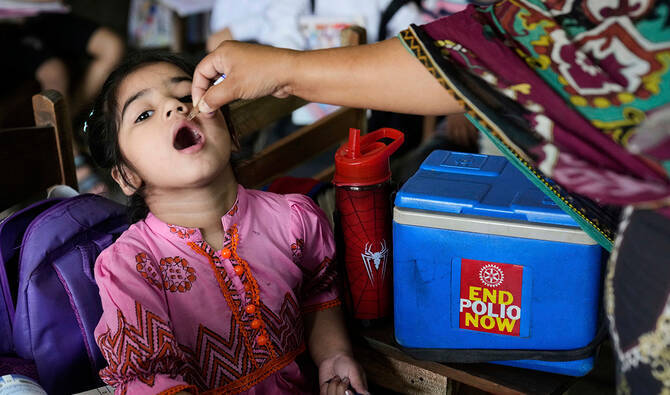
A health worker administers a polio vaccine to a child in a school in Lahore, Pakistan, on April 21, 2025. (AP)
Short Url
Updated 19 June 2025
Follow

Pakistan reports 99% drop in polio cases, urges more investment at Gavi board meeting

  • Pakistan has reported 10 polio cases so far in 2025, compared to 74 in 2024
  • Pakistan and Afghanistan remain the only countries where polio is still endemic

ISLAMABAD: Pakistan has recorded a 99% decline in polio cases, Health Minister Syed Mustafa Kamal told the Gavi board meeting on Thursday, calling for more investments to "train and retain" vaccinators.

The global vaccine organization Gavi helps low-income countries buy vaccines to protect against killer diseases. Around one billion children have been immunized as a result of Gavi’s work across the world since 2000.

Polio is a paralyzing disease with no cure, making prevention through vaccination critical. Multiple doses of the oral polio vaccine, along with the completion of the routine immunization schedule for all children, are essential to build strong immunity against the virus.

According to Pakistan’s polio program, 10 cases have been confirmed so far this year, with 74 reported in 2024.

Environmental surveillance carried out earlier this year has detected the virus in 272 sewage samples collected from 127 testing sites across 68 districts, indicating ongoing transmission.

"Pakistan has witnessed over a 99% decline in polio cases — a testament to our coordinated strategy, dedication of frontline workers and the collective efforts of all stakeholders," the health ministry quoted Kamal as saying following a virtual joint session of Gavi and Pakistan's Polio Oversight Board.

However, the statement did not specify the starting point for this decline.

"Strengthening the integrated immunization system requires continued support from both Gavi and the Polio Oversight Board,” he added. “We need additional investments to ensure the training and retention of vaccinators."

He called for implementing a joint strategy to reach zero-dose children and mobilizing biker teams to access far-flung areas.

The health minister said "coordinated microplanning and effective monitoring" between polio and the Expanded Program on Immunization was improving immunization coverage and delivering results.

Kamal said polio eradication remained the government's top priority, highlighting how Pakistani Prime Minister Shehbaz Sharif personally oversees the eradication efforts.

Pakistan, one of the last two countries where polio remains endemic, has made significant progress in curbing the virus, with annual cases dropping from around 20,000 in the early 1990s to just eight in 2018.

The country reported six cases in 2023 and only one in 2021.

Pakistan launched its polio eradication program in 1994, but efforts have repeatedly been hindered by widespread vaccine misinformation and resistance from hardline religious groups who claim immunization campaigns are a Western conspiracy to sterilize Muslim children or a front for espionage.

Militant groups have also targeted polio workers and their security escorts, often with deadly attacks that have hampered vaccination drives, particularly in the country’s remote and conflict-prone regions.

Pakistan and neighboring Afghanistan are the only two countries in the world where the poliovirus remains endemic.


Pakistan urges concessional finance for developing nations to boost clean energy security

Updated 11 January 2026
Follow

Pakistan urges concessional finance for developing nations to boost clean energy security

  • Pakistan has emerged as one of world’s fastest growing solar markets, with 12GWs of off-grid and 6GWs of net-metered capacity in 2025
  • PM’s aide says Islamabad remains committed to Paris Agreement, looks for continued support in building a resilient and low-carbon future

ISLAMABAD: Pakistan has urged international partners to scale up concessional financing for developing countries, the country’s Press Information Department (PID) said on Sunday, citing an aide to Prime Minister Shehbaz Sharif.

The call was made by Sharif’s coordinator on climate change, Romina Khurshid Alam, while delivering Pakistan’s national statement at the 16th International Renewable Energy Agency (IRENA) Assembly in Abu Dhabi.

Pakistan has emerged as one of the world’s fastest growing solar markets, with 12 gigawatts (GWs) of off-grid and over 6GWs of net-metered solar capacity by the end of 2025. Last fiscal year, renewables accounted for a historic 53 percent of total electricity generation, according to Alam.

The prime minister’s aide stressed that affordable funding for developing nations is critical to accelerating their transition to clean energy and strengthening energy security amid rising climate and economic challenges.

“Alam reaffirmed Pakistan’s target of achieving 60 percent renewables in the power mix by 2030,” the PID said in a statement.

“In her call to action, she urged IRENA and Member States to increase concessional finance for developing nations, treat technologies such as energy storage and green hydrogen as global public goods, and strengthen regional cooperation for shared energy security.”

IRENA is a global intergovernmental agency for energy transformation that serves as the principal platform for international cooperation, supports countries in their energy transition, and provides state of the art data and analyzes on technology, innovation, policy, finance and investment. Its membership comprises 170 countries and the European Union (EU).

The 16th session of the IRENA Assembly is taking place on Jan. 10-12 in Abu Dhabi and focuses on the theme of “Powering Humanity: Renewable Energy for Shared Prosperity.” The session has gathered global leaders and energy decision-makers to discuss strategies and underline necessary actions for the acceleration of renewable energy across countries, regions, and the world, driving economic inclusion, equity, and human well-being.

Alam shared that Pakistan is taking action against energy poverty through initiatives like the Punjab Solar Panel Scheme 2026, which provides free or subsidized systems to low-income households.

She highlighted how distributed solar kits have restored power and livelihoods in flood-affected communities and offer a replicable model for climate-resilient recovery.

“Pakistan remains fully committed to the Paris Agreement and looks to IRENA for continued technical and financial support in building a resilient, inclusive, and low-carbon future,” Alam said.

Adopted in 2015 to combat climate change, the Paris Agreement binds nations to hold “the increase in the global average temperature to well below 2°C above pre-industrial levels” and pursue efforts “to limit the temperature increase to 1.5°C above pre-industrial levels.”