

OPEC+ has proven to be oil markets’ central bank, says Saudi energy minister

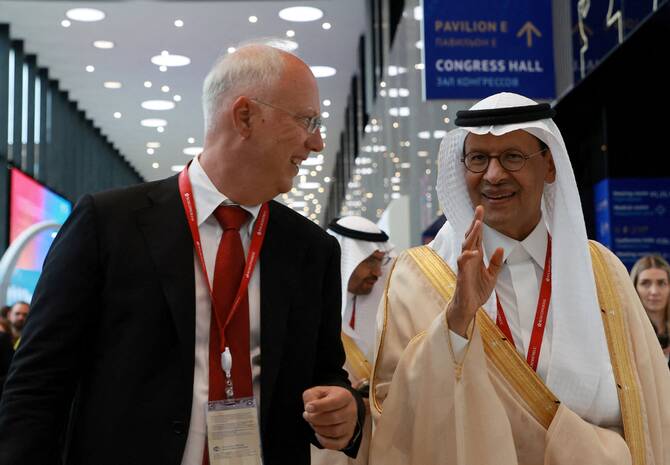
Head of the Russian Direct Investment Fund Kirill Dmitriev and Saudi Arabia’s Minister of Energy Prince Abdulaziz bin Salman arrive at the St. Petersburg International Economic Forum in Saint Petersburg, Russia on Thursday. Reuters
Short Url
Updated 19 June 2025
Follow

OPEC+ has proven to be oil markets’ central bank, says Saudi energy minister

RIYADH: OPEC+ has proven to be the “central bank” and regulator of the global oil market, providing much-needed stability, Saudi Arabia’s energy minister said.

Speaking at the annual St. Petersburg International Economic Forum in Russia, Prince Abdulaziz bin Salman praised the alliance’s role in balancing oil markets amid global economic uncertainties.

“I would have to say that OPEC+ had proven to be an instrument that if it wasn’t invented by us and Russia and our colleagues, it should have been invented a long time ago because this is what OPEC+ had achieved in terms of bringing stability to the market and had proven that it is the central bank and the regulator of oil markets,” the energy minister said.

Prince Abdulaziz also highlighted the ongoing partnership between Saudi Arabia and Russia through the Saudi-Russian Joint Committee, noting plans for Russian Deputy Prime Minister Alexander Novak to visit the Kingdom later this year with a high-level business delegation.

“I’m looking forward to host Alexander — the co-chair of our joint committee — to Saudi Arabia this year, with the biggest, most sizable business community participation,” he said.

Prince Abdulaziz emphasized that the collaboration seeks to deepen bilateral economic ties and foster diversified investment opportunities.

“We have a lot to showcase that bonding together. It will allow us to have a much more diversified relationship, and we are, as a government, working together to provide the right environment for those who want to invest in Saudi Arabia or in Russia or in any type or form of joint venturing that we should facilitate that and ensure that the investment environment is congenial for it to happen,” he added.

The minister described the energy alliance as a flexible mechanism responsive to changing global conditions, reaffirming Saudi Arabia’s commitment to cooperation with partners to maintain market stability.

Acknowledging the challenges facing Russia, Prince Abdulaziz noted the Kingdom’s support amid external restrictions.

“It’s been a challenging time what Russia is going through, but we have shown a great deal of understanding of the situation, and we’re trying to maneuver with the restrictions that are existing today,” he said.

“That has been the discharge of our leadership willingness to accommodate with this current situation and hopefully helping to support Russia in mitigating these exterior most daunting issues.”

On whether Saudi Arabia and Russia would compensate for any loss of Iranian crude supplies, the minister stressed that such scenarios are hypothetical and that OPEC+ decisions are collective.

“You give me a question that is not evidently seen happening, I don’t have an answer for you. Again, we only react to realities. But if anybody gives a question that is not relating to the reality today, I fail to see where we could predict things and how we would relate to it,” he said.

The minister clarified that OPEC+ consists of 22 member states and is not dominated by Saudi Arabia and Russia alone. A core group of eight countries is tasked with engaging the full membership to ensure coordinated responses to market changes.

“To respond to a hypothetical question by giving a hypothetical answer, which none of us two here have the right to speak on behalf of everybody without knowing their opinion, is too much of an ask,” he added.

He concluded by highlighting OPEC+’s reputation as a reliable and adaptive organization.

“What we know and what Alexander was saying just a while ago is that we have, as OPEC even before, an OPEC+ attending to so many circumstances since its first, it was in sequence, even inception, that we have been a reliable organization, a serious organization, an effective organization, and attentive to circumstances when they prevail,” he said.


UNCTAD, Social Development Bank launch fellowship to power Saudi entrepreneurs

Updated 23 December 2025
Follow

UNCTAD, Social Development Bank launch fellowship to power Saudi entrepreneurs

RIYADH: The Social Development Bank has signed a memorandum of understanding with UN Trade and Development to launch the “Empretec Saudi Fellowship,” a new initiative aimed at equipping high-potential Saudi entrepreneurs with advanced training and tools to scale their ventures.

The agreement was signed on the sidelines of the second edition of the DeveGo 2025 forum, held on Dec. 21–22 at the King Abdulaziz International Conference Center in Riyadh. The event brought together entrepreneurs, policymakers, and representatives from regional and international organizations, alongside public and private sector leaders.

Featuring more than 150 exhibitors, 85 speakers, and 45 workshops, the forum focused on sharing local and global best practices and strengthening the Kingdom’s entrepreneurial ecosystem.

The Empretec Saudi Fellowship is part of UNCTAD’s flagship capacity-building program to promote entrepreneurship and support micro, small, and medium-sized enterprises and startups. Active in more than 40 countries, the program seeks to develop personal entrepreneurial behaviors through intensive training, access to international experts, and technical tools that help transform promising ideas into scalable, high-impact businesses.

Rebeca Grynspan, UNCTAD secretary-general, said Saudi Arabia offers fertile ground for entrepreneurial growth.

“Saudi Arabia has a wonderful platform to bring everybody up, and the entrepreneurs here are so eager. They have ideas, creativity, and energy,” she told Arab News. “If they come through our program with the Social Development Bank, which does a wonderful job, they will be more successful — because that’s what we want.”

In his opening remarks, Saudi Minister of Human Resources and Social Development Ahmed Al-Rajhi, who also chairs the SDB board, highlighted the rapid evolution of the Kingdom’s startup landscape.

“The Kingdom is witnessing a qualitative transformation in the entrepreneurship and freelance ecosystem, enabling young men and women to enter new promising sectors such as artificial intelligence, renewable energy, advanced technologies, and venture capital,” he said. “This provides broader opportunities to contribute to innovation, expansion, and global competitiveness.”

During a tour of the exhibition alongside Al-Rajhi, Grynspan met a wide range of small and medium-sized businesses and handicraft makers, praising the depth of local talent. She noted that participants spanned the full spectrum of enterprises — from early-stage ventures to more established and sophisticated companies — reflecting a rich diversity of experience.

Al-Rajhi said the Social Development Bank invests more than SR8 billion annually to support enterprises and entrepreneurs, helping raise employment in bank-financed businesses from about 12,000 in 2021 to more than 140,000 in 2025.

Beyond financing, the bank runs several non-financial programs, including the Jada 30 business communities, which have incubated more than 4,300 enterprises across 13 cities, and the Dulani Business Center, which has delivered over 67,000 consultations benefiting more than 150,000 male and female entrepreneurs.

Speaking on the broader economic outlook, Grynspan added: “This is a wonderful place to come. Now is an economy that is thriving, is a population that is hopeful. And you have these young, talented people that are only waiting for an opportunity to make it happen for everybody.”

During the forum, the bank also signed multiple cooperation agreements spanning key sectors such as finance, education, energy, healthcare, heritage, the nonprofit sector, and freelance work. The partnerships align with SDB’s strategy to build an integrated system of financial and non-financial empowerment tailored to the needs of entrepreneurs, startups, and micro-enterprises.