


KYIV: Fighting between Iran and Israel could deflect global attention from the Russian invasion of Ukraine and even bolster Kremlin’s war effort, Ukrainian officials say.
Israel launched a massive bombing campaign on Iran last week that prompted Tehran — a close ally of Russia — to strike back with missiles and drones.
The conflict has pushed up the price of oil — a key revenue stream funding Russia’s invasion.
“For Ukraine, the challenge is the price of oil, because if prices remain high for a long time, the Russians will earn more,” a senior Ukrainian political source told AFP.
However, Kyiv has welcomed Israeli attacks on a country which has directly aided and provided weapons to Moscow for its own strikes on Ukraine.
The campaign has left several high-ranking Iranian military officials dead and put pressure on Tehran’s military capacity that is likely to limit the practical support it can provide to Russia.
“The Iranian regime is Russia’s ally, so the more they lose, the better,” the Ukrainian source said.
“Overall, Israel is doing the whole world a favor. That is a fact,” the source added.
The possibility of weaker support and attention from Washington, however, concerns Kyiv.
The administration of US President Donald Trump, Israel’s closest ally, has made clear that its security priorities are the Middle East and Asia, with Europe lower on the list.
This could mean further Russian advances on the battlefield or deadly aerial attacks will meet with a muted reaction from a White House that already sees the Ukraine conflict mainly as a European problem.
Kyiv’s efforts to lobby for more support from Washington have been complicated by tense relations between Trump and Volodymyr Zelensky, the Ukrainian leader.
Zelensky recently told journalists that Trump was “obsessed with Iran” and conceded that its bombing campaign with Israel spelt risks for Kyiv.
“No one is claiming to have a relationship more important than America and Israel, but we would like to see the aid to Ukraine would not be reduced because of this,” he said.
He referred to Israel’s war in Gaza that was sparked by a deadly October 7, 2023 attack by Palestinian militant group Hamas, as a precedent for this.
“It was a factor that slowed down assistance to Ukraine,” he added.
In an interview with US media, the Ukrainian leader said at the beginning of this month that Washington could send “20,000” missiles needed by for Ukraine to shoot down Russian drones to the Middle East instead.
Senior officials in Zelensky’s office told AFP after the outbreak of the war in Gaza that it had spurred Ukraine to focus to developing its own arms industry.
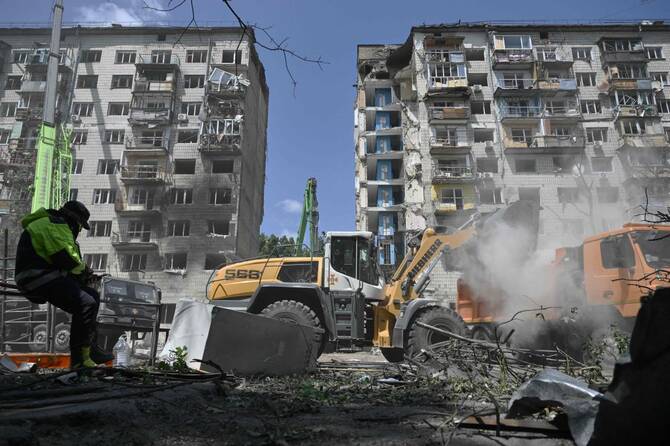
Russia has rained down thousands of drones and missiles on Ukraine since it launched its full-scale invasion early in 2022, including Iranian-made and designed projectiles.
Israel has claimed to have attacked production sites in Iran, which has also launched silos of missiles at Israel that now cannot be sent to Russia for attacks on Ukraine.
“Let’s hope that the corresponding production or transfer (of weapons) to the Russians will decrease. This helps Ukraine,” Zelensky said.
The British defense ministry said Iran’s supply of weapons to Russia could slow as a result of Tehran’s war with Israel.
But it said global focus on the Middle East could overall help Moscow.
“Russia almost certainly perceives some benefit in the conflict as it distracts international focus from its war against Ukraine,” it said on social media.
Moscow also produces its own drones and missiles, and has received projectiles from North Korea.
Ukrainian military analyst and blogger Sergiy Sternenko was among voices to issue caution against celebrating the attacks on Iran.
“Do not rush to get too excited about the strikes on Iran. Of course, Iran is our enemy, and we wish these pigs the worst. But fighting in the Middle East will inevitably lead to higher oil prices,” he wrote.


