

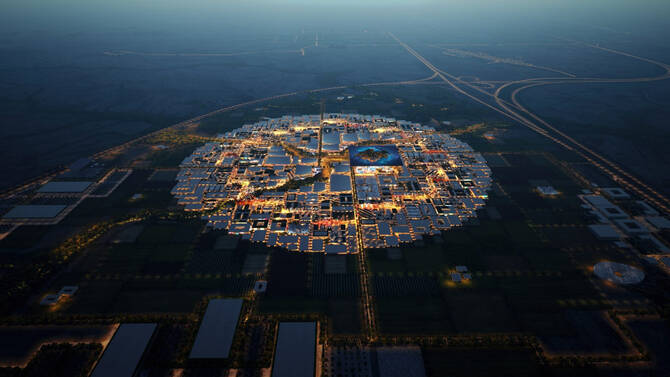
Saudi Arabia’s PIF launches company to build and run Expo 2030

During its development phases, the project is projected to contribute $64 billion to Saudi Arabia’s gross domestic product. Photo/Supplied
Short Url
Updated 19 June 2025
Follow

Saudi Arabia’s PIF launches company to build and run Expo 2030

  • New firm to turn site into multicultural hub post-event

RIYADH: Saudi Arabia’s Public Investment Fund has launched Expo 2030 Riyadh Co., a wholly owned entity tasked with developing, managing, and operating the infrastructure and programming for the Kingdom’s first World Expo.

During its development phases, the project is projected to contribute $64 billion to Saudi Arabia’s gross domestic product and generate around 171,000 direct and indirect jobs. Once operational, it is expected to add $5.6 billion to the national economy.

According to an official release on Thursday, the newly established company will play a pivotal role not only in executing the large-scale event but also in preserving its long-term legacy.

Known as ERC, the company will fast-track operations to meet its ambitious mandate. It plans to collaborate with both local and international private sector partners to deliver on construction, cultural programming, and event management goals.

“ERC benefits from PIF’s diverse local and global ecosystem and the establishment of the company aligns with PIF’s local real estate strategy, which drives economic transformation and diversification, advancing urban innovation and enhancing quality of life, driven by the ambitious goals of Saudi Vision 2030,” said Saad Al-proud, head of PIF’s Local Real Estate Investment Division.

Covering an expansive 6 million sq. m, the Expo 2030 site will be one of the largest World Expo venues ever built. Strategically located north of Riyadh near the upcoming King Salman International Airport, it will offer direct access to major city landmarks.

Set to run from Oct. 1, 2030 to March 31, 2031, Expo 2030 Riyadh is expected to draw over 40 million visits. Following the event, ERC aims to repurpose the gated expo area into a “global village” — a multicultural destination featuring retail, food  and beverages, and premium residential offerings, all aligned with the Kingdom’s push toward sustainable tourism and innovation.

Participating nations will have the opportunity to construct permanent pavilions, enabling a lasting impact beyond the event itself and encouraging long-term investment and business ties.

PIF emphasized that the initiative reflects its broader strategy to drive economic diversification while securing sustainable financial returns.

The fund remains at the forefront of delivering Saudi Arabia’s transformative giga-projects and real estate ventures, reshaping the national landscape and bolstering the Kingdom’s global positioning.

Riyadh secured the rights to host Expo 2030 in November 2024, winning the international vote in the first round — further solidifying its reputation as a fast-evolving capital that blends connectivity, sustainability, and high quality of life at scale.


Saudi IsDB approves $1.37bn in financing to support development projects in 12 countries 

Updated 5 sec ago
Follow

Saudi IsDB approves $1.37bn in financing to support development projects in 12 countries 

RIYADH: Saudi Arabia’s Islamic Development Bank has approved a new package of projects with a total value of approximately $1.37 billion, allocated to support 12 member countries. 

The approval was made by the board of executive directors of the bank, during its 363rd meeting chaired by its President Muhammad Al-Jasser. 

The session approved 14 financing operations to support development projects covering renewable energy, cross-border energy networks, major transport corridors, water and food security, alongside education and health services.  

This contributes to enhancing economic resilience, improving access to basic services, and supporting progress toward achieving the Sustainable Development Goals. 

The approvals included financing of €306.89 million ($360 million) for the expansion and development project of the Godomey–Ouedo–Hillacondji road in Benin, to enhance a strategic segment of the Abidjan–Lagos Corridor.  

Cote d’Ivoire received €200 million in financing to develop the Taferi–Ferkessedougou section of the A3 highway, boosting trade and mobility between central and northern regions and neighboring landlocked countries. 

Funding of $180.72 million was also approved for the King Faisal Road development project in Manama, Bahrain, aiming to alleviate traffic congestion and improve urban transport mobility.  

Lebanon benefited from $13.50 million in financing to establish the Bqarqacha bypass and develop the Bqarqacha–Bcharre road, to improve traffic safety and accessibility for local communities. 

In the energy sector, Uzbekistan will receive total financing of $110 million for utility-scale photovoltaic solar and battery storage projects in Samarkand-1 and Samarkand-2, enhancing national grid capacities.  

The bank also approved €55.19 million in financing for Mauritania to connect electricity grids with Mali and support related solar power stations, to provide cleaner and more reliable electricity to local communities. 

In the field of water and food security, the bank approved €188.82 million in financing for Morocco’s Water Stress Mitigation project, including the construction of dams and related works to ensure water supplies and transfer surplus from northern basins to the more stressed southern regions.  

Additionally, €18.23 million was approved for an inland aquaculture value chain development project. 

Sierra Leone was allocated €25.93 million for the Freetown Water Supply, Sanitation, and Aquatic Environment Revamping project, to improve water and sanitation services and restore key watersheds.  

Cameroon received €36.66 million for the Sustainable Irrigation and Agricultural Value Chain Development project, to support climate-resilient irrigation and improve rural infrastructure. 

In Jordan, the Hima Oasis for Prosperity and Employment program for rural employment and agricultural growth benefited from $11.25 million in financing to support rural jobs and agricultural productivity, focusing on women and youth by improving access to finance, skills, and market linkages. 

The Board also approved investments in the health and human capital development sector, including an allocation of €61.41 million for Mauritania to establish a 440-bed Maternal, Neonatal, and Child Health Referral Hospital in Nouakchott, enhancing access to specialized healthcare. 

In Tajikistan, $13.95 million in financing was approved for the Tourism Business Education Development project, aiming to elevate tourism and hospitality education and establish a national training center focusing on Halal tourism.  

Pakistan received $10 million in financing from the Islamic Solidarity Fund for Development to support the Out-of-School Children project in Azad Jammu and Kashmir. 

These approvals reflect the IsDB’s ongoing commitment to supporting member countries in bridging infrastructure gaps, expanding essential social services, accelerating the energy transition, and promoting comprehensive and sustainable development.