

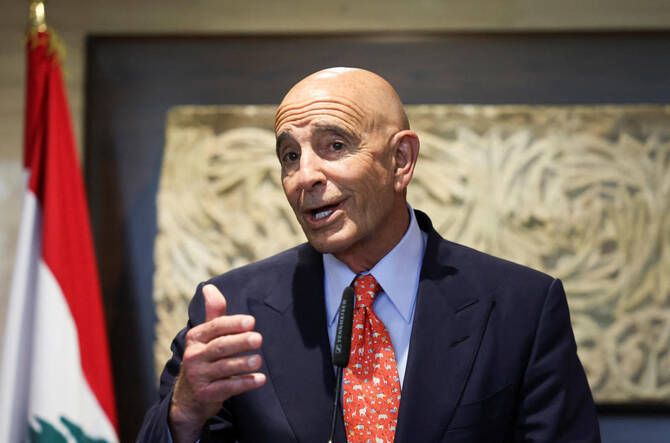

BEIRUT: In an attempt to restore peace in southern Lebanon, President Joseph Aoun outlined key priorities during talks with Thomas Barrack, the US ambassador to Turkiye and special envoy to Syria.
Aoun said his country needs US support to restore security and stability in the region.
He called for Israeli forces to withdraw from the five hills they occupy and urged an end to hostile actions.
Aoun also emphasized the need to extend UNIFIL’s mandate, which operates in coordination with the Lebanese army to implement UN Resolution 1701 and aims to deploy along Lebanon’s internationally recognized border.
Aoun revealed plans to bolster Lebanon’s military presence in the south.
He announced that Lebanon will increase its army troops south of the Litani River to 10,000 soldiers.
Aoun said these units are working to implement UN Resolution 1701 fully, removing visible weapons, confiscating arms and ammunition, and ensuring only official security forces are armed.
But, he said, Israel’s occupation of the five hills and surrounding areas was hindering the army’s efforts.
The Lebanese president reaffirmed Lebanon’s commitment to uphold the principle of exclusive state control over weapons.
Aoun told Barrack that discussions were ongoing at both the Lebanese and Palestinian levels regarding the issue of Palestinian refugees’ weapons in the camps.
He expressed hope that the talks would intensify once the regional situation, recently disrupted by the escalating Israeli-Iranian conflict, stabilizes.
A source from the presidency told Arab News that Lebanon planned to move weapons north of the Litani River, but that the process would take time.
After Lebanon’s civil war, the source said armed militias gradually handed over its weapons to the government — a process that took considerable time to complete.
A source said that Barrack — temporarily handling Lebanese matters until a successor to former US envoy Morgan Ortagus is named — showed understanding and a positive attitude toward Lebanon’s position during meetings with political officials about the disarmament process.
Although no prompt response followed Barrack’s alert about the possibility of Hezbollah supporting Iran, the group released a statement on Thursday denouncing US threats against Ali Khamenei.
Hezbollah warned: “Threatening to kill him is not only a political folly, but a recklessness that will have dangerous repercussions.”
Hezbollah emphasized that “today, we stand more determined than ever to adhere to Imam Khamenei’s path and firm positions in confronting, along with the Islamic Republic, the Israeli-US aggression. Through its blind support for Israel, the US is marching toward an abyss from which it will not survive.”
Also on Thursday, the Iranian Embassy in Lebanon received a large delegation of Lebanese parties, forces, and figures allied with Hezbollah, and a coalition of Palestinian forces and factions close to the party, who came to “declare their solidarity with Iran against the Israeli aggression.”
Tawfiq Samadi, the charge d’affaires at the embassy, said that “any military action taken by Iran will be limited, targeted, gradual and proportionate to the threat.”
He said he “held the US responsible for its full support of Israel in its crimes against Iran. While it is not yet a direct party to the aggressions, continued US support for the actions of the Israeli entity will carry strategic and legal consequences.”


