

Three Pakistani schools among Top 10 finalists for World’s Best School Prizes 2025

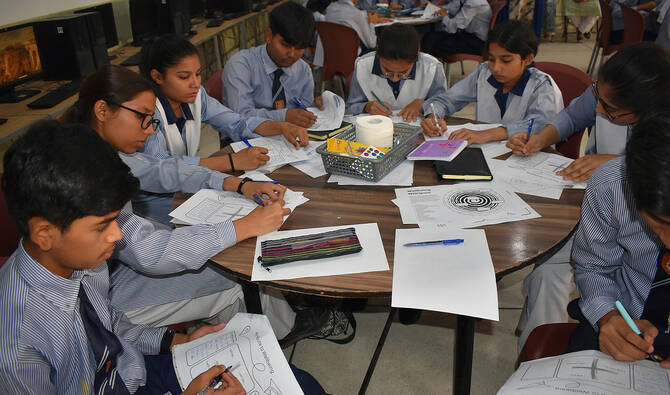
The picture shared on May 1, 2025 shows students coloring a work sheet at Sanjan Nagar Public Education Trust School in Lahore, Pakistan. (Sanjan Nagar Public Education Trust School)
Short Url
Updated 19 June 2025
Follow

Three Pakistani schools among Top 10 finalists for World’s Best School Prizes 2025

  • Finalists are Sanjan Nagar Public Education Trust School, Nordic International School, Beaconhouse College Program Juniper Campus
  • The winners and finalists of the global schools prizes will be invited to the World Schools Summit in Abu Dhabi, UAE, on November 15–16

ISLAMABAD: Three Pakistani schools have this week been named among the Top 10 finalists for the World’s Best School Prizes 2025, prestigious global awards founded by T4 Education to spotlight exceptional schools transforming education and communities.

T4 Education is a global digital platform and community founded to empower teachers and schools to share best practices and drive positive change in education worldwide. It launched the World’s Best School Prizes to spotlight schools making an exceptional impact beyond the classroom.

Winners of the five World’s Best School Prizes — for Community Collaboration, Environmental Action, Innovation, Overcoming Adversity, and Supporting Healthy Lives — will be announced in October following evaluation by an expert Judging Academy and a global public vote. Finalists and winners will share their insights at the World Schools Summit in Abu Dhabi in November.

Prime Minister Muhammad Shehbaz Sharif commended the management, teachers and students of the three Pakistani schools: the Sanjan Nagar Public Education Trust Higher Secondary School and Nordic International School, both in Lahore, and the Beaconhouse College Program Juniper Campus in Quetta.

“These schools have made a name for themselves in terms of modern curriculum, research, technology, environment, development of backward and rural areas,” Sharif said in a statement released by his office.

“These educational institutions have made the country’s name known all over the world.”

Sanjan Nagar Public Education Trust Higher Secondary School in Lahore has been shortlisted for the World’s Best School Prize for Overcoming Adversity. The charity school, which began in an abandoned factory, now educates nearly 800 students from marginalized backgrounds through the International Baccalaureate’s Primary Years Program. It is the first in Pakistan to offer this curriculum to underserved communities, empowering students with critical 21st-century skills and bridging socio-economic divides.

Beaconhouse College Program, Juniper Campus, Quetta, is a finalist for the Community Collaboration prize for its “Science Gaari” initiative — a student-led mobile science lab bringing hands-on STEM education to remote schools in Balochistan, one of Pakistan’s most underserved provinces. The project has reached over 150 schools, boosting science engagement and inspiring rural students to pursue careers in technology and research.

Nordic International School Lahore has also been named a finalist for Community Collaboration. The independent school emphasizes strong parental involvement and a culture of kindness to foster a supportive learning environment. Parents are engaged throughout students’ academic journeys via an interactive app, regular workshops, and celebrations of learning milestones.

“It is in schools like Sanjan Nagar, BCP Juniper Campus Quetta, and Nordic International School Lahore where we find the innovations and expertise that give us hope for a better future,” T4 Education Founder Vikas Pota said.



Pakistan reviews austerity measures amid Middle East crisis, urges strict nationwide implementation

Updated 11 March 2026
Follow

Pakistan reviews austerity measures amid Middle East crisis, urges strict nationwide implementation

  • Deputy Prime Minister Ishaq Dar chairs review meeting of austerity steps
  • Officials briefed on salary cuts, school closures, four‑day week, petrol conservation

ISLAMABAD: Pakistan’s government on Wednesday assessed progress on a sweeping set of austerity measures introduced to mitigate the country’s economic strain from sharply rising global oil prices and supply disruptions linked to the ongoing war in the Middle East.

Prime Minister Shehbaz Sharif this week announced a series of austerity steps, including a four‑day work week for government offices, requiring 50  percent of staff to work from home, cutting fuel allowances for official vehicles by half, grounding up to 60  percent of the government fleet and closing all schools for two weeks to conserve fuel amid the global oil crisis.

The measures were unveiled in response to global oil market volatility triggered by the conflict involving the United States, Israel and Iran, which has disrupted supply routes such as the Strait of Hormuz and pushed crude prices sharply higher, straining Pakistan’s heavily import‑dependent energy sector.

“The meeting stressed the importance of strict and transparent adherence to the austerity measures, promoting fiscal responsibility and prudent use of public resources,” Deputy Prime Minister and Foreign Minister Senator Mohammad Ishaq Dar said in a statement.

He was chairing a meeting of the Committee for Monitoring and Implementation of Conservation and Additional Austerity Measures, constituted under the directions of the PM, bringing together federal and provincial officials to review execution of the broad cost‑cutting plan. 

Dar emphasized the government’s commitment to enforcing the PM’s austerity steps nationwide. The committee’s review also covered reductions in departmental expenditure, deductions from salaries of senior officials earning over Rs. 300,000 ($1,120), and coordination with provincial administrations to ensure uniform implementation of the plan.

Participants at the meeting reiterated that all ministries and divisions must continue strict monitoring and reporting, with transparent oversight mechanisms, as Pakistan navigates the economic pressures from the prolonged Middle East crisis and its fallout on global energy and trade markets.