

Putin says he does not want to discuss the possible Israeli-US killing of Iran’s supreme leader

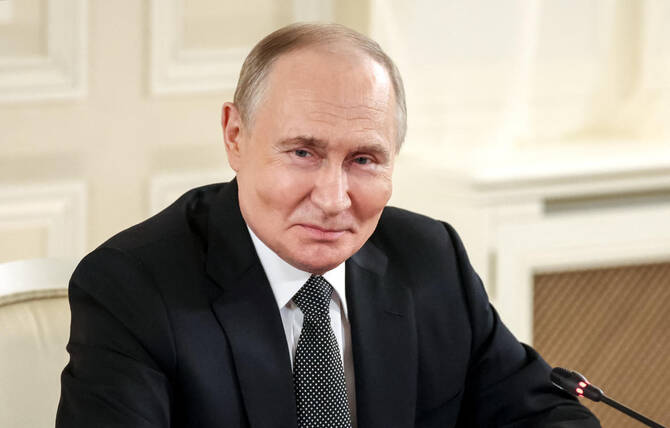
Russian President Vladimir Putin said a strategic partnership treaty signed with Tehran in January did not envisage military cooperation and that Iran had not made any formal request for assistance. (Sputnik via Reuters)
Short Url
Updated 19 June 2025
Follow

Putin says he does not want to discuss the possible Israeli-US killing of Iran’s supreme leader

  • Israeli leader Benjamin Netanyahu has openly speculated that Israel’s military attacks could result in regime change in Iran
  • Donald Trump said US knows Supreme Leader Ayatollah Ali Khamenei is ‘hiding but that Washington is not going to kill him ‘for now’

ST PETERSBURG, Russia: President Vladimir Putin on Thursday refused to discuss the possibility that Israel and the United States would kill Iranian Supreme Leader Ayatollah Ali Khamenei and said the Iranian people were consolidating around the leadership in Tehran.

Israeli Prime Minister Benjamin Netanyahu has openly speculated that Israel’s military attacks could result in regime change in Iran while US President Donald Trump said on Tuesday that the US knew where Khamenei was “hiding” but that Washington was not going to kill him “for now.”

Asked what his reaction would be if Israel did kill Khamenei with the assistance of the United States, Putin said: “I do not even want to discuss this possibility. I do not want to.”

When pressed, Putin said he had heard the remarks about possibly killing Khamenei but that he did not want to discuss it.

“We see that today in Iran, with all the complexity of the internal political processes taking place there...that there is a consolidation of society around the country’s political leadership,” Putin told senior news agency editors in the northern Russian city of St. Petersburg.

Putin said all sides should look for ways to end hostilities in a way that ensured both Iran’s right to peaceful nuclear power and Israel’s right to the unconditional security of the Jewish state.

Putin was speaking as Trump kept the world guessing whether the US would join Israel’s bombardment of Iranian nuclear and missile sites and as residents of Iran’s capital streamed out of the city on the sixth day of the air assault.

Putin said he had been in touch with Trump and with Netanyahu, and that he had conveyed Moscow’s ideas on resolving the conflict while ensuring Iran’s continued access to civil nuclear energy.

Iranian nuclear facilities

Questioned about possible regime change in Iran, Putin said that before getting into something, one should always look at whether or not the main aim is being achieved before starting something.

He said Iran’s underground uranium enrichment facilities were still intact.

“These underground factories, they exist, nothing has happened to them,” Putin said.

“It seems to me that it would be right for everyone to look for ways to end hostilities and find ways for all parties to this conflict to come to an agreement with each other,” Putin said. “In my opinion, in general, such a solution can be found.”

Asked if Russia was ready to provide Iran with modern weapons to defend itself against Israeli strikes, Putin said a strategic partnership treaty signed with Tehran in January did not envisage military cooperation and that Iran had not made any formal request for assistance.

Russian Deputy Foreign Minister Sergei Ryabkov said on Wednesday that Moscow was telling the United States not to strike Iran because it would radically destabilize the Middle East.

A spokeswoman for the Russian Foreign Ministry also warned that Israeli strikes on Iranian nuclear facilities risked triggering a nuclear catastrophe.

Putin said that Israel had given Moscow assurances that Russian specialists helping to build two more reactors at the Bushehr nuclear power plant in Iran would not be hurt in air strikes.

Putin said that Moscow had “a very good relationship with Iran” and that Russia could ensure Iran’s interests in nuclear energy.

Russia has offered to take enriched uranium from Iran and to supply nuclear fuel to the country’s civil energy program.

“It is possible to ensure Iran’s interests in the field of peaceful nuclear energy. And at the same time, to address Israel’s concerns about its security,” Putin said. “We have outlined them (our ideas) to our partners from the USA, Israel and Iran.”


Junta leader Gen. Mamdi Doumbouya is declared winner of Guinea’s election, provisional results show

Updated 31 December 2025
Follow

Junta leader Gen. Mamdi Doumbouya is declared winner of Guinea’s election, provisional results show

  • Mamady Doumbouya took power in 2021 coup

CONAKRY, Guinea: Guinea coup leader ​Mamady Doumbouya has been elected president, according to provisional results announced on Tuesday, completing the return to civilian rule in the bauxite- and iron ore-rich West African nation.
The former special forces commander, thought to be in his early 40s, seized power in 2021, toppling then-President Alpha Conde, who had been in office since 2010. It was one in a series of nine coups that have reshaped politics in West and Central Africa since 2020.
The provisional results announced ‌on Tuesday showed Doumbouya ‌winning 86.72 percent of the December 28 vote, ‌an ⁠absolute majority ​that allows ‌him to avoid a runoff.
The Supreme Court has eight days to validate the results in the event of any challenge.
Doumbouya’s victory, which gives him a seven-year mandate, was widely expected. Conde and Cellou Dalein Diallo, Guinea’s longtime opposition leader, are in exile, which left Doumbouya to face a fragmented field of eight challengers.
Doumbouya reversed pledge not to run
The original post-coup charter in Guinea barred junta members from running ⁠in elections, but a constitution dropping those restrictions was passed in a September referendum.
Djenabou Toure, the ‌country’s top election official who announced the results on ‍Tuesday night, said turnout was 80,95 percent. However ‍voter participation appeared tepid in the capital Conakry, and opposition politicians rejected ‍a similarly high turnout figure for the September referendum.
Guinea holds the world’s largest bauxite reserves and the richest untapped iron ore deposit at Simandou, officially launched last month after years of delay.
Doumbouya has claimed credit for pushing the project forward and ensuring Guinea benefits ​from its output.
His government this year also revoked the license of Emirates Global Aluminium’s subsidiary Guinea Alumina Corporation following a refinery dispute, ⁠transferring the unit’s assets to a state-owned firm.
The turn toward resource nationalism — echoed in Mali, Burkina Faso and Niger — has boosted his popularity, as has his relative youth in a country where the median age is about 19.
Political space restricted, UN says
Political debate has been muted under Doumbouya. Civil society groups accuse his government of banning protests, curbing press freedom and restricting opposition activity.
The campaign period was “severely restricted, marked by intimidation of opposition actors, apparently politically motivated enforced disappearances, and constraints on media freedom,” UN rights chief Volker Turk said last week.
On Monday, opposition candidate Faya Lansana Millimono told a press conference the election was marred by “systematic fraudulent practices” and ‌that observers were prevented from monitoring the voting and counting processes.
The government did not respond to a request for comment.