


RIYADH: The Joint Incidents Assessment Team on Wednesday issued a statement in response to allegations of human rights violations in Yemen over the targeting of Sarwah Rural Hospital in Harib directorate, Marib governorate on April 24, 2015.
After examining various documents, including air tasking orders, daily mission schedules, mission execution procedures, after-mission reports and satellite images, the JIAT concluded that the hospital is located in Sarwah village and included on the coalition forces’ no-strike list.
Specialists studied satellite images of the hospital and found no trace of damage to its structures caused by aerial targeting.
Analyzing coalition air missions on April 24, 2015, the JIAT found no evidence of operations in Sarwah village. Similarly, missions on April 23 and April 25 showed no activity in the area.
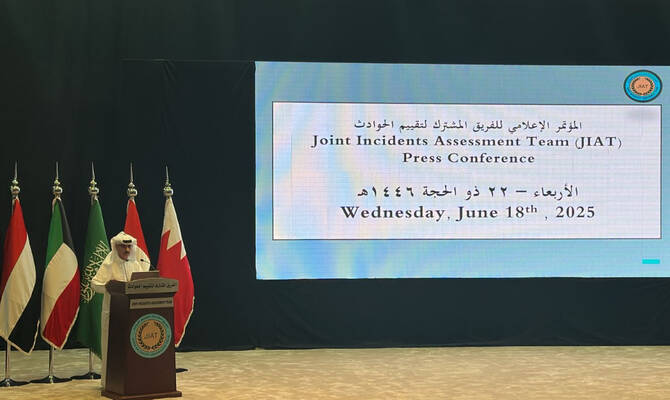
In a press conference in Riyadh, JIAT spokesman Mansour Al-Mansour addressed an allegation that coalition forces targeted a mosque in Al-Sawad in Yemen’s Amran governorate on Sept. 23, 2019.
After reviewing air missions, the JIAT found that no coalition operations were carried out in Amran on that date.
By studying missions conducted the day before, the JIAT reported that intelligence indicated Houthi militia fighters were gathering at mobilization sites in Harf Sufyan in Amran in preparation for a major attack.
Coalition forces identified four locations and carried out an air mission on what was considered a legitimate military target and in line with international humanitarian law.
“The coalition forces have taken all possible precautions to avoid accidental loss or damage to civilians and civilian objects, or in any case, to minimize it to the lowest possible level, during the planning and execution of the military operation,” Al-Mansour said.
The precautions included the use of “guided bombs proportionate to the size of the military targets and ensuring that there were no civilians present before or during the targeting,” he said.
The JIAT concluded that the strike was lawful. It noted that while the targeted structure was claimed to be a mosque, no indications such as a minaret were found.
It also addressed an allegation that a coalition airstrike hit a pickup truck in Al-Jarr village, Hajjah governorate, followed by a second strike 10 minutes later that destroyed a house on June 16, 2019.
After reviewing air mission data, satellite images and visiting operational centers, the JIAT found no evidence of coalition activity on that date, nor on the days before or after. Satellite imagery also showed no signs of aerial targeting.
The JIAT concluded that coalition forces did not target Al-Jarr village, as claimed.
It also addressed an allegation that coalition forces targeted houses in Al-Hijrah village, Markhah Al-Sofla directorate in Shabwah on Jan. 4, 2019.
After reviewing air tasking orders, mission schedules, post-mission reports and satellite images, it found that no coalition air missions were conducted in Shabwah.
The JIAT also confirmed that no air missions were carried out in the governorate on Jan. 3 or Jan. 5, 2019, and concluded that coalition forces did not target houses in Al-Hijrah village as claimed.


