

Pakistan secures $1 billion in ADB-backed financing from Middle Eastern banks

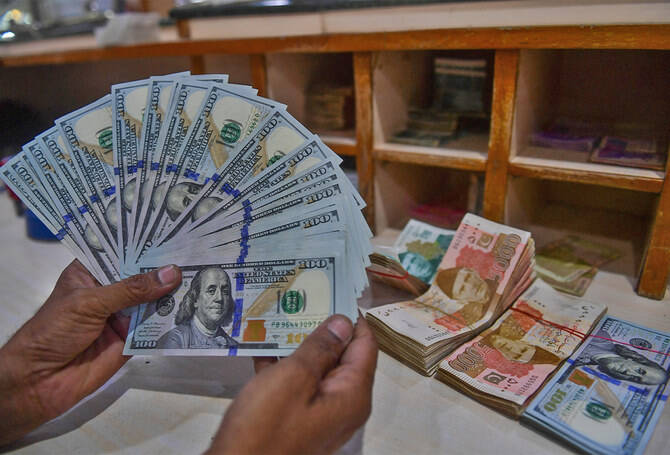
A foreign currency dealer counts US dollars at a shop in Karachi, Pakistan, on May 19, 2022. (AFP/ file)
Short Url
Updated 19 June 2025
Follow

Pakistan secures $1 billion in ADB-backed financing from Middle Eastern banks

  • The loan aims to strengthen the country’s fiscal resilience, support reform momentum
  • The government says the deal signals renewed trust in Pakistan’s economic trajectory

KARACHI: Pakistan has signed a $1 billion syndicated term finance facility backed by Middle Eastern banks, marking its return to the region’s financial markets after more than two years, the finance ministry said on Wednesday.

The five-year facility is partially guaranteed by the Asian Development Bank (ADB) under its Policy-Based Guarantee program, which is linked to fiscal reforms undertaken by Pakistan to improve resource mobilization and economic stability.

The financing by the Middle Eastern banks is structured across Islamic and conventional tranches, with 89 percent of the total amount raised through a Shariah-compliant facility.

“This is a landmark transaction for the Government of Pakistan that demonstrates strong support from leading financiers in the region,” the finance ministry said in a statement.

It informed that Dubai Islamic Bank acted as the sole Islamic global coordinator on the landmark issue, while Dubai Islamic Bank and Standard Chartered Bank acted as mandated lead arrangers and bookrunners.

Other financiers include Abu Dhabi Islamic Bank as mandated lead arranger, and Sharjah Islamic Bank, Ajman Bank and Pakistan’s Habib Bank Limited (HBL) as arrangers.

The deal marks the first time a facility has been backed by an ADB Policy-Based Guarantee linked to specific reform measures undertaken by a member country.

According to the ministry, the ADB’s support helped Pakistan attract significant interest from regional lenders and re-enter global capital markets at a critical time for the economy.

The government said the success of the transaction signals renewed trust in Pakistan’s fiscal outlook and macroeconomic trajectory, marking the beginning of a new partnership with Middle Eastern banks.

Pakistan, which has faced persistent external financing gaps in recent years, has relied on friendly nations and global lenders to stabilize its balance of payments and rebuild investor confidence.

The ADB-backed facility is intended to help strengthen fiscal resilience while supporting economic reform momentum.


Pakistan forms committee to negotiate financial advisory services for Islamabad airport privatization

Updated 5 sec ago
Follow

Pakistan forms committee to negotiate financial advisory services for Islamabad airport privatization

  • Committee to engage Asian Development Bank to negotiate terms of financial advisory services agreement, says privatization ministry
  • Inaugurated in 2018, Islamabad airport has faced criticism over construction delays, poor facilities and operational inefficiencies

ISLAMABAD: Pakistan’s Privatization Ministry announced on Wednesday that it has formed a committee to engage the Asian Development Bank (ADB) to negotiate a potential financial advisory services agreement for the privatization of Islamabad International Airport.

The Islamabad International Airport, inaugurated in 2018 at a cost of over $1 billion, has faced criticism over construction delays, poor facilities, and operational inefficiencies.

The Negotiation Committee formed by the Privatization Commission will engage with the ADB to negotiate the terms of a potential Financial Advisory Services Agreement (FASA) for the airport’s privatization, the ministry said. 

“The Negotiation Committee has been mandated to undertake negotiations and submit its recommendations to the Board for consideration and approval, in line with the applicable regulatory framework,” the Privatization Ministry said in a statement. 

The ministry said Islamabad airport operations will be outsourced under a concession model through an open and competitive process to enhance its operational efficiency and improve service delivery standards. 

Pakistan has recently sought to privatize or outsource management of several state-run enterprises under conditions agreed with the International Monetary Fund (IMF) as part of a $7 billion bailout approved in September last year.

Islamabad hopes outsourcing airport operations will bring operational expertise, enhance passenger experience and restore confidence in the aviation sector.

In December 2025, Pakistan’s government successfully privatized its national flag carrier Pakistan International Airlines (PIA), selling 75 percent of its stakes to a consortium led by the Arif Habib Group. 

The group secured a 75 percent stake in the PIA for Rs135 billion ($482 million) after several rounds of bidding, valuing the airline at Rs180 billion ($643 million).

Pakistan’s Finance Minister Muhammad Aurangzeb said this week the government has handed over 26 state-owned enterprises to the Privatization Commission.