Mediterranean rescuers say saved 175,000 people since 2015

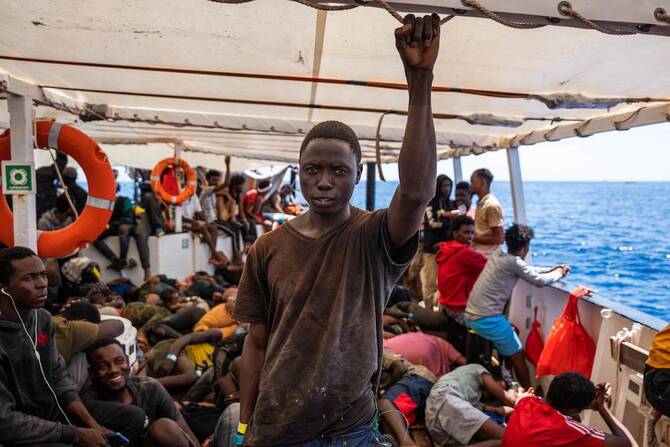
A group of 21 NGOS active in Mediterranean estimated that at least 28,932 people had died while trying to cross the sea since 2015. (AFP file photo)
Short Url
Updated 18 June 2025
Follow

Mediterranean rescuers say saved 175,000 people since 2015

  • The majority had died in the central Mediterranean, waters between between Libya, Tunisia, Italy and Malta
  • In that area, the equivalent of five adults and one child lost their lives every day over the past decade

BERLIN: Maritime rescue organizations said Wednesday they had pulled more than 175,000 people from the Mediterranean over the past 10 years, as waves of migrants sought to use the dangerous sea route to reach Europe.

The group of 21 NGOS active in the region estimated that at least 28,932 people had died while trying to cross the sea since 2015.

The majority had died in the central Mediterranean – waters between Libya, Tunisia, Italy and Malta – Mirka Schaefer of German NGO SOS Humanity told a Berlin press conference.

In that area, the equivalent of five adults and one child lost their lives every day over the past decade, she said.

The number of unrecorded cases was likely to be “significantly higher,” she added.

Of the 21 organizations currently engaged in maritime rescue in the region, 10 of them are based in Germany. Between them the groups operate 15 boats, four sail ships and four planes.

The organizations have frequently clashed with authorities over their rescue operations, which were launched as Europe’s migration crisis broke out in 2015, when hundreds of thousands headed to the continent, mostly from the Middle East.

In Italy the current government has vowed to end crossings and attacked NGOs for creating a “pull factor” that encourages departures, something migration observers say is unproven.

Giorgia Meloni’s hard-right government has passed laws requiring rescue ships to return to a designated port, a measure NGOs say is contrary to maritime law.

“The pressure on us is growing,” Schaefer said, criticizing a lack of support from the German government.

The rescue organizations were calling on Berlin to support “an effective, coordinated sea rescue program, fully funded by the EU,” Sea Watch spokeswoman Giulia Messmer said at the press conference.

The proposal, which had been sent to the German government and to the European Commission, called for the EU to spend between €108 million-€240 million ($124 million-$276 million) a year on rescue patrols and arrival centers.


Hundreds rally in Paris to support Ukraine after four years of war

Updated 5 sec ago
Follow

Hundreds rally in Paris to support Ukraine after four years of war

  • Demonstrators chanted: “We support Ukraine against Putin, who is killing it“
  • “Frozen Russian assets must be confiscated, they belong to Ukraine“

PARIS: Around one thousand took to the streets of Paris on Saturday to show their “massive support” for Ukraine, just days before the fourth anniversary of Russia’s invasion.
Demonstrators marching through the French capital chanted: “We support Ukraine against Putin, who is killing it,” and “Frozen Russian assets must be confiscated, they belong to Ukraine.”
“In public opinion, there is massive support for Ukraine that has not wavered since the first day of the full-scale invasion” by the Russian army on February 24, 2022, European Parliament member Raphael Glucksmann, told AFP.
“On the other hand, in the French political class, sounds of giving up are starting to emerge. On both the far left and the far right, voices of capitulation are getting louder and louder,” he added.
In the crowd, Irina Kryvosheia, a Ukrainian who arrived in France several years ago, “thanked with all her heart the people present.”
She said they reminded “everyone that what has been happening for four years is not normal, it is not right.”
Kryvosheia said she remains in daily contact with her parents in Kyiv, who told her how they were deprived “for several days” of heating, electricity and running water following intense bombardments by the Russian army.
Francois Grunewald, head of “Comite d’Aide Medicale Ukraine,” had just returned from a one-month mission in the country, where the humanitarian organization has delivered around forty generators since the beginning of the year.
Russia’s full-scale invasion sent shockwaves around the world and triggered the bloodiest and most destructive conflict in Europe since World War II.
The war has seen tens of thousands of civilians and hundreds of thousands of military personnel killed on both sides. Millions of refugees have fled Ukraine, where vast areas have been devastated by fighting.
Russia occupies nearly 20 percent of Ukrainian territory and its heavy attacks on the country’s energy sites have sparked a major energy crisis.