

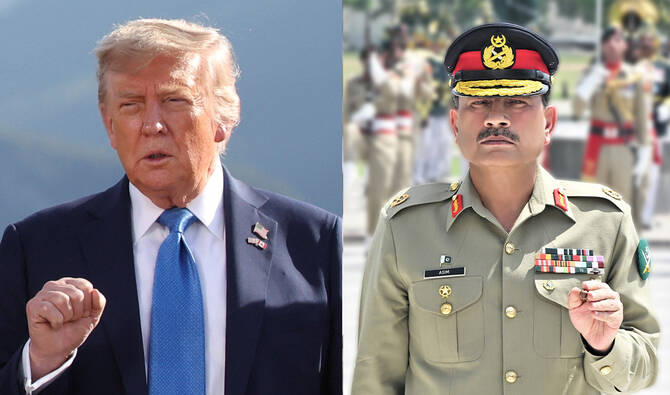
Trump calls Pakistan army chief ‘extremely influential’ ahead of White House luncheon

The collage of images created on June 18, 2025, shows US President Donald Trump (left) and Pakistan's Field Marshal General Syed Asim Munir. (AFP/ISPR/File)
Short Url
Updated 18 June 2025
Follow

Trump calls Pakistan army chief ‘extremely influential’ ahead of White House luncheon

  • Pakistan and the United States signal intent to rebuild ties after years of counterterrorism disagreements
  • This is the first time in years a Pakistani army chief is being hosted at the White House by a US President

ISLAMABAD: US President Donald Trump on Wednesday called Pakistan’s army chief “extremely influential,” crediting him with playing a major role in securing a ceasefire with India, shortly before a scheduled luncheon with Field Marshal Asim Munir.

The meeting comes amid heightened tensions in the Middle East and marks a rare direct engagement, signaling a cautious thaw in US-Pakistan relations under Trump’s second term.

This will be the first time in several years a Pakistani army chief is hosted by a sitting US president at the White House.

Both sides appear eager to rebuild military and economic cooperation after years of strained ties, largely over counter-terrorism disagreements.

“I love Pakistan,” Trump said when asked what he wanted to achieve diplomatically in the meeting with Pakistan’s army chief.

“This man [the army chief] was extremely influential in stopping it [the war] from the Pakistan side,” he added.

Trump also highlighted his role in the India-Pakistan ceasefire, saying that he prevented war between two nuclear powers.

Previously, he has hinted at a possible trade deal with Pakistan and India after helping broker a ceasefire between the nuclear-armed neighbors, following a deadly flare-up earlier this year.

Around 70 people were killed on both sides during the hostilities, which saw the exchange of missiles, drones and artillery fire. Pakistan said it shot down six Indian Air Force fighter jets, including three French-made Rafale aircraft.

The US has praised Pakistan’s leadership and reinstated military assistance previously suspended over concerns related to Afghanistan as part of Washington’s renewed outreach.

Islamabad, meanwhile, is also seeking to balance its deepening strategic partnership with China including arms supplies and defense infrastructure with broader engagement with the US.

Pakistan’s powerful military remains central to shaping its foreign and security policies.

The direct outreach to its top commander underscores Washington’s efforts to manage regional stability, including the fallout from the Taliban takeover in Afghanistan, recent cross-border tensions with India and the broader Israel-Iran escalation.

Security analysts say the meeting also signals a renewed US push to retain influence in a region where China is expanding its footprint through infrastructure investments and growing defense cooperation with Islamabad.

It remains unclear whether Trump will raise the Iran-Israel conflict with Munir, though Pakistan’s status as the world’s only nuclear-armed Muslim country and its shared border with Iran may factor into broader regional security discussions.


Pakistan offers Kyrgyzstan Arabian Sea access as two states sign 15 cooperation accords

Updated 5 sec ago
Follow

Pakistan offers Kyrgyzstan Arabian Sea access as two states sign 15 cooperation accords

  • Pakistan and Kyrgyzstan sign MOUs spanning trade, energy, agriculture, ports, education, security cooperation
  • Kyrgyz president is on first visit to Pakistan in 20 years as both sides push connectivity and CASA-1000 power links

ISLAMABAD: Pakistan on Thursday offered Kyrgyzstan the shortest and most economical route to the Arabian Sea as the two countries signed 15 agreements and memoranda of understanding aimed at boosting cooperation across trade, energy, agriculture, education, customs data-sharing and port logistics.

The accords were signed during a visit to Islamabad by President Sadyr Zhaparov, the first by a Kyrgyz head of state to Pakistan in two decades, and part of Islamabad’s renewed push to link South Asia with landlocked Central Asian economies through ports, power corridors and transport routes.

For Pakistan, Kyrgyzstan offers access to hydropower through CASA-1000, a $1.2 billion regional electricity transmission project designed to carry surplus summer electricity from Kyrgyzstan and Tajikistan through Afghanistan into Pakistan. For Bishkek, Pakistan provides overland access to warm-water ports on the Arabian Sea, creating a shorter commercial route to global markets.

“President Asif Ali Zardari has reiterated Pakistan’s readiness to offer Kyrgyzstan the shortest and most economical route to the Arabian Sea,” Radio Pakistan reported after Zhaparov met the Pakistani president. 

The two leaders also discussed expanding direct flights to deepen business, tourism and people-to-people ties.

Zardari welcomed Kyrgyzstan’s completion of its segment of the CASA-1000 project and “reaffirmed Pakistan’s commitment to completing its part of the project, which is now at an advanced stage,” the state broadcaster said. 

Zhaparov thanked Islamabad for supporting Bishkek’s candidacy for a non-permanent UN Security Council seat and invited Zardari to visit Kyrgyzstan at a time of his convenience. Both sides expressed satisfaction with progress under the Quadrilateral Traffic in Transit Agreement, designed to facilitate road movement between Pakistan, Kyrgyzstan, Kazakhstan and China.

Earlier, both governments exchanged 15 sectoral cooperation documents covering commerce, mining, geosciences, power, agriculture, youth programs, the exchange of convicted persons, customs electronic data systems and a sister-city linkage between Islamabad and Bishkek.

According to APP, the MOUs were signed by ministers representing foreign affairs, commerce, economy, energy, power, railways, interior, culture, health and tourism. Agreements also covered cooperation between Pakistan’s Foreign Service Academy and the Diplomatic Academy of Kyrgyzstan, as well as collaboration between universities, youth ministries and cultural institutions.

“Our present mutual trade, comprising of about $15–16 million will be enhanced to $200 million in the next two years,” Prime Minister Shehbaz Sharif said after the agreements were signed, calling them “a framework for structured, result-oriented engagement and closer institutional linkages.”

Sharif said Pakistan was ready to serve as a maritime outlet for the landlocked Central Asian republic, offering access to Karachi, Port Qasim and Gwadar to help Kyrgyz goods reach regional and global markets.