

Japan’s foreign minister avoids sanctioning Israel, criticizes Iran’s nuclear ‘ambitions’

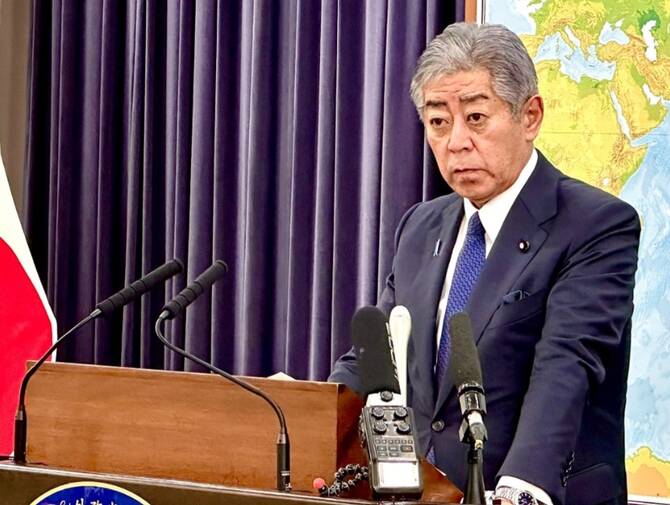
Japanese Foreign Minister Iwaya Takeshi is seen listening to a question at a press conference on June17 at the Ministry building in Tokyo. (Arab News Japan)
Short Url
Updated 18 June 2025
Follow

Japan’s foreign minister avoids sanctioning Israel, criticizes Iran’s nuclear ‘ambitions’

  • “We do not permit Iran’s nuclear development, and we believe that solving this through discussion is crucial,” Takeshi stated
  • “Moving forward, we will continue to exert all necessary diplomatic efforts”

TOKYO: Japanese Foreign Minister Iwaya Takeshi avoided condemning or approving sanctioning Israel in a press conference on Tuesday, shifting the emphasis onto Iran’s alleged pursuit of a nuclear weapon.

“We do not permit Iran’s nuclear development, and we believe that solving this through discussion is crucial,” he stated, emphasizing the potential for peaceful resolutions. “Moving forward, we will continue to exert all necessary diplomatic efforts to prevent further deterioration of the situation (between Iran and Israel.)”

When asked by Arab News Japan about the possibility of Israel using nuclear weapons in its conflict with Iran, as well as potentially targeting other countries like Pakistan and Egypt, as suggested by some reports, Iwaya opted not to answer directly. Instead, he stated, “Our country believes that the current tense situation in the Middle East is detrimental to the international community as a whole. We strongly urge all parties involved, including Israel, to exercise maximum restraint and to de-escalate the situation,” highlighting the urgency of the situation.

The Japanese Foreign Minister also said he strongly urged de-escalation when he spoke with Iran’s Foreign Minister on Monday, adding that Japan has “also been making efforts with Israel,” without specifying what those efforts entail or outlining how Japan might influence the situation. Rather, he emphasized Japan’s closeness to Israel.

“Israel is, of course, a friendly nation to our country, and we have had long-standing diplomatic relations with Iran, so we believe it is essential for Japan to work toward resolving issues through dialogue and consultation,” he stated.

“The peace and stability of the Middle East are extremely important to our country. The situation is becoming increasingly tense, particularly in Iran. We plan to raise the danger level further and issue evacuation adviseries for the Japanese for the entire country of Iran soon.”

Minister Iwaya was confronted about why Japan agreed with its G-7 partners to support so-called Israel’s self-defense and condemn Iran after Tokyo initially condemned Israel immediately when it launched a preemptive attack on Iran.

The Japanese Foreign Minister justified the change in the position, saying: “Initially, there were attacks from Israel that we condemned, but Iran retaliated, and this back-and-forth continues to this day. We believe that both Israel and Iran should ensure that they are engaged in dialogue and consultation to resolve issues.”

This situation is a source of significant concern for us, Iwaya continued. Regarding the G7 leaders’ statement, it is a consensus that reflects the discussions among the leaders considering the current situation. It reiterates the G7’s commitment to peace and stability in the Middle East.


Russia diverts its naphtha from Oman due to Middle Eastern crisis, data shows​

Updated 5 sec ago
Follow

Russia diverts its naphtha from Oman due to Middle Eastern crisis, data shows​

  • Strikes have disrupted energy production and shipping, including naphtha loadings and discharges
  • Since the European Union’s full embargo on Russian oil products took effect in February 2023, most Russian naphtha has been directed to the Middle East and Asia

MOSCOW: Russia has diverted its naphtha cargoes from Oman amid the Middle East crisis as it looks for new buyers, traders said and LSEG data showed, with at least one tanker now heading for Singapore.
Iran’s strikes on Gulf countries in retaliation for Israeli and US strikes against it have disrupted energy production and shipping, including naphtha loadings and discharges.
Since the European Union’s full embargo on Russian oil products took effect in February 2023, most Russian naphtha has been directed to the Middle East and Asia.
Middle Eastern countries are also the top ⁠supplier to Asia ⁠with the recent disruption forcing Asia’s naphtha margin to four-year highs, while at least one South Korean naphtha cracker operator was considering declaring force majeure and another has cut its operating rate by around a fifth.
The Liberia-flagged tanker, Amfitrion, which loaded in February in the Russian Black Sea ⁠port of Novorossiysk destined for Oman, last week halted navigation near the Gulf of Masira and on Tuesday turned for Singapore, according to LSEG data.
Five middle-sized tankers carrying a total 180,000 metric tons of naphtha in January departed Russian ports for an offshore STS (ship-to-ship) berth near Oman’s Shinas, shipping data showed. The final destination of these cargoes remains unknown.
According to data from LSEG and traders, Russia also sent two cargoes to Oman’s Sohar in November-December, ⁠carrying a total ⁠of 190,000 tons of naphtha as its other markets dried up.
India and Taiwan were among the main Asian buyers of Russian naphtha, but recent US sanctions have prompted both countries to pull back. Exports to Venezuela have also fallen to zero this year after US President Donald Trump in December ordered a blockade on all sanctioned oil tankers entering or leaving the Latin American country.
Though Asian buyers face naphtha shortages, Western sanctions could force traders to shun Russian cargoes. The long navigation from Russia’s Baltic ports to Asia also prevents prompt shipments, market sources said.