

WHO says Gaza health care at breaking point as fuel runs out

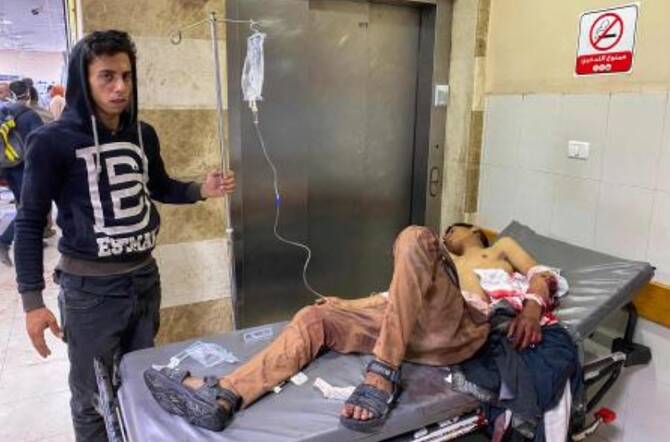
Palestinians who were injured in Israeli fire as they gathered near a food aid center, receive care at Khan Yunis’ Nasser hospital in the southern Gaza Strip on Jun. 17, 2025. (AFP)
Short Url
Updated 17 June 2025
Follow

WHO says Gaza health care at breaking point as fuel runs out

  • “For over 100 days, no fuel has entered Gaza and attempts to retrieve stocks from evacuation zones have been denied,” said Peeperkorn
  • Peeperkorn said only 17 of Gaza’s 36 hospitals were currently minimally to partially functional

GENEVA: The World Health Organization on Tuesday pleaded for fuel to be allowed into Gaza to keep its remaining hospitals running, warning the Palestinian territory’s health system was at “breaking point.”

“For over 100 days, no fuel has entered Gaza and attempts to retrieve stocks from evacuation zones have been denied,” said Rik Peeperkorn, the WHO’s representative in the Palestinian territories.

“Combined with critical supply shortages, this is pushing the health system closer to the brink of collapse.”

Peeperkorn said only 17 of Gaza’s 36 hospitals were currently minimally to partially functional. They have a total of around 1,500 beds — around 45 percent fewer than before the conflict began.

He said all hospitals and primary health centers in north Gaza were currently out of service.

In Rafah in southern Gaza, health services are provided through the Red Cross field hospital and two partially-functioning medical points.

Speaking from Jerusalem, he said the 17 partially functioning hospitals and seven field hospitals were barely running on a minimum amount of daily fuel and “will soon have none left.”

“Without fuel, all levels of care will cease, leading to more preventable deaths and suffering.”

Hospitals were already switching between generators and batteries to power ventilators, dialysis machines and incubators, he said, and without fuel, ambulances cannot run and supplies cannot be delivered to hospitals.

Furthermore, field hospitals are entirely reliant on generators, and without electricity, the cold chain for keeping vaccines would fail.

The war was triggered by an unprecedented Hamas attack on Israel on October 7, 2023, which resulted in the deaths of 1,219 people, according to official Israeli figures.

The health ministry in Hamas-run Gaza said on Monday that 5,194 people have been killed since Israel resumed strikes on the territory on March 18 following a truce.

The overall death toll in Gaza since the war broke out on October 7, 2023 has reached 55,493 people, according to the health ministry.

“People often ask when Gaza is going to be out of fuel; Gaza is already out of fuel,” said WHO trauma surgeon and emergency officer Thanos Gargavanis, speaking from the Strip.

“We are walking already the fine line that separates disaster from saving lives. The shrinking humanitarian space makes every health activity way more difficult than the previous day.”



‘Speed over scale’: Saudi Arabia positioned to shape future of industry, say experts

Updated 6 sec ago
Follow

‘Speed over scale’: Saudi Arabia positioned to shape future of industry, say experts

  • WEF p anelists also discussed how global industrial forces are evolving

DAVOS: Saudi Arabia is primed to position itself at the forefront of the global industrial transformation, leveraging its scale, strategic vision, and competitive energy infrastructure to become a leader in sectors such as clean industries and advanced technologies, experts said on Tuesday.
Speaking at a panel at the World Economic Forum in Davos, Rayan Fayez, deputy CEO at NEOM, highlighted how the Kingdom’s industrial city, Oxagon, is driving diversification and clean manufacturing.
The city is already home to several key sectors, including green hydrogen, renewable manufacturing and AI data centers.
The world’s largest green hydrogen project, a collaboration with ACWA Power and Air Products, is 90 percent complete and expected to be operational by 2027, Fayez said.
Renewable manufacturing partnerships are also taking off, with Chinese companies establishing solar and wind production outside China for the first time.
Fayez highlighted that NEOM’s success rests on four core competitive advantages: digital infrastructure, abundant renewable energy, ready-to-use land and strategic location.
“The location is not only strategic for the Kingdom, but also in connection to the rest of the world through the port of NEOM,” he said, adding that the city is poised to serve as a hub for both domestic and export-oriented industries.
Panelists also discussed how global industrial forces are evolving.
Frederico Torti from the WEF highlighted the structural volatility in supply chains, driven by geopolitics, technological change, natural disasters, cybersecurity risks and talent shortages.
He highlighted the importance of agility, collaboration and holistic operational transformation.
“The only way to make this happen is through collaboration, dialogue, and cooperation across public and private sectors,” he said.
Saudi Arabia’s strategic position, combined with its low-cost energy and infrastructure readiness, make it a magnet for industrial investment, Torti said.
“Countries that invest in the right factors will attract manufacturing investments and create value for the next decade,” he said, pointing to NEOM as a prime example of this approach.
ACWA Power CEO Marco Arcelli highlighted why Saudi Arabia is a compelling market for gigascale renewable energy and water desalination projects.
“In a world of uncertainty, Saudi Arabia is a country where you can really smell the hope,” he said.
“It speaks with China and the US, with Russia and Ukraine, with Europe and Southeast Asia and Africa, and looks to partner to solve problems and to develop domestically but also abroad.”
ACWA Power is now the largest water desalination company in the world, with operations across the Middle East and new projects in Azerbaijan, Senegal and China, he added.
Arcelli highlighted the water-energy nexus, where low-cost renewable power enables large-scale, sustainable desalination.
“Countries that are moving faster in these sectors are typically countries that will enjoy higher economic growth,” he said.
Looking ahead, panelists highlighted that the future of competitiveness will rely less on scale and more on speed and collaboration.
“You cannot be good at everything,” Arcelli said. “It’s going to be more about cooperation. It’s an economy of speed, not economy of scale anymore to thrive and be the best around.”
Torti reiterated the need for cross-border partnerships and dialogue, adding: “Open up, connect and make best use of forums like this to get different perspectives on solving problems. Collaboration is invaluable.”
Fayez added that investing in talent remains a critical element to drive industrial transformation in the Kingdom as well as globally, alongside infrastructure and technology.