

Pakistan stresses increasing trade, tourism cooperation with Bangladesh amid improving ties

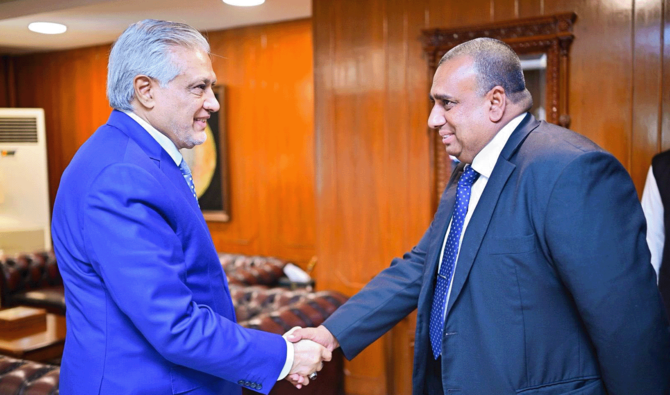
Pakistan's Deputy Prime Minister and Foreign Minister, Ishaq Dar (left) shaking hands with Bangladesh’s High Commissioner Iqbal Hussain Khan in Islamabad, Pakistan on June 17, 2025. (@ForeignOfficePk/X)
Short Url
Updated 17 June 2025
Follow

Pakistan stresses increasing trade, tourism cooperation with Bangladesh amid improving ties

  • Deputy PM Ishaq Dar meets Bangladesh high commissioner to discuss ties, says Pakistan’s FO
  • Islamabad, Dhaka have sought closer ties since ex-Bangladesh PM Sheikh Hasina’s ouster in 2024

ISLAMABAD: Pakistan’s Deputy Prime Minister Ishaq Dar on Tuesday stressed the need to enhance cooperation in trade and tourism with Bangladesh, the Pakistani foreign office said, as Dhaka and Islamabad attempt to forge closer ties amid improving bilateral relations. 

Pakistan and Bangladesh have improved their strained ties since August last year after former premier Sheikh Hasina fled to India, forced by a violent student-led protest. Pakistan and Bangladesh were once one nation but split in a brutal 1971 war, with Bangladesh drawing closer to India. 

Bangladesh’s High Commissioner Iqbal Hussain Khan met Dar, who also serves as Pakistan’s foreign minister, in Islamabad to discuss bilateral ties, the Pakistani foreign office said. 

“Appreciating the positive trajectory of bilateral ties, he [Dar] emphasized the need to further expand cooperation- especially in trade, tourism, & people-to-people exchanges,” the foreign office said. 

In February this month, Bangladesh and Pakistan started direct government-to-government trade with Dhaka importing 50,000 tons of rice from Islamabad, a sign of improving relations between the two. 

Direct private trade between the countries restarted in November 2024, when a container ship sailed from Pakistan’s Karachi to Bangladesh’s Chittagong. It was the first cargo ship in decades to sail directly between the two nations. 

In recent months, Pakistan’s Prime Minister Shehbaz Sharif and Bangladesh’s Chief Adviser Muhammad Yunus have met on the sidelines of international forums, including the United Nations General Assembly in New York and the D-8 Summit in Cairo.

These interactions have been described as cordial, with both leaders expressing a desire to deepen bilateral cooperation.


Pakistan, ADB reaffirm commitment to ML-1 rail project amid economic reforms

Updated 6 sec ago
Follow

Pakistan, ADB reaffirm commitment to ML-1 rail project amid economic reforms

  • Flagship railway upgrade tied to IMF-backed stabilization, multilateral financing
  • ADB, World Bank working with Pakistan to address project delays, readiness gaps

ISLAMABAD: Pakistan and the Asian Development Bank (ADB) have reaffirmed their commitment to advancing the long-delayed Main Line-1 (ML-1) railway modernization project, a flagship infrastructure upgrade central to the country’s economic reform and connectivity agenda, the information ministry said on Thursday. 

The renewed focus on ML-1 follows meetings this week between senior Pakistani ministers and ADB officials in Islamabad, as the government seeks to revive large-scale infrastructure investment while maintaining fiscal discipline under an International Monetary Fund (IMF) program.

ML-1 is Pakistan Railways’ busiest north–south corridor, linking the southern port city of Karachi with major population and industrial centers in Punjab and Khyber Pakhtunkhwa. The project aims to modernize tracks, signaling and rolling stock to improve safety, cut travel times and lower transport costs. 

Originally envisioned as a flagship transport upgrade under the China-Pakistan Economic Corridor (CPEC), ML-1 has struggled to reach financial close amid cost concerns, debt sustainability debates and implementation challenges. Pakistan has since sought broader multilateral engagement, with institutions including the Asian Development Bank now playing a central role in project structuring, financing discussions and efforts to address execution bottlenecks.

During a meeting with Leah Gutierrez, Director General for Central and West Asia at the ADB, Federal Minister for Economic Affairs Ahad Cheema underscored the government’s reform priorities and the importance of the project’s timely execution.

“The Minister underscored the Government’s strong commitment to the timely implementation of the Main Line–1 (ML-1) railways project and emphasized that ADB’s continued support would be critical to achieving this milestone,” the information ministry said in a statement.

The ministry said Cheema also highlighted coordination with provincial governments and welcomed joint efforts by the ADB and the World Bank to identify implementation bottlenecks and improve project readiness to ensure timely disbursements.

Gutierrez commended Pakistan’s reform agenda and acknowledged the government’s focus on macroeconomic recovery and fiscal consolidation, reaffirming that ADB teams were working closely with Pakistani authorities on ML-1, according to the statement.

Separately, Federal Minister for Railways Muhammad Hanif Abbasi told Defense Secretary Lt. Gen. Muhammad Ali in a meeting that an agreement for the ML-1 project had been finalized with the ADB and that steps were being taken to move the project forward.

“Concrete steps are being taken to complete the project at the earliest,” the statement quoted Abbasi as telling Ali. “The ML-1 project will serve as a milestone in modernizing Pakistan Railways.”

Abbasi also briefed participants on parallel reform measures at Pakistan Railways, including the launch of an artificial intelligence-based monitoring system at Rawalpindi Railway Station, real-time tracking of trains and rolling stock through digital tagging, and the installation of a weigh bridge in Karachi to address overloading and improve safety.

Pakistan Railways has long struggled with aging infrastructure, safety challenges and financial losses, even as rail transport remains vital for passenger movement and freight. Multilateral lenders have repeatedly stressed the need for stronger execution capacity and governance reforms to translate infrastructure commitments into economic gains.