

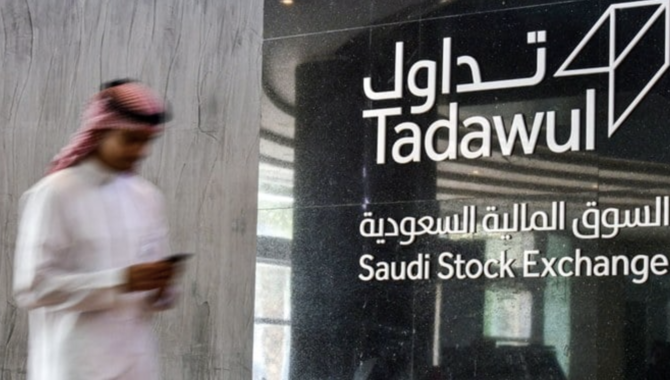

RIYADH: Foreign investors held SR394.58 billion ($105.2 billion) in Saudi equities as of June 12, marking an annual decline of 1.1 percent, although their market share rose amid a broader downturn.
According to the latest data from Saudi Exchange, the dip in foreign ownership comes as the total value of holdings in the main market fell to SR9.14 trillion, down from SR9.95 trillion in June 2024, as valuations across key sectors — including financials, materials, and energy — softened.
The increase in foreign investors’ market share — from 4.01 percent to 4.32 percent — is attributed to the overall decline in market size.
Saudi nationals remain dominant in the market, holding SR8.68 trillion, or 94.94 percent of total ownership, down from SR9.48 trillion, or 95.28 percent, a year earlier.
Investments from Gulf Cooperation Council countries also dipped, with holdings falling from SR70.17 billion to SR67.46 billion, despite their share slightly increasing to 0.74 percent.
The drop in market capitalization coincided with a 1.5 percent decline in the Tadawul All Share Index on June 12, driven by losses in heavyweight stocks such as Al Rajhi Bank and Saudi Arabian Mining Co. The selloff came amid renewed geopolitical tensions in the region.
“While solid fundamentals offer a hopeful outlook, the market’s reaction was more heavily influenced by geopolitical tensions,” said Milad Azar, a market analyst at XTB MENA, in comments to Reuters.
His statement followed the US decision to reposition diplomatic staff in the region, stoking concerns over escalating tensions with Iran. The move added pressure to already cautious markets, where investors have been rebalancing portfolios in response to rising interest rates and shifting risk appetite.
Despite recent volatility, the long-term outlook for foreign participation remains strong. Saudi Arabia’s inclusion in global emerging market indices — such as MSCI, FTSE Russell, and S&P Dow Jones — continues to support passive fund flows.
Reforms under Vision 2030, including enhanced transparency, stronger corporate governance, and an expanding privatization pipeline, are widely viewed as central to boosting long-term investor engagement in Saudi Arabia’s capital markets.
The government’s commitment to diversifying the economy has opened new sectors for investment, while regulatory upgrades have helped align local practices with international standards.
As part of these reforms, Tadawul has undergone a transformation in recent years to enhance its global appeal. The market’s inclusion in major emerging market indices between 2018 and 2019 helped unlock billions in passive fund inflows. Since then, Tadawul has focused on improving disclosure quality, streamlining Qualified Foreign Investor registration, and modernizing its trading and post-trade systems.
This evolution continues to attract international capital through a growing pipeline of sector-diverse initial public offerings. Recent listings in health care, technology, and consumer goods have provided foreign investors with broader exposure to non-oil growth areas, further supporting portfolio diversification.
Meanwhile, ongoing efforts to enhance post-trade infrastructure and environmental, social, and governance reporting are expected to improve overall market competitiveness and strengthen the exchange’s appeal to long-term institutional investors.


