

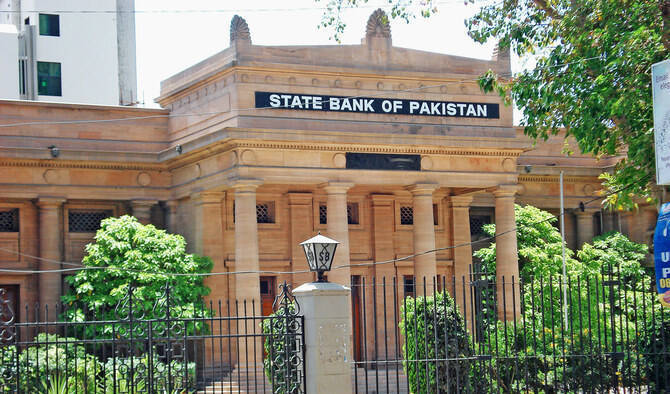

KARACHI: Pakistan’s central bank kept its key interest rate unchanged at 11% on Monday, maintaining a cautious stance, as financial analysts warn heightened Middle East tensions and volatile global oil prices add new risks to the country’s fragile external sector and inflation rate.
A Reuters poll released earlier on Monday had shown analysts revising their expectations for a rate cut in light of Israel’s military strikes on Iran that began on Friday and have since intensified, pushing up global commodity prices.
“The [Monetary Policy] Committee noted some potential risks to the external sector amidst the sustained widening in the trade deficit and weak financial inflows. Moreover, some of the proposed FY26 budgetary measures may further widen the trade deficit by increasing imports,” the central bank said, announcing its decision to leave the rate unchanged.
“In this regard, the Committee deemed today’s decision appropriate to sustain the macroeconomic and price stability.”
Monday’s decision comes days after Pakistan announced its Rs16.7 trillion ($62 billion) annual budget targeting 4.2% growth, up from a provisional estimate of 2.7% for the current year.
The MPC noted that despite the widening trade deficit, the current account remained broadly balanced in April, and foreign exchange reserves rose to $11.7 billion as of June 6 after the completion of the first review under the International Monetary Fund’s Extended Fund Facility. The country expects $14 billion foreign exchange reserves by the end June.
The bank paused its policy rate easing cycle in March, following cumulative cuts totaling 1,000 basis points from a record high of 22%, and resumed it with a 100-basis-point reduction in May.
Inflation in Pakistan has slowed markedly since peaking at around 40% in May 2023. However, last month it rose to 3.5% year-on-year, above the finance ministry’s projection of up to 2%, partly due to the fading of favorable base effects. The central bank projects average inflation between 5.5% and 7.5% for the fiscal year ending this month.
“Going forward, inflation is expected to trend up and stabilize in the target range,” the MPC said.
The escalating tensions in key oil-producing regions have triggered a sharp surge in global oil prices with brent, West Texas Intermediate (WTI) and Arab Light crude oils showing a 12% week-on-week increase and daily spikes exceeding 6%, Arif Habib Ltd, a Karachi-based research firm, said in its latest note.
‘WAIT-AND-SEE’ STANCE
Amreen Soorani, the head of research at Al Meezan Investment Management, said the SBP’s decision was primarily driven by emerging geopolitical risks that had affected international oil prices.
“Even with substantial improvements in Pakistan’s inflation and external account, the central bank seems to have taken a cautious “wait-and-see” stance,” she told Arab News.
The regional tensions, she said, were posing potential challenges to Pakistan’s balance of payment and inflation rate. Cash-strapped Pakistan spent $17 billion on oil imports last year.
Soorani said petroleum was a major driver of Pakistan’s trade deficit, accounting for approximately 30% of all imports and consuming around 55% of export proceeds.
“All else being equal, a $5 per barrel increase in average oil prices for the year would worsen our trade deficit by an estimated $900 million annually,” the analyst said.
Pakistan is closely watching the global oil market, where brent and WTI crude traded at around $73.5 and $70.5 a barrel on Monday and fell 1% after opening lower in the Western markets, Finance Adviser Khurram Schehzad said.
“Global calls for increasing supplies is (are) one of the reasons among potential resolve of the Israel-Iran conflict by the US,” Schehzad said.
Muhammad Waqas Ghani, head of research at JS Global Capital Ltd., said the SBP’s current monetary stance was aligned with the IMF’s recommendation to Islamabad to maintain a sufficiently tight monetary policy to anchor inflation.
“Additionally, the committee may have preferred to wait for greater clarity on the budget measures and their potential impact on inflation dynamics,” he told Arab News.
STOCKS GAIN, RUPEE DECLINES
Pakistani stocks gained by 82 points to close at 122,225 points “despite geopolitical risk amid speculations over SBP policy announcement,” Ahsan Mehanti, chief executive officer at Arif Habib Commodities Ltd, said.
The rupee declined for the fifth consecutive session and inched down 0.07% to Rs283.17 per dollar. Qazi Owais Ul Haq, a currency dealer at Arid Habib Ltd. said Pakistan’s currency was “feeling the heat” as regional tensions surge.
“They are trying to hold the rate but as a third-world country war affects us,” Haq told Arab News.
Pakistan’s top trade body, the Federation of Pakistan Chamber of Commerce & Industry (FPCCI) and the Karachi Chamber of Commerce and Industry, (KCCI) said the central bank’s decision to maintain the policy rate at 11% was disappointing
“The SBP has not only ignored market signals but has also dampened business sentiment at a time when the economy urgently requires a boost,” KCCI President Muhammad Jawed Bilwani in a statement.


