

India relocates students in Iran as Israel strikes continue

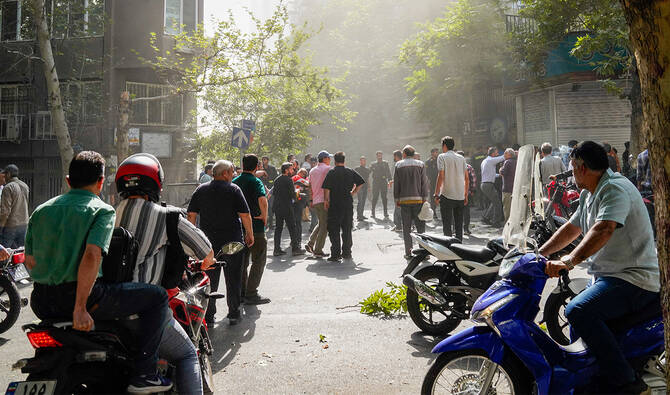
People gather in the street amid smoke following the Israeli strikes on Iran, in Tehran, Iran, on June 15, 2025. (Wana News Agency/File)
Short Url
Updated 16 June 2025
Follow

India relocates students in Iran as Israel strikes continue

  • Tehran has hit back with strikes against Israel since it unleashed attacks against Iran on Friday
  • The escalation has sparked global alarm that the conflict could erupt into a regional war

New Delhi said Monday its diplomats were helping some Indian students relocate out of harm’s way in Iran, which has come under days of deadly Israeli bombardment.

Tehran has hit back with strikes against Israel since it unleashed waves of attacks against Iran on Friday, sparking global alarm that the conflict could erupt into a regional war.

New Delhi, which has relations with both countries, has sought to relocate its citizens within Iran after Tehran closed its airspace.

“The Indian Embassy in Tehran is continuously monitoring the security situation and engaging Indian students in Iran to ensure their safety,” a foreign ministry statement said.

“In some cases, students are being relocated with (the) Embassy’s facilitation to safer places within Iran,” the ministry added.

There are around 10,000 Indian citizens in Iran, according to government data last year, while figures from 2022 listed more than 2,000 students in Iran.

New Delhi on Friday said it stood ready “to extend all possible support” to both countries, as it urged them to “avoid any escalatory steps.”

“Existing channels of dialogue and diplomacy should be utilized,” said foreign ministry spokesman Randhir Jaiswal.

Iran’s health ministry has reported at least 224 people killed in Israeli strikes, while Israeli authorities have tallied more than a dozen deaths since Tehran began its retaliatory attacks Friday.


First urban cable car unveiled outside Paris

Updated 13 December 2025
Follow

First urban cable car unveiled outside Paris

  • The cable car will carry some 11,000 passengers per day in its 105 gondolas
  • The 138-million-euro project was cheaper to build than a subway, officials said

PARIS: Gondolas floated above a cityscape in the southeastern suburbs of Paris Saturday as the first urban cable car in the French capital’s region was unveiled.
Officials inaugurated the C1 line in the suburb of Limeil-Brevannes in the presence of Valerie Pecresse, the head of the Ile-de-France region, and the mayors of the towns served by the cable car.
The 4.5-kilometer route connects Creteil to Villeneuve-Saint-Georges and passes through Limeil-Brevannes and Valenton.
The cable car will carry some 11,000 passengers per day in its 105 gondolas, each able to accommodate ten seated passengers.
The total journey will take 18 minutes, including stops along the way, compared to around 40 minutes by bus or car, connecting the isolated neighborhoods to the Paris metro’s line 8.
The 138-million-euro project was cheaper to build than a subway, officials said.
“An underground metro would never have seen the light of day because the budget of more than billion euros could never have been financed,” said Gregoire de Lasteyrie, vice president of the Ile-de-France regional council in charge of transport.
It is France’s seventh urban cable car, with aerial tramways already operating in cities including Brest, Saint-Denis de La Reunion and Toulouse.
Historically used to cross rugged mountain terrain, such systems are increasingly being used to link up isolated neighborhoods.
France’s first urban cable car was built in Grenoble, nestled at the foot of the Alps, in 1934. The iconic “bubbles” have become one of the symbols of the southeastern city.