

Pakistan says fuel stocks sufficient, vows vigilance as Israel-Iran conflict rattles markets

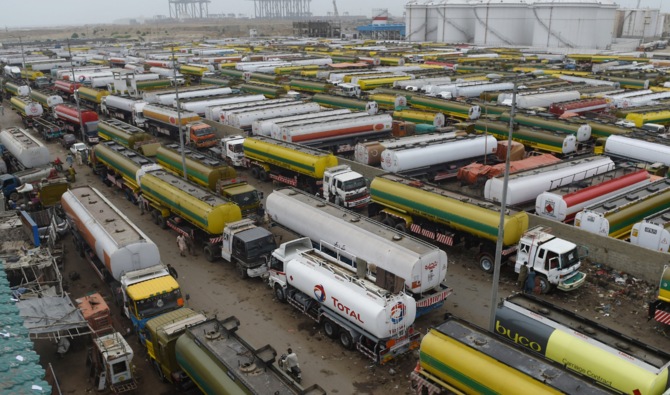
Oil tankers park in a terminal amid a countrywide strike by the All Pakistan Oil Tankers Association near a port in the Pakistani city of Karachi on July 26, 2017. (AFP/ file)
Short Url
Updated 16 June 2025
Follow

Pakistan says fuel stocks sufficient, vows vigilance as Israel-Iran conflict rattles markets

  • Committee to monitor petroleum pricing and supply in response to Israel’s attack on Iran holds inaugural meeting
  • Pakistan relies heavily on imported oil, global price swings can drain its foreign reserves and fuel domestic inflation

KARACHI: Pakistan currently holds adequate stocks of petroleum products and faces no immediate risk of supply disruption, the finance ministry said on Monday, while warning that continued vigilance was needed as Middle East tensions pushed oil markets into fresh volatility.

The statement came after the inaugural meeting of a committee formed by Prime Minister Shehbaz Sharif last week to monitor petroleum pricing and supply in response to an ongoing military confrontation between Israel and Iran. 

Oil markets have been volatile amid the escalation, with Brent crude prices jumping about 7 percent last Friday to near $75 per barrel, but edging down on Monday, as renewed military strikes by both nations over the weekend left oil production and export facilities unaffected.

Concern is focused on potential disruptions in the Strait of Hormuz, through which roughly one‑fifth of global oil transits, and weak supply growth from Iran, which produces about 3.3 million barrels per day. Analysts caution any sustained spike could drive up global freight rates, insurance premiums and inflation, particularly in energy‑importing countries like Pakistan.

“The committee expressed satisfaction that Pakistan currently holds adequate stocks of petroleum products and there is no immediate risk of supply disruption. Nonetheless, members emphasized the need for continued vigilance given the rapidly changing regional context,” the finance ministry said after the first meeting of the committee, chaired by Finance Minister Muhammad Aurangzeb.

The ministry added that to ensure timely response and effective coordination, a working group would monitor developments on a daily basis, and the full committee would meet weekly to review the situation and submit recommendations to the prime minister. 

“The Government of Pakistan remains fully committed to maintaining energy security, stabilizing markets, and protecting the national interest during this critical time,” the statement added.

The committee has been entrusted with monitoring the forward/futures prices of petroleum products and the predictability of supply chains, determining the foreign reserve implications of price volatility in the short and medium term, suggesting a plan, if and when required, to ensure there were no supply disruptions and the market was well supplied, and carrying out a detailed analysis of the fiscal impact in the event of a protracted conflict.

Pakistan relies heavily on imported oil, and any sustained spike in prices could widen its current account deficit and push inflation higher at a time when the country is struggling with low foreign reserves and slow growth.

The Israel-Iran conflict started on Friday when Israel launched a massive wave of attacks targeting Iranian nuclear and military facilities but also hitting residential areas, sparking retaliation and fears of a broader regional conflict. Over 220, mostly civilians have been killed in Iran so far, while Israel has reported 23 deaths in retaliatory strikes by Tehran.

Pakistan and Iran share a 909 kilometer (565 mile) long international boundary that separates Iran’s southeastern Sistan-Baluchestan province from Pakistan’s southwestern Balochistan province. 

“Israel-Iran conflict presents complex challenges for Pakistan as rising oil prices may increase import costs and inflation, influencing monetary policy and growth, while disruptions to key routes like the Strait of Hormuz can affect energy supplies and critical projects,” Khaqan Najeeb, an economist and former finance ministry adviser, told Arab News last week. 

“It can potentially affect consumer purchasing power and production costs ... Possible disruptions to shipping routes and higher freight charges might result in delays to imports and exports, thereby exerting additional pressure on Pakistan’s external sector.”


In Peshawar, 76-year-old artist struggles to keep near-extinct Mughal wax art alive

Updated 4 sec ago
Follow

In Peshawar, 76-year-old artist struggles to keep near-extinct Mughal wax art alive

  • Craft involves intricate process using heated wax, oil, pigments, limestone to create textured, miniature artworks
  • Riaz Ahmad, who has trained his son in wax art, says he hopes to train more people to preserve traditional craft 

PESHAWAR: Riaz Ahmad, 76, stirs wax in a small plastic can with a long chopstick, takes it out on the palm of his left hand and adds natural color before drawing designs on a piece of cloth.

Surrounded by several such pieces of black cloth with unique art, Ahmad strives every passing day to keep the 500-year-old, Mughal-era wax art alive at his home near the Lahori Gate in the northwestern Pakistani city of Peshawar.

Ahmad comes from a well-known family of wax artists who were based in Shillong and Darjeeling in present-day India and had migrated to Peshawar during the 1947 partition of the sub-continent.

His work remains rooted in tradition, faithfully repeating patterns passed down through generations and winning Ahmad several awards both at home and abroad in recognition of his dedication.

“I have been making the same Mughal era designs that my forefathers used to make,” he told Arab News last week.


“I went to India in 2004, where I received the UNESCO Seal of Excellence [for Handicrafts] award... On 23 March, 2012, the Government of Pakistan awarded me the Tamgha-i-Imtiaz.”

The near-extinct traditional craft, which is believed to have originated in Central Asia and refined under the Mughal patronage, particularly in Peshawar, involves an intricate process using heated wax, linseed oil, powdered pigments, and limestone to create detailed, textured and often colorful miniature artworks by hand.

Ahmad learnt wax art from his father, Miran Bakhsh, nearly six decades ago.

“My parents used to do this work in Shillong and Darjeeling [in present-day India]. They had a shop there, and after the Partition, they migrated to Peshawar, Pakistan,” he said. “When they came here, they started doing the same work.”

A basic piece of his work costs around Rs3,000 ($10.7). A larger piece made on order can fetch between Rs5,000 and Rs15,000 ($17-$53), but such orders are rare.

“Wax and colors have become expensive. When I sell a piece for Rs3,000, around Rs1,000 goes into expenses, and Rs2,000 is my daily wage,” Ahmad said.

But the 76-year-old worries more about the future of the art form, which he insists cannot be learned quickly and requires “love and dedication.”

“Some people say they want to come, some from Karachi and some from Lahore, but it becomes difficult for me to go there or for them to come here,” he said.

Most wax artists in Peshawar have abandoned the art due to a lack of institutional support, according to Ahmad, who relies primarily on exhibitions to earn a living.

“The reason [for the decline of this art form] is that the government does not pay attention. They are caught in their own conflicts, and the culture is suffering,” Ahmad said.

“Other artists have left this art. Some are selling rice and some are driving rickshaws,” he added. “I have been doing this work inside my house. If there is any event, we go there and sell our art.”

Saad Bin Awais, a spokesperson for the Khyber Pakhtunkhwa Culture and Tourism Authority (KPCTA), said the government has engaged artisans in several projects. He said some of these projects have come to an end while others are ongoing.

“Riaz Ahmad is the only wax artist in Khyber Pakhtunkhwa and the authority is serious about facilitating him,” he said, adding that the KPCTA facilitates Ahmad’s participation in exhibitions across the country to showcase his art.

“We have also been collecting data of artists in Khyber Pakhtunkhwa for an upcoming project to facilitate them in any way possible.”

Ahmad has trained his son, Fayyaz, in wax art who now practices it in Islamabad. The septuagenarian says he wishes to train more people to preserve the dying art form.

“I cannot leave this work,” he said. “I will continue this art even though my hands shake.”