

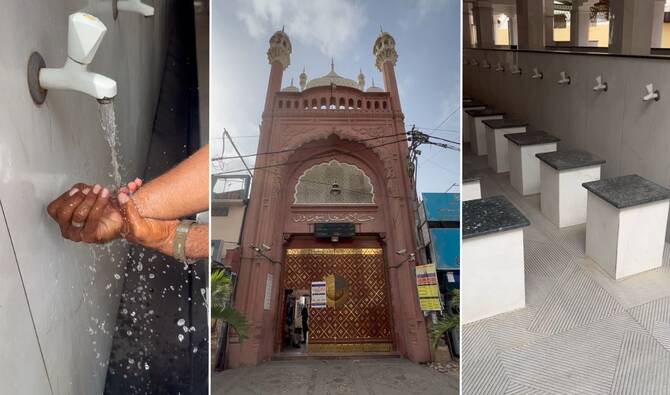

KARACHI: On a sweltering afternoon in Karachi’s Gulberg neighborhood earlier this month, rows of men lined up under shaded arcades at a seminary to perform wudu, the ritual ablution Muslims perform before prayers.
In a city battered by chronic water scarcity, each drop of this cleansing water is precious but until last year, gallons of it flowed straight into Karachi’s aging sewer lines, lost forever.
Now, at over 20 mosques scattered across this sprawling megacity of more than 20 million people, this water has found a second purpose. It is being stored underground to help replenish the city’s shrinking aquifers, drop by precious drop.
The unconventional fix is the brainchild of Dr. Syed Imran Ahmed, who heads the Panjwani Hisaar Water Institute at Karachi’s NED University. He convinced the administrators of Jamia Uloom Islamia Banuri, one of Pakistan’s biggest seminaries, to store ablution water in underground wells instead of letting it drain away.
And what started as a pilot at the Banuri mosque has since spread to more than 20 mosques citywide.
“A lot of people go to the mosque and use water there without any thinking. Now this water directly goes to wastewater, so it becomes part of wastewater,” Dr. Ahmed told Arab News.
“But what if you divert it to a tank or to a well in the mosque?”
Karachi is Pakistan’s economic engine but also one of its thirstiest cities. Official estimates show it needs about 1,200 million gallons per day but gets barely half that on average.
As residents bore deeper and deeper wells to tap the ground beneath them, they have left behind hollow pockets in the earth, literal sinkholes that are swallowing parts of the city.
A landmark study by Singapore’s Nanyang Technological University found Karachi ranks second in the world for urban land subsidence, just behind China’s Tianjin. Between 2014 and 2020 alone, parts of the city sank by as much as 15 centimeters due to excessive groundwater pumping.
“And that rate of sinking is higher than the sea level rise due to climate change. Now they are calling them bowl cities ... the city is like a bowl because different areas of it are sinking.” said Yasir Husain, founder of the Climate Action Center in Karachi.
The mosque project, he explained, addressed this destructive cycle in which countless homes had bore ever deeper into the earth for water.
“People have on every street two or three houses which have bores, and they suck water from the ground,” he said. “And they’ve gone deeper and deeper.”
Recharging wells, however small, could help restore the balance, Hussain added.
OTHER FAITHS, OTHER CITIES
The idea isn’t unique to Karachi. From India to Indonesia, communities have long explored ways to reuse water from places of worship.
In India’s Hyderabad, the centuries-old Charminar mosque installed a water recycling system in 2019 that filters ablution water for reuse in gardens.
In Kuala Lumpur, Malaysia, a green mosque project uses treated wudu water for toilet flushing and irrigation.
In the Middle East, where water stress is even more acute, countries like the UAE have pioneered mosque greywater reuse for landscaping, transforming prayer halls into unexpected allies for urban water security.
At the Jamia Masjid Falah in the city’s Gulberg neighborhood, Abdullah Malik, a mosque committee member, said he could see the water recycling results firsthand.
“It’s essential that any sweet water used should be saved instead of being wasted into the gutter lines,” he said, estimating that 700–800 people performed ablution at his mosque daily.
Even saving three liters per person could mean thousands of liters recharging the earth every day, Malik added, a small, steady buffer against Karachi’s mounting water emergency.
Indeed, encouraged by the community response, Dr. Ahmed has mapped 27 flood-prone areas in the city where monsoon rain can also be stored in recharge wells.
He hopes local authorities will greenlight the proposal soon.
“I think that these 27 wells would be soon active, god willing,” he said.
Meanwhile, supporters like Husain believe mosques and local leaders could play a crucial role in changing habits.
“The water which is used for wudu [ablution] will not end up in your gutter,” he said. “That water is precious.”
No doubt, for Karachi, every drop saved, and returned to the earth, is a promise that the city’s lifeline might yet endure.


