Pakistan hikes petrol, diesel prices in fortnightly review

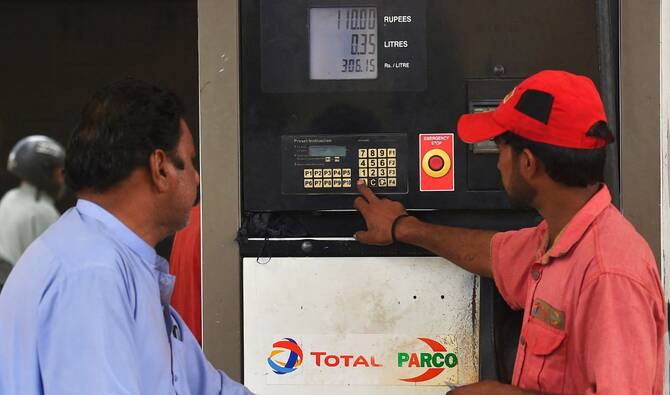
An employee prepares to fill petrol in a vehicle at a fuel station in Karachi on September 1, 2023. (AFP/ file)
Short Url
Updated 16 June 2025
Follow

Pakistan hikes petrol, diesel prices in fortnightly review

  • Government sets petrol at Rs258.43 per liter, up from Rs253.63
  • High-speed diesel will cost Rs262.59 per liter, up from Rs254.64

KARACHI: Pakistan’s government has increased fuel prices, raising the rate of high-speed diesel (HSD) by Rs7.95 per liter and petrol by Rs4.80 per liter effective from today, Monday, an official notification from the finance division said. 

The notification set the price of petrol at Rs258.43 per liter, up from Rs253.63, while high-speed diesel will cost Rs262.59 per liter, up from Rs254.64.

The revision is based on “recommendations from the Oil and Gas Regulatory Authority and relevant ministries,” the finance division saiad. 

The government did not provide a specific explanation for the hike.

Fuel prices in Pakistan are generally influenced by global oil market trends, currency fluctuations, and changes in domestic taxes.

Fuel costs are revised every two weeks and have a direct impact on inflation. Rising fuel prices increase production and transportation costs, leading to higher prices for goods and services across the board in Pakistan, including food and other essential items. This direct relationship is further amplified by the country’s dependence on imported fuel. 


Pakistan’s Punjab deports more than 31,000 Afghans under nationwide removal campaign

Updated 4 sec ago
Follow

Pakistan’s Punjab deports more than 31,000 Afghans under nationwide removal campaign

  • Police say hundreds more Afghans remain in holding centers as repatriation process continues
  • Pakistan has expelled over 1.5 million Afghans since launching the drive campaign in late 2023

ISLAMABAD: Police in Pakistan’s Punjab province said on Saturday they have deported more than 31,000 Afghan nationals living in various districts without legal documentation, as authorities continue a sweeping campaign to expel such people.

Pakistan launched its nationwide deportation drive in late 2023, ordering all “illegal immigrants,” mostly Afghan nationals, to leave the country. The decision was taken after a series of deadly suicide attacks in which the government said Afghan nationals were involved. Kabul denied its citizens were involved in the bombings, describing Pakistan’s security challenges as its own internal issue.

Last month, state broadcaster Radio Pakistan said Islamabad had repatriated over 1.5 million Afghan citizens since November 2023.

“The Punjab Police have so far deported 31,377 Afghans among other illegally residing foreign nationals from Lahore and across the province,” the law enforcement agency said in a statement.

“Another 203 undocumented individuals are currently present in holding points,” it added.

The statement did not specify the period in which these people were rounded up and sent back to their home countries.

According to the statement, the deportees include 11,576 men, 6,679 women and 13,133 children.

Police said those removed comprised individuals with partial documentation such as proof of residence (10,043 people), Afghan Citizen Cards (11,067) and those found to be living illegally (10,267).

“There are five holding centers in Lahore and 46 across the province,” the statement said.

The province’s top cop, Inspector-General of Police Dr. Usman Anwar, said security had been heightened to ensure the removal of undocumented foreign nationals.

“Punjab Police is implementing the policy for the evacuation of illegally residing foreigners under international laws,” he said. “Human rights are being fully taken into account during the process.”

Pakistan has hosted millions of Afghans since the Soviet invasion of Afghanistan in 1979, but deteriorating security concerns and strained relations with Kabul have led Islamabad to initiate the latest deportation campaign, which rights groups have criticized as abrupt and lacking adequate safeguards.