

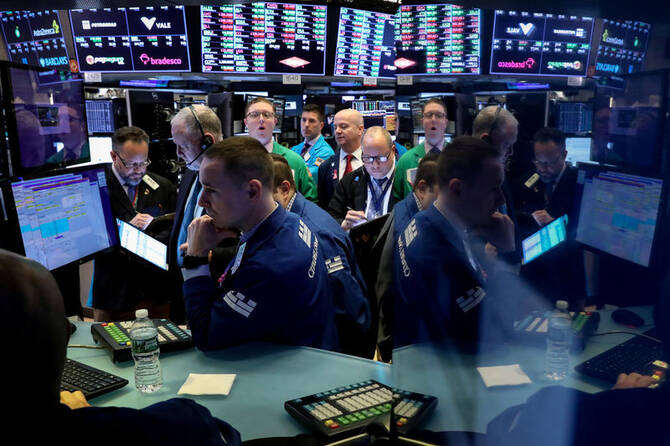
Investors on edge over Israel-Iran conflict, anti-Trump protests

Any damage to sentiment and the willingness to take risks could curb near-term gains in the S&P 500, which appears to have stalled after rallying from its early April trade war-induced market swoon. Reuters
Short Url
Updated 15 June 2025
Follow

Investors on edge over Israel-Iran conflict, anti-Trump protests

  • Israel launched a barrage of strikes across Iran on Friday and Saturday
  • Strikes knocked risky assets on Friday, including stocks

NEW YORK: Dual risks kept investors on edge ahead of markets reopening late on Sunday, from heightened prospects of a broad Middle East war to US-wide protests against US President Donald Trump that threatened more domestic chaos.

Israel launched a barrage of strikes across Iran on Friday and Saturday, saying it had attacked nuclear facilities and missile factories and killed a swathe of military commanders in what could be a prolonged operation to prevent Tehran building an atomic weapon.

Iran launched retaliatory airstrikes at Israel on Friday night, with explosions heard in Jerusalem and Tel Aviv, the country’s two biggest cities.

On Saturday Prime Minister Benjamin Netanyahu said Israeli strikes would intensify, while Tehran called off nuclear talks that Washington had held out as the only way to halt the bombing.

Israel on Saturday also appeared to have hit Iran’s oil and gas industry for the first time, with Iranian state media reporting a blaze at a gas field.

The strikes knocked risky assets on Friday, including stocks, lifted oil prices and prompted a rush into safe havens such as gold and the dollar.

Meanwhile, protests, organized by the “No Kings” coalition to oppose Trump’s policies, were another potential damper on risk sentiment. Hours before those protests began on Saturday, a gunman posing as a police officer opened fire on two Minnesota politicians and their spouses, killing Democratic state assemblywoman Melissa Hortman and her husband.

All three major US stock indexes finished in the red on Friday, with the S&P 500 dropping 1.14 percent. Oil and gold prices soaring. The dollar rose.

Israel and Iran are “not shadowboxing any more,” said Matt Gertken, chief geopolitical analyst at BCA Research. “It’s an extensive and ongoing attack.”

“At some point actions by one or the other side will take oil supply off the market” and that could trigger a surge in risk aversion by investors, he added.

Any damage to sentiment and the willingness to take risks could curb near-term gains in the S&P 500, which appears to have stalled after rallying from its early April trade war-induced market swoon. The S&P 500 is about 20 percent above its April low, but has barely moved over the last four weeks.

“The overall risk profile from the geopolitical situation is still too high for us to be willing to rush back into the market," said Alex Morris, chief investment officer of F/m Investments in Washington.

US stock futures are set to resume trading at 6 p.m. (2200 GMT) on Sunday.

With risky assets sinking, investors’ expectations for near-term stock market gyrations jumped.

The Cboe Volatility Index rose 2.8 points to finish at 20.82 on Friday, its highest close in three weeks.

The rise in the VIX, often dubbed the Wall Street ‘fear gauge,’ and volatility futures were “classic signs of increased risk aversion from equity market participants,” said Michael Thompson, co-portfolio manager at boutique investment firm Little Harbor Advisors.

Thompson said he would be watching near-term volatility futures prices for any rise toward or above the level for futures set to expire months from now.

“This would indicate to us that near-term hedging is warranted,” he said.

The mix of domestic and global tensions is a recipe for more uncertainty and unease across most markets, BCA’s Gertken said.

“Major social unrest does typically push up volatility somewhat, and adding the Middle Eastern crisis to the mix means it’s time to be wary.”


Industry leaders highlight Riyadh’s Metro, infrastructure as investment catalysts

Updated 29 December 2025
Follow

Industry leaders highlight Riyadh’s Metro, infrastructure as investment catalysts

RIYADH: Saudi Arabia’s capital, Riyadh, is experiencing a transformative phase in its real estate sector, with the construction market projected to reach approximately $100 billion in 2025, accompanied by an anticipated annual growth rate of 5.4 percent through 2029.

The Kingdom is simultaneously advancing its data center capacity at an accelerated pace, with an impressive 2.7 GW currently in the pipeline. This expansion underscores the critical role of strategic land and power planning in establishing national infrastructure as a cornerstone of economic growth.

These insights were shared by leading industry experts during JLL’s recent client event in Riyadh, which focused on the city’s macroeconomic landscape and emerging trends across office, residential, retail, hospitality, and pioneering sectors, including AI infrastructure and Transit-Oriented Development.

Saud Al-Sulaimani, Country Lead and Head of Capital Markets at JLL Saudi Arabia, commented: “Riyadh is positioned at the forefront of Saudi Arabia’s Vision 2030, offering unparalleled opportunities for both investors and developers. National priorities are continuously recalibrated to ensure strategic alignment of projects and foster deeper collaboration with the private sector.”

He added: “Recent regulatory developments, including the introduction of the White Land Tax and the rent freeze, are designed to stabilize the market and are expected to drive renewed focus on delivering premium-quality assets. This dynamic environment, coupled with evolving construction cost considerations in select segments, is fundamentally reshaping the market landscape while accelerating progress toward our national objectives.”

The event further underscored the transformative impact of infrastructure initiatives. Mireille Azzam Vidjen, Head of Consulting for the Middle East and Africa at JLL, highlighted Riyadh’s transit revolution. She detailed the Riyadh Metro, a $22.5 billion investment encompassing 176 kilometers, six lines, and 84 stations, providing extensive geographic coverage, with a depth of 9.8 km per 100 sq. km. This strategic development generates significant TOD opportunities, with properties in proximity potentially commanding a 20-30 percent premium. JLL emphasized the importance of implementing climate-responsive last-mile solutions to enhance mobility and accessibility, particularly given Riyadh’s extreme temperatures.

Gaurav Mathur, Head of Data Centers at JLL, emphasized the rapid expansion of the Kingdom’s AI infrastructure, signaling a critical area for technological investment and innovation.

Focusing on the construction sector, Maroun Deeb, Head of Projects and Development Services, KSA at JLL, explained that the industry is actively navigating complexities such as skilled labor availability, material costs, and supply chain dynamics.

He highlighted the adoption of Building Information Modeling as a key driver for enhancing operational efficiency and project delivery.