

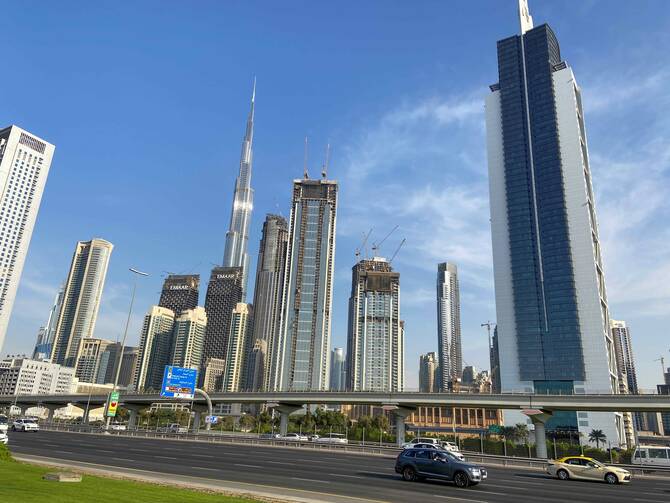

JEDDAH: The UAE’s gross domestic product reached 1.77 trillion dirhams ($481.4 billion) in 2024, recording 4 percent growth, with non-oil sectors contributing 75.5 percent of the total, highlighting diversification progress.
The Central Bank of the UAE has maintained its real GDP growth forecast at 4 percent for 2024, with an expected acceleration to 4.5 percent in 2025 and 5.5 percent in 2026.
According to the Central Bank’s Quarterly Economic Review for December 2024, this growth outlook was supported by strong performances in tourism, transportation, financial and insurance services, construction and real estate, and communication sectors.
In comparison, Saudi Arabia, the largest economy in the region, recorded a modest growth rate of 1.3 percent in 2024, with its non-oil sector contributing 54.8 percent of GDP as the Kingdom steadily advances its Vision 2030 reforms.

UAE Minister of Economy Abdulla bin Touq Al-Marri said the latest GDP figures released by the FCSC reflect a renewed and positive momentum in the national economy. File/WAM
Qatar’s economy expanded by 2.4 percent, supported by non-hydrocarbon activities comprising nearly 64 percent of GDP, reflecting ongoing efforts to broaden its economic base.
Oman’s GDP grew by 1.7 percent, driven by a 3.9 percent increase in non-oil activities, particularly in industry and services, while Kuwait’s economy contracted by 2.7 percent in 2024 due to lower oil revenues under extended OPEC+ cuts, though its non-oil sector showed relative resilience with stronger private sector credit growth.
According to the Federal Competitiveness and Statistics Centre, the non-oil GDP grew by 5 percent, totaling 1,342 billion dirhams, while oil-related activities contributed 434 billion dirhams to the overall economy.
Minister of Economy Abdulla bin Touq Al-Marri emphasized that the latest GDP figures released by the FCSC reflect a renewed and positive momentum in the national economy, according to the UAE’s official news agency.

Construction and building contributed 11.7 percent, while real estate activities accounted for 7.8 percent of the non-oil GDP. File/WAM
He added that they further underscore the new milestones achieved by the UAE in economic diversification and competitiveness, guided by the vision and directives of its leadership.
The minister emphasized that “these indicators reflect the sustained success of the nation’s economic strategies, which are driving the transition toward an innovative, knowledge-based, and sustainable economic model aligned with global trends and emerging technologies,” WAM reported.
“With each milestone, we are moving closer to achieving the UAE’s target of raising GDP to 3 trillion dirhams by the next decade, while reinforcing its position as a global hub for the new economy, driven by sustainable development, international competitiveness, and forward-looking leadership,” Al-Marri said, as per WAM.
FCSC Managing Director Hanan Mansour Ahli saId that the UAE’s 4 percent GDP growth in 2024 reflects the country’s strong economic performance, driven by a forward-looking vision centered on sustainable, non-oil-led development.

The Central Bank of the UAE has maintained its real GDP growth forecast at 4 percent for 2024, with an expected acceleration to 4.5 percent in 2025 and 5.5 percent in 2026. Wikipedia
As per the WAM report, the transport and storage sector was the fastest-growing contributor to the country’s GDP last year, expanding by 9.6 percent year-on-year. This surge was largely attributed to the outstanding performance of the country’s airports, which handled 147.8 million passengers, marking a rise of nearly 10 percent.
It added that the building and construction sector registered an 8.4 percent growth in 2024, driven by robust investments in urban infrastructure. Financial and insurance activities grew by 7 percent, while the hospitality sector, including hotels and restaurants, saw a 5.7 percent increase.
The real estate sector also posted a 4.8 percent rise during the same period.
Based on the FCSC findings, the news agency stated that with regard to non-oil economic activities that contributed most to the GDP, the trade sector contributed 16.8 percent, the manufacturing sector accounted for 13.5 percent, and financial and insurance activities contributed 13.2 percent.

The transport and storage sector was the fastest-growing contributor to the country’s GDP last year, expanding by 9.6 percent year-on-year. File/WAM
“Construction and building contributed 11.7 percent, while real estate activities accounted for 7.8 percent of the non-oil GDP,” it concluded.
According to WAM, passenger traffic through the UAE’s airports also saw a notable rise of 10 percent, reaching a total of 147.8 million travelers.
Meanwhile, financial and insurance activities grew by 7 percent, while the hospitality sector, including restaurants and hotels, expanded by 5.7 percent. The real estate sector posted a 4.8 percent growth, underscoring its continued importance in the nation’s economic landscape.


