


ISLAMABAD: Since seeing thousands of comments justifying the recent murder of a teenage TikTok star in Pakistan, Sunaina Bukhari is considering abandoning her 88,000 followers.
“In my family, it wasn’t an accepted profession at all, but I’d managed to convince them, and even ended up setting up my own business,” she said.
Then last week, Sana Yousaf was shot dead outside her house in the capital Islamabad by a man whose advances she had repeatedly rejected, police said.
News of the murder led to an outpouring of comments under her final post — her 17th birthday celebration where she blew out the candles on a cake.
In between condolence messages, some blamed her for her own death: “You reap what you sow” or “it’s deserved, she was tarnishing Islam.”
Yousaf had racked up more than a million followers on social media, where she shared her favorite cafes, skincare products and traditional shalwar kameez outfits.
TikTok is wildly popular in Pakistan, in part because of its accessibility to a population with low literacy levels. On it, women have found both audience and income, rare in a country where fewer than a quarter of the women participate in the formal economy.
But as TikTok’s views have surged, so have efforts to police the platform.
Pakistani telecommunications authorities have repeatedly blocked or threatened to block the app over what it calls “immoral behavior,” amid backlash against LGBTQ and sexual content.
TikTok has pledged to better moderate content and blocked millions of videos that do not meet its community guidelines as well as at the request of Pakistan authorities.
After Yousaf’s murder, Bukhari, 28, said her family no longer backs her involvement in the industry.
“I’m the first influencer in my family, and maybe the last,” she said.
Only 30 percent of women in Pakistan own a smartphone compared to twice as many men (58 percent), the largest gap in the world, according to the Mobile Gender Gap Report of 2025.
“Friends and family often discourage them from using social media for fear of being judged,” said a statement from the Digital Rights Foundation (DRF).
In southwestern Balochistan, where tribal law governs many rural areas, a man confessed to orchestrating the murder of his 14-year-old daughter earlier this year over TikTok videos that he said compromised her honor.
In October, police in Karachi, in the south, announced the arrest of a man who had killed four women relatives over “indecent” TikTok videos.
These murders each revive memories of Qandeel Baloch, dubbed Pakistan’s Kim Kardashian and one of the country’s first breakout social media stars whose videos shot her to fame.
After years in the spotlight, she was suffocated by her brother.
Violence against women is pervasive in Pakistan, according to the country’s Human Rights Commission, and cases of women being attacked after rejecting men are not uncommon.
“This isn’t one crazy man, this is a culture,” said Kanwal Ahmed, who leads a closed Facebook group of 300,000 women to share advice.
“Every woman in Pakistan knows this fear. Whether she’s on TikTok or has a private Instagram with 50 followers, men show up. In her DMs. In her comments. On her street,” she wrote in a post.
In the fifth-most-populous country in the world, where 60 percent of the population is under the age of 30, the director of digital rights organization Bolo Bhi, Usama Khilji, says “many women don’t post their profile picture, but a flower, an object, very rarely their face.”
“The misogyny and the patriarchy that is prevalent in this society is reflected on the online spaces,” he added.
A 22-year-old man was arrested over Yousaf’s murder and is due to appear in court next week.
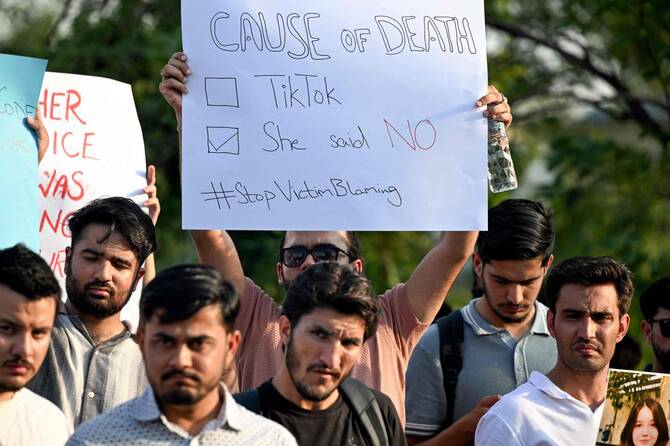
At a vigil in the capital last week, around 80 men and women gathered, holding placards that read “no means no.”
“Social media has given us a voice, but the opposing voices are louder,” said Hira, a young woman who joined the gathering.
The capital’s police chief, Syed Ali Nasir Rizvi, used a press conference to send a “clear message” to the public.
“If our sisters or daughters want to become influencers, professionally or as amateurs, we must encourage them,” he said.


