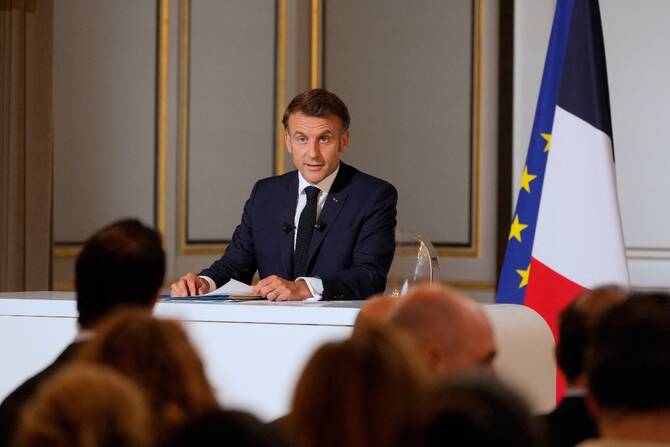
NUUK: French President Emmanuel Macron’s first trip to Greenland, the strategic Arctic island coveted by US President Donald Trump, is aimed at shoring up Europe’s political backing for Denmark and its semiautonomous territory.
Macron’s visit on Sunday comes just ahead a meeting of the Group of Seven leading industrialized nations next week in Canada that will be attended by both Macron and Trump.
The French president’s office said the trip to Greenland is a reminder that Paris supports principles of sovereignty, territorial integrity and the inviolability of borders as enshrined in the UN charter.
Macron is also to meet with Danish Prime Minister Mette Frederiksen and Greenlandic Prime Minister Jens-Frederik Nielsen.
Macron mentioned Greenland last week in his opening speech at the UN Ocean Conference, saying it isn’t “up for grabs” in remarks that appeared directed largely at Trump.
“The deep seas are not for sale, nor is Greenland up for grabs, nor are the Arctic or the high seas for sale, nor are fishing licenses in developing countries up for grabs, nor are scientific data and the security of coastal populations to be sacrificed,″ Macron said at the summit in Nice, France.
Macron’s role in Europe
Macron in recent months has sought to reinvigorate France’s role as the diplomatic and economic heavyweight of the 27-nation European Union.
The French president has positioned himself as a leader in Europe amid Trump’s threats to pull support from Ukraine as it fights against Russia’s invasion. Macron hosted a summit in Paris with other European heads of state to discuss Kyiv, as well as security issues on the continent.
Sunday’s visit will also be the occasion to discuss how to further enhance relations between the EU and Greenland when it comes to economic development, low-carbon energy transition and critical minerals. The leaders will also have exchanges on efforts to curb global warming, according to Macron’s office.
A meeting between Macron, Frederiksen and Nielsen will take place on a Danish helicopter carrier, showing France’s concerns over security issues in the region, Macron’s office said.
Trump and Greenland
Last week, US Defense Secretary Pete Hegseth appeared to acknowledge that the Pentagon has developed plans to take over Greenland and Panama by force if necessary but refused to answer repeated questions during a hotly combative congressional hearing Thursday about his use of Signal chats to discuss military operations.
Hegseth’s comments were the latest controversial remarks made by a member of the Trump administration about the Arctic island. The president himself has said he won’t rule out military force to take over Greenland, which he considers vital to American security in the high north.
The Wall Street Journal last month reported that several high-ranking officials under the US director of national intelligence, Tulsi Gabbard, had directed intelligence agency heads to learn more about Greenland’s independence movement and sentiment about US resource extraction there.
Nielsen in April said that US statements about the island have been disrespectful and that Greenland “will never, ever be a piece of property that can be bought by just anyone.”


![]()

Macron to visit Greenland to show European support for the strategic Arctic island coveted by Trump
Short Url
https://arab.news/vxtr5
Macron to visit Greenland to show European support for the strategic Arctic island coveted by Trump
- The French president mentioned Greenland last week in his opening speech at the UN Ocean Conference, saying it isn’t “up for grabs” in remarks that appeared directed largely at Trump


Latest updates


© 2026 SAUDI RESEARCH & PUBLISHING COMPANY, All Rights Reserved And subject to Terms of Use Agreement.