

Greenland ice melted much faster than average in May heatwave: scientists

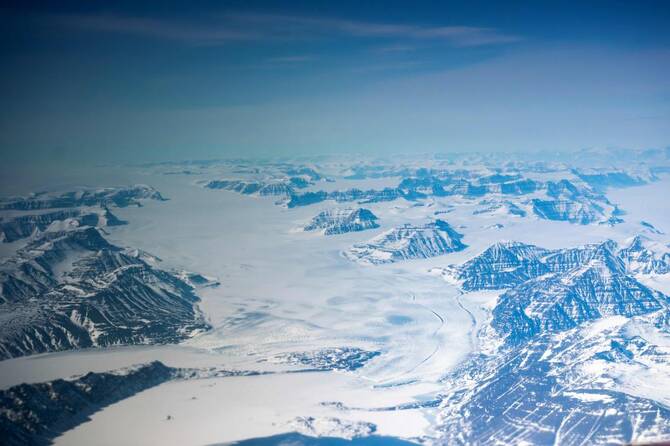
Above, sea ice melting on April 23, 2024 near Ittoqqortoormiit, Eastern Greenland. (AFP)
Short Url
Updated 11 June 2025
Follow

Greenland ice melted much faster than average in May heatwave: scientists

  • The Arctic region is on the frontline of global warming, heating up four times faster than the rest of the planet since 1979
  • In Greenland, the higher temperatures coupled with heavy rainfall can have numerous consequences on nature

COPENHAGEN: Greenland’s ice sheet melted 17 times faster than the past average during a May heatwave that also hit Iceland, the scientific network World Weather Attribution (WWA) said in a report Wednesday.

The Arctic region is on the frontline of global warming, heating up four times faster than the rest of the planet since 1979, according to a 2022 study in scientific journal Nature.

“The melting rate of the Greenland ice sheet by, from a preliminary analysis, a factor of 17... means the Greenland ice sheet contribution to sea level rise is higher than it would have otherwise been without this heat wave,” one of the authors of the report, Friederike Otto, told reporters.

“Without climate change this would have been impossible,” said Otto, an associate professor in climate science at the Imperial College London.

The data from the May 15-21, 2025 heatwave was compared to the average ice melt for the same week during the period 1980-2010.

In Iceland, the temperature exceeded 26 degrees Celsius (79 Fahrenheit) on May 15, unprecedented for that time of year on the subarctic island.

“Temperatures over Iceland as observed this May are record-breaking, more than 13 degrees Celsius hotter than the 1991-2020 average May daily maximum temperatures,” the WWA said.

In May, 94 percent of Iceland’s weather stations registered record temperatures, according to the country’s meteorological institute.

In eastern Greenland, the hottest day during the heatwave was about 3.9C warmer compared to the preindustrial climate, the WWA said.

“While a heatwave that is around 20 degrees Celsius might not sound like an extreme event from the experience of most people around the world, it is a really big deal for this part of the world,” Otto said.

“It affects the whole world massively,” she said.

According to the WWA, the record highs observed in Iceland and Greenland this May could reoccur every 100 years.

For Greenland’s indigenous communities, the warmer temperatures and melting ice affect their ability to hunt on the ice, posing a threat to their livelihood and traditional way of life.

The changes also affect infrastructure in the two countries.

“In Greenland and Iceland, infrastructure is built for cold weather, meaning during a heatwave ice melt can lead to flooding and damage roads and infrastructure,” the WWA said.

In Greenland, the higher temperatures coupled with heavy rainfall can have numerous consequences on nature.

In 2022, higher temperatures caused the permafrost to thaw, releasing iron and other metals into numerous Arctic lakes, it said.

Health and hygiene can also be affected, as rural Greenlandic households often lack sewage systems.


Canada PM Carney says can’t rule out military participation in Iran war

Updated 55 min 12 sec ago
Follow

Canada PM Carney says can’t rule out military participation in Iran war

  • Carney had said the US-Israeli strikes on Iran were “inconsistent with international law”
  • However, he supports the efforts to stop Iran from obtaining a nuclear weapon

CANBERRA, Australia: Canadian Prime Minister Mark Carney said Thursday that he couldn’t rule out his country’s military participation in the escalating war in the Middle East.
Carney’s visit to Australia this week has been overshadowed by expanding war in the Middle East, sparked by a massive US-Israeli strike on Iran that killed its supreme leader, Ayatollah Ali Khamenei.
Speaking alongside local counterpart Anthony Albanese in Canberra, Carney was asked whether there was a situation in which Canada would get involved.
“One can never categorically rule out participation,” he said, while stressing the question was a “hypothetical” one.
“We will stand by our allies,” said Carney, adding that “we will always defend Canadians.”
Carney had said the US-Israeli strikes on Iran were “inconsistent with international law.”
However, he supports the efforts to stop Iran from obtaining a nuclear weapon — a position that Canada takes “with regret” as it represented “another example of the failure of the international order.”
The Canadian leader reiterated on Thursday his call for a “de-escalation” of the conflict.
Carney’s trip is part of a multi-country tour of the Asia-Pacific aimed at reducing reliance on the United States — a hedge against what he has described as a fading US-led global order.
The Australia leg of the tour is aimed at bringing in investment and deepening ties with a like-minded “middle power” partner.

‘Middle power’ rallying cry

On Thursday morning he issued a rallying cry in Australia’s parliament to “middle powers,” urging them to work together in an increasingly hegemonic world order.
Nations like Australia and Canada faced a stark choice — work together to help write the “new rules” of the global order or have great powers do it for them, he said.
“In this brave new world, middle powers cannot simply build higher walls and retreat behind them. We must work together,” he said.
“Great powers can compel, but compulsion comes with costs, both reputational and financial,” the former central banker added.
“Middle powers like Australia and Canada hold this rare convening power because others know we mean what we say and we will match our values with our actions.”
The Canadian leader also said the two countries would together as “strategic collaborators” to pool their vast combined rare earth mineral resources.
And he detailed renewed cooperation in areas from defense to artificial intelligence.
“We know we must work with others who share our values to build solid capabilities,” he told parliament.
Otherwise, he warned, they risked being “caught between the hyperscalers and the hegemons.”
The Canadian leader has frequently clashed with US President Donald Trump, who has repeatedly threatened to annex Canada and slapped swingeing tariffs on the country.
In a speech to political and financial elites at the World Economic Forum in January, Carney warned the US?led global system of governance was enduring “a rupture.”