

Yemen’s Houthis target Israel with ballistic missiles in coordination with Iran

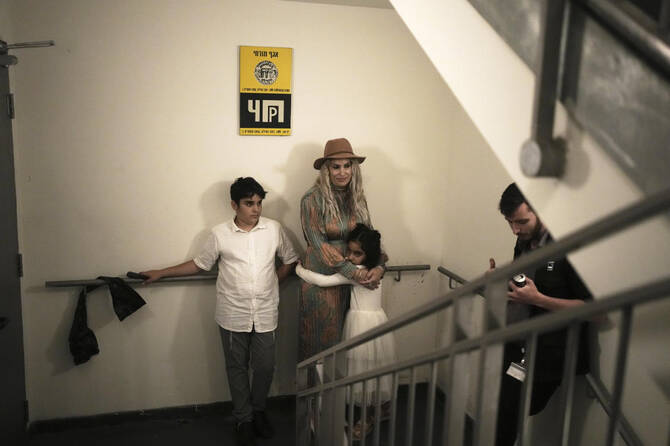
Residents take cover, as a siren sounds a warning following a missile that was launched from Yemen, in Jerusalem on June 13, 2025. (AP)
Short Url
Updated 17 June 2025
Follow

Yemen’s Houthis target Israel with ballistic missiles in coordination with Iran

  • The group has been launching attacks against Israel, most of which have been intercepted

CAIRO: Yemen’s Iran-aligned Houthis said on Sunday that they targeted central Israel’s Jaffa with several ballistic missiles in the last 24 hours in coordination with Iran, as Israel and Iran continued to exchange missile attacks.

The group has been launching attacks against Israel, most of which have been intercepted, in what they say is support for Palestinians in Gaza during the Israel-Hamas war there.


Israel bars Al-Aqsa imam from entering mosque in Ramadan

Updated 17 February 2026
Follow

Israel bars Al-Aqsa imam from entering mosque in Ramadan

  • ‘This ban is a grave matter for us as our soul is tied to Al-Aqsa, Al-Aqsa is our life’

JERUSALEM: A senior imam of the Al-Aqsa Mosque in East Jerusalem said on Tuesday that Israeli authorities had barred him from entering the compound, just days before the start of the holy month of Ramadan.

“I have been barred from the mosque for a week, and the order can be renewed,” Sheikh Muhammad Al-Abbasi said.
He said he was not informed of the reason for the ban, which came into effect from Monday.

FASTFACT

A Waqf source said 33 of its employees had been barred from entering the compound in the week leading up to Ramadan.

“I had only returned to Al-Aqsa a month ago after spending a year in the hospital following a serious car accident,” Abbasi said. “This ban is a grave matter for us, as our soul is tied to Al-Aqsa. Al-Aqsa is our life.”
On Monday, Israeli police said they had recommended issuing 10,000 permits for Palestinians from the occupied West Bank, who require special permission to enter Jerusalem.
Arad Braverman, a senior Israeli police officer in occupied Jerusalem, said forces would be deployed “day and night” across the compound.
He said thousands of police would also be on duty for Friday prayers, which draw the largest crowds of Muslim worshippers.
The Palestinian Jerusalem Governorate said it had been informed that permits would again be restricted to men over 55 and women over 50, mirroring last year’s criteria.
It added that Israeli authorities had prevented the Islamic Waqf — the Jordanian-run body that administers the site — from carrying out routine preparations, including installing shade structures and setting up temporary medical clinics.
A Waqf source said 33 of its employees had been barred from entering the compound in the week leading up to Ramadan.
Under long-standing arrangements, Jews may visit the Al-Aqsa compound —  but they are not permitted to pray there.
Palestinians fear the status quo it is being eroded.
In a separate development, Israeli NGOs have raised the alarm over a settlement plan signed by the government which they say would mark the first expansion of Jerusalem’s borders into the occupied West Bank since 1967. Palestinians view East Jerusalem as the capital of their future state.
The proposal, published in early February but reported by Israeli media only on Monday, comes as international outrage mounts over creeping measures aimed at strengthening Israeli control over the West Bank.
Critics say these actions by the Israeli authorities are aimed at the de facto annexation of the Palestinian territory.
The planned development, announced by Israel’s Ministry of Construction and Housing, is formally a westward expansion of the Geva Binyamin, or Adam, settlement situated northeast of Jerusalem in the West Bank.
In a statement, the ministry said the development agreement included the construction of around 2,780 housing units for the settlement, with an investment of roughly $38.7 million.
But the area to be developed lies on the Jerusalem side of the separation barrier built by Israel in the early 2000s, while Geva Binyamin sits on the West Bank side of the barrier, and the two are separated by a road.
Israeli settlement watchdog Peace Now said there would be no “territorial or functional connection” between the area to be developed and the settlement.
“The new neighborhood will be integral to the city of Jerusalem,” Lior Amihai, Peace Now’s executive director, said.
“What is unique about that one is that it will be connected directly to Jerusalem, but it will be beyond the annexed municipal border. So it will be in complete West Bank territory, but just adjacent to Jerusalem,” he said.