

Zelensky says Ukraine halted Russian troop advance in Sumy region

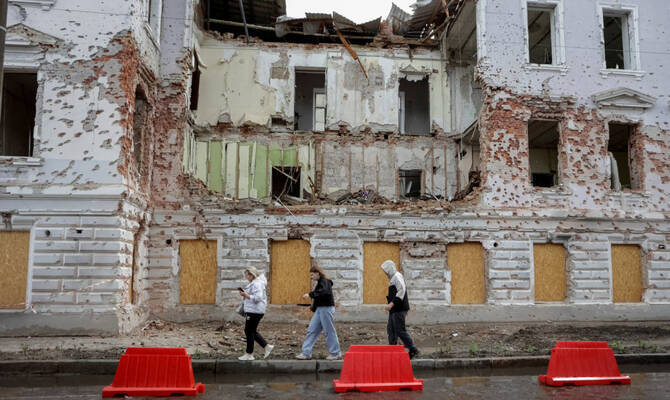
Residents walk near a damaged building in Sumy, Ukraine. (Reuters)
Short Url
Updated 14 June 2025
Follow

Zelensky says Ukraine halted Russian troop advance in Sumy region

  • Ukrainian forces are now battling to regain control along the border with Russia, President Volodymyr Zelensky says

KYIV: Ukrainian forces have stopped Russian troops advancing in the northeastern Sumy region and are now battling to regain control along the border with Russia, President Volodymyr Zelensky said.

In remarks released for publication by his office on Saturday, Zelensky said that Moscow has amassed about 53,000 troops in the direction of Sumy.

“We are leveling the position. The fighting there is along the border. You should understand that the enemy has been stopped there. And the maximum depth at which the fighting takes place is 7 km from the border,” Zelensky said.

Meanwhile, Ukraine and Russia conducted another POW swap — the fourth one in a week — the warring sides said on Saturday, under agreements reached in Istanbul earlier this month.

“We continue to take our people out of Russian captivity. This is the fourth exchange in a week,” President Zelensky wrote on social media.

“In accordance with the Russian-Ukrainian agreements ... another group of Russian servicemen was returned from the territory controlled by the Kyiv regime,” Russia’s Defense Ministry said on Telegram.

Kyiv also said it had received another batch of 1,200 unidentified bodies from Russia, which it said Russia claimed “belong to Ukrainian citizens, including military personnel,” as part of the Istanbul agreements as well.

Ukraine did not say whether it returned any bodies to Russia.

Some were injured, others disembarked from buses and hugged those welcoming them, or were seen calling someone by phone, sometimes covering their faces or smiling.

Moscow’s Defense Ministry released its own video showing men in uniforms holding Russian flags, clapping and chanting “Russia, Russia,” “glory to Russia” and “hooray,” some raising their fists in the air.


EU leaders work into the night to ease Belgian fears of Russian retaliation over a loan to Ukraine

Updated 58 min 32 sec ago
Follow

EU leaders work into the night to ease Belgian fears of Russian retaliation over a loan to Ukraine

BRUSSELS: European Union leaders worked into the night on Thursday, seeking to reassure Belgium that they would provide guarantees to protect it from Russian retaliation if it backs a massive loan for Ukraine. Ukraine’s Volodymyr Zelensky meanwhile pleaded for a quick decision to keep Ukraine afloat in the new year.
At a summit in Brussels with high stakes for both the EU and Ukraine, leaders of the 27-nation bloc discussed how best to use tens of billions of euros in frozen Russian assets to underwrite a loan to meet Ukraine’s military and financial needs over the next two years.
The bulk of the assets — some 193 billion euros  as of September — are held in the Brussels-based financial clearing house Euroclear. Russia’s Central Bank launched a lawsuit against Euroclear last week.
“Give me a parachute and we’ll all jump together,” Belgian Prime Minister Bart De Wever told lawmakers ahead of the summit. “If we have confidence in the parachute that shouldn’t be a problem.”
Belgian concerns over Russian pressure
Belgium fears that Russia will strike back and wants the bloc to borrow the money on international markets. It says frozen assets held in other European countries should be thrown into the pot as well, and that its partners should guarantee that Euroclear will have the funds it needs should it come under legal attack.
An estimated 25 billion euros  in Russian assets are frozen in banks and financial institutions in other EU countries, including France, Germany and Luxembourg.
The Russian Central Bank’s lawsuit ramped up pressure on Belgium and its EU partners ahead of the summit.
The “reparations loan” plan would see the EU lend 90 billion euros  to Ukraine. Countries like the United Kingdom, which said Thursday it is prepared to share the risk, as well as Canada and Norway would help make up any shortfall.
Russia’s claim to the assets would still stand, but the assets would remain locked away at least until the Kremlin ends its war on Ukraine and pays for the massive damage it caused.
In mapping out the loan plan, the European Commission set up safeguards to protect Belgium, but De Wever remained unconvinced and EU envoys were working late on Thursday to address his concerns.
Zelensky describes it as a moral question

Soon after arriving in Brussels, the Ukrainian president sat down with the Belgian prime minister to make his case for freeing up the frozen funds. The war-ravaged country is at risk of bankruptcy and needs new money by spring.
“Ukraine has the right to this money because Russia is destroying us, and to use these assets against these attacks is absolutely just,” Zelensky told a news conference.
In an appeal to Belgian citizens who share their leader’s worries about retaliation, Zelensky said: “One can fear certain legal steps in courts from the Russian Federation, but it’s not as scary as when Russia is at your borders.”
“So while Ukraine is defending Europe, you must help Ukraine,” he said.
Allies maintain support for Ukraine
Whatever method they use, the leaders have pledged to meet most of Ukraine’s needs in 2026 and 2027. The International Monetary Fund estimates that would amount to 137 billion euros .
“We have to find a solution today,” European Commission President Ursula von der Leyen told reporters. EU Council President António Costa, who is chairing the meeting, vowed to keep leaders negotiating until an agreement is reached, even if it takes days.
Polish Prime Minister Donald Tusk said it was a case of sending “either money today or blood tomorrow” to help Ukraine.
If enough countries object, the plan could be blocked. There is no majority support for a plan B of raising the funds on international markets, although that too was being discussed at the summit.
German Chancellor Friedrich Merz said that he hopes Belgium’s concerns can be addressed.
“The reactions of the Russian president in recent hours show how necessary this is. In my view, this is indeed the only option. We are basically faced with the choice of using European debt or Russian assets for Ukraine, and my opinion is clear: We must use the Russian assets.”
Hungary and Slovakia oppose a reparations loan. Apart from Belgium, Bulgaria, Italy and Malta are also undecided.
“I would not like a European Union in war,” said Hungarian Prime Minister Viktor Orbán, who sees himself as a peacemaker. He’s also Russian President Vladimir Putin’s closest ally in Europe. “To give money means war.”
Orbán described the loan plan as a “dead end.”
High stakes for the EU

The outcome of the summit has significant ramifications for Europe’s place in negotiations to end the war. The United States wants assurances that the Europeans are intent on supporting Ukraine financially and backing it militarily — even as negotiations to end the war drag on without substantial results.
The loan plan in particular also poses important challenges to the way the bloc goes about its business. Should a two-thirds majority of EU leaders decide to impose the scheme on Belgium, which has most to lose, the impact on decision-making in Europe would be profound.
The EU depends on consensus, and finding voting majorities and avoiding vetoes in the future could become infinitely more complex if one of the EU’s founding members is forced to weather an attack on its interests by its very own partners.
De Wever too must weigh whether the cost of holding out against a majority is worth the hit his government’s credibility would take in Europe.
Whatever is decided, the process does not end at this summit. Legal experts would have to convert any political deal into a workable agreement, and some national parliaments may have to weigh in before the loan money could start flowing to Ukraine.