

Israeli fire and airstrikes kill 35 in Gaza

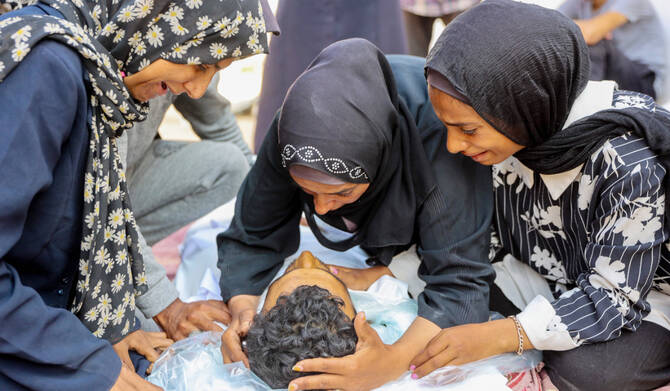
Women mourn over the body of a man killed during overnight Israeli bombardment on June 12, 2025, at al-Shifa hospital in Gaza City. (AFP)
Short Url
Updated 15 June 2025
Follow

Israeli fire and airstrikes kill 35 in Gaza

  • Hamas, which denies Israeli charges that it steals aid, accused Israel of “employing hunger as a weapon of war and turning aid distribution sites into traps of mass deaths of innocent civilians”

GAZA: Israeli fire and airstrikes killed at least 35 Palestinians across the Gaza Strip, most of them near an aid distribution site operated by the US-backed Gaza Humanitarian Foundation, local health authorities said.

Medics at Al-Awda and Al-Aqsa hospitals in central Gaza areas, where most of the casualties were moved to, said at least 15 people were killed as they tried to approach the GHF aid distribution site near the Netzarim corridor.

The rest were killed in separate attacks across the enclave, they added.

BACKGROUND

The Gaza Health Ministry said in a statement on Saturday that at least 274 people have so far been killed, and more than 2,000 wounded, near aid distribution sites since the Gaza Humanitarian Foundation began operations.

There has been no immediate comment by the Israeli military or the GHF on Saturday’s incidents.

The GHF began distributing food packages in Gaza at the end of May, overseeing a new model of aid distribution which the UN says is neither impartial nor neutral.

The Gaza Health Ministry said in a statement on Saturday that at least 274 people have so far been killed, and more than 2,000 wounded, near aid distribution sites since the GHF began operations in Gaza.

Hamas, which denies Israeli charges that it steals aid, accused Israel of “employing hunger as a weapon of war and turning aid distribution sites into traps of mass deaths of innocent civilians.”

Later on Saturday, health officials at Shifa Hospital in Gaza said Israeli fire killed at least 12 Palestinians, who gathered to wait for aid trucks along the coastal road north of the strip, taking Saturday’s death toll to at least 35.

The Israeli military ordered residents of Khan Younis and the nearby towns of Abassan and Bani Suhaila in the southern Gaza Strip to leave their homes and head west toward the so-called humanitarian zone, saying it would forcefully work against “terror organizations” in the area.

The war in Gaza erupted 20 months ago after militants raided Israel and took 251 hostages and killed 1,200 people on Oct. 7, 2023, Israel’s single deadliest day.

Israel’s military campaign has killed nearly 55,000 Palestinians, most of them civilians, according to health authorities in Gaza, and flattened much of the densely populated strip, which is home to more than 2 million people.

Most of the population is displaced, and malnutrition is widespread.

Despite efforts by the US, Egypt, and Qatar to restore a ceasefire in Gaza, neither Israel nor Hamas has shown willingness to back down on core demands, with each side blaming the other for the failure to reach a deal.


Aid workers find little life in El-Fasher after RSF takeover

Updated 11 sec ago
Follow

Aid workers find little life in El-Fasher after RSF takeover

  • First UN visit to the devastated Sudanese city finds traumatized civilians in ‘unsafe conditions’

PORT SUDAN: Traumatized civilians left in Sudan’s El-Fasher after its capture by paramilitary forces are living without water or sanitation in a city haunted by famine, UN aid coordinator Denise Brown said on Monday.
El-Fasher fell to the paramilitary Rapid Support Forces in October after more than 500 days of siege, and last Friday, a small UN humanitarian team was able to make its first short visit in almost two years.
Mass atrocities, including massacres, torture, and sexual violence, reportedly accompanied the capture of the city. Satellite pictures reviewed by AFP show what appear to be mass graves.

FASTFACT

From a humanitarian point of view, UN aid coordinator Denise Brown said, El-Fasher remains Sudan’s ‘epicenter of human suffering’ and the city — which once held more than a million people — is still facing a famine.

Brown described the city as a “crime scene,” but said human rights experts would carry out investigations while her office focuses on restoring aid to the survivors.
“We weren’t able to see any of the detainees, and we believe there are detainees,” she said.
From a humanitarian point of view, she said, El-Fasher remains Sudan’s “epicenter of human suffering” and the city — which once held more than a million people — is still facing a famine.
“El-Fasher is a ghost of its former self,” Brown said in an interview.
“We don’t have enough information yet to conclude how many people remain there, but we know large parts of the city are destroyed. The people who remain, their homes have been destroyed.”
“These people are living in very precarious situations,” warned Brown, a Canadian diplomat and the UN’s humanitarian coordinator in Sudan.
“Some of them are in abandoned buildings. Some of them ... in very rudimentary conditions, plastic sheeting, no sanitation, no water. So these are very undignified, unsafe conditions for people.”
Since April 2023, Sudan has been gripped by a conflict between the regular army and its former allies, the RSF, which has triggered a humanitarian catastrophe.
Brown said the team “negotiated hard with the RSF” to obtain access and managed to look around, visit a hard-pressed hospital, and some abandoned UN premises — but only for a few hours.
Their movements were also limited by fears of unexploded ordnance and mines left behind from nearly two years of fighting.
“There was one small market operating, mostly with produce that comes from surrounding areas, so tomatoes, onions, potatoes,” she said.
“Very small quantities, very small bags, which tells you that people can’t afford to buy more.”
“There is a declared famine in El-Fasher. We’ve been blocked from going in. There’s nothing positive about what’s happened in El-Fasher.
“It was a mission to test whether we could get our people safely in and out, to have a look at what remains of the town, who remains there, what their situation is,” she said.
The war in Sudan has killed tens of thousands of people, driven 11 million from their homes, and caused what the UN has declared “the world’s worst humanitarian disaster.”