


GENEVA: The US and Israeli-backed Gaza Humanitarian Foundation has been a failure from a humanitarian standpoint, the UN said on Friday.
The UN and major aid groups have refused to cooperate with the foundation over concerns it was designed to cater to Israeli military objectives.
“GHF, I think it’s fair to say, has been, from a principled humanitarian standpoint, a failure,” Jens Laerke, spokesman for the UN humanitarian agency OCHA, told a press briefing in Geneva.
“They are not doing what a humanitarian operation should do, which is providing aid to people where they are, safely and securely.
“We have the operation ready to roll with food and other supplies ready. We have them in the region; they are pre-cleared by the Israelis.
“We need the borders open to get in, and of course, we need the safety and security and some resemblance of law and order inside Gaza to distribute it.”
An officially private effort with opaque funding and backed by Israel, GHF began operations on May 26 after Israel completely cut off supplies into Gaza for more than two months, sparking warnings of mass famine.
GHF claimed on Thursday it had distributed nearly 2.6 million meals on Thursday and more than 18.6 million to date.
The Palestinian Authority said internet and fixed-line communication services were down in Gaza on Thursday following an attack on the territory’s last fiber optic cable, which it blamed on Israel.
“There was and still is a massive comms blackout,” said Laerke.
“If there is no communication, it really is damaging” for aid services, he said.
“There is an active effort to try to fix it, of course, and everybody is looking into that, because things kind of ground to a halt when these things happen.”
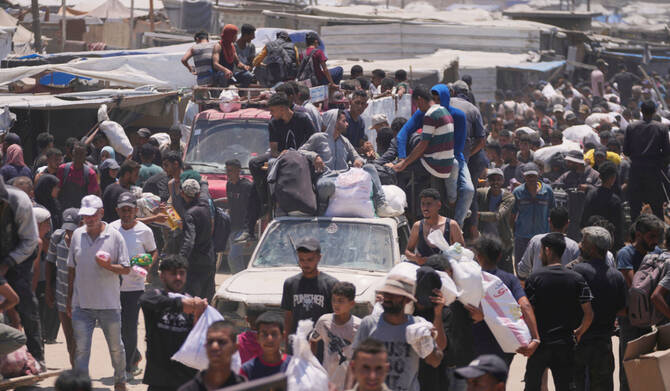
The distribution of food and basic supplies in the blockaded and war-ravaged Gaza has become increasingly fraught and perilous, exacerbating the territory’s deep hunger crisis.
The GHF said a bus carrying its staff to a distribution site near the southern city of Khan Younis was “brutally attacked by Hamas” around 10 p.m. on Wednesday.
Israel charged that Hamas was “weaponizing suffering in Gaza” after the US and the GHF accused the Palestinian group of killing its aid workers in the territory.
Asked to respond to the GHF accusation, the Hamas government media office in Gaza said GHF was a “filthy tool” of Israeli forces and was being used to “lure civilians into death traps.”
Dozens of Palestinians have been killed while trying to reach GHF distribution points since they began operating in late May, according to Gaza’s civil defense agency.
The agency said another 21 people were killed while waiting for aid on Thursday, adding that they were among 29 people across the territory who were killed by Israeli fire.
Contacted by AFP about reports of a deadly incident near an aid distribution point close to the Netzarim corridor in central Gaza, the Israeli military said it had “conducted warning shots hundreds of meters from the aid distribution site, prior to its opening hours.”
Gaza medics have said hospitals are being inundated with people wounded while trying to obtain food.
At Gaza City’s Al-Shifa Hospital on Wednesday, the emergency department said it had received dozens of people who had been killed or wounded while waiting for aid in recent days, including 200 in a single day.
“Many Gazans went to the Nabulsi and Netzarim areas to receive aid and were shot at and shelled with tanks,” said Mutaz Harara, head of Al-Shifa’s emergency department.
But with few medical supplies and no operating theaters, “many patients died while waiting for their turn,” he said.
The war has caused major damage to infrastructure across Gaza, including water mains, telecommunication cables, power lines, and roads.


