

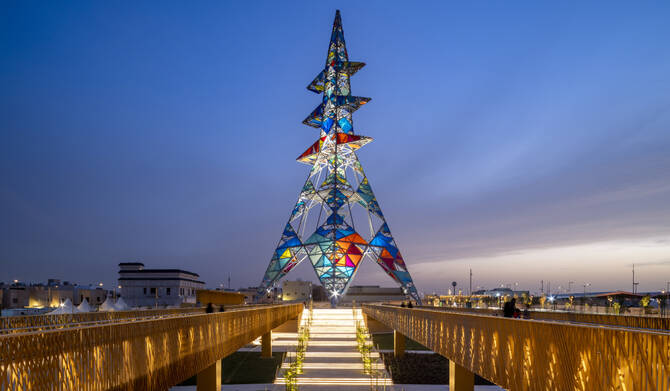

RIYADH: As you venture down the promenade of the capital’s latest attraction, Sports Boulevard, a new landmark is sure to catch your eye.
A tower at the intersection of Prince Mohammed bin Salman bin Abdulaziz Road and Prince Turki bin Abdulaziz Al-Awwal Road bursts with color and character.
The mind behind this work, named “The Arts Tower,” is renowned Saudi artist Abdulnasser Gharem, who has centered the mundane within the architectural landscape early on in his career with works like “Siraat” (The Path) and “Road to Makkah.”

The Arts Tower at the intersection of Prince Mohammed bin Salman bin Abdulaziz Road and Prince Turki bin Abdulaziz Al Awwal Road bursts with color and character. (Supplied)
Gharem told Arab News: “This piece is a witness to the transformation that’s happening here. It’s a symbol of investment into the cultural infrastructure as proof of how important that is to any society or community. I think the tower represents this transformation, especially that it, in itself, transforms one of the symbols of energy into a beacon for creative expression.”
Previously one of numerous 83.5-meter electricity pylons, the tower was meant to be removed for the sake of the Sports Boulevard project.
“I asked if I could have one,” Gharem said, explaining that, as one of the nominated artists to propose a work to beautify the boulevard, he was keen to use the existing structure.
HIGHLIGHTS
• The selected proposal features a total of 691 colored panels that were installed to bring the tower’s vibrant facade to life.
• The pieces used are all related to the grand narrative of the Kingdom, including economic diversity, cultural transformations, and social changes.
Author and curator Nato Thompson said about the work in a statement: “By repurposing a symbol of energy infrastructure and turning it into a beacon of artistic expression, Gharem highlights the evolving role of culture and art in Saudi Arabia’s development journey.
“It stands as living proof of the Kingdom’s commitment to nurturing its cultural landscape, making arts and creativity an inseparable part of its identity just as oil and energy were in the past.”
The selected proposal features a total of 691 colored panels that were installed to bring the tower’s vibrant facade to life.

Abdulnasser Gharem, Saudi artist
It utilizes elements from Saudi architecture and patterns we recognize from our old homes, primarily the triangular shape.
“I was lucky that the tower was made up of triangles, which is a geometrical shape that brings together the different regions of the Kingdom and the historical features of our beginnings, so it’s a symbol of unity,” Gharem said.
The pieces used are all related to the grand narrative of the Kingdom, including economic diversity, cultural transformations, and social changes.
This piece is a witness to the transformation that’s happening here. It’s a symbol of investment into the cultural infrastructure as proof of how important that is to any society or community.
Abdulnasser Gharem, Saudi artist
“The colors are alluding to the connection between our history and heritage and the concepts of cheerfulness and mental hospitality. A tower always forces you to look up.”
For Gharem, Saudi Arabia’s Vision 2030, like “The Arts Tower,” constantly lifts eyes upward, motivating people to leap from the familiar into the unexpected, pushing them to embrace the future with imagination.
“The piece is based on sunlight,” he said. “The daylight gives a completely, completely different dimension to the work compared to its urban illumination during the night.

The sketch of “The Arts Tower” by Abdulnasser Gharem. (Supplied)
“The colors do not just appear; they shift, transform, and come alive in different ways throughout the day. Here, nature becomes a crucial element to the structure.”
Even the wind has played a part in determining the number and placement of the colored pieces used. “It taught me that there needs to be some gaps in order to allow the piece to breathe and I was forced to humble myself upon the power of nature.
“The wind became my partner in design,” he said.
“The Arts Tower” is designed to make people feel represented and connected.
While the Sports Boulevard promotes physical activity, the creative landmark serves a deeper purpose: it is a thoughtful space meant to inspire human interaction and community — and more importantly, invite them to slow down, engage, and ponder the future.
“Culture is one of the key factors for our country’s development path. At the end of the day, culture is just as important as energy. It’s worth investing in, and it’s a certificate that the Kingdom is committed to nurturing its cultural scene,” Gharem said.


