

Pakistan warns of ‘first water war’ under nuclear shadow if India cuts off river flows

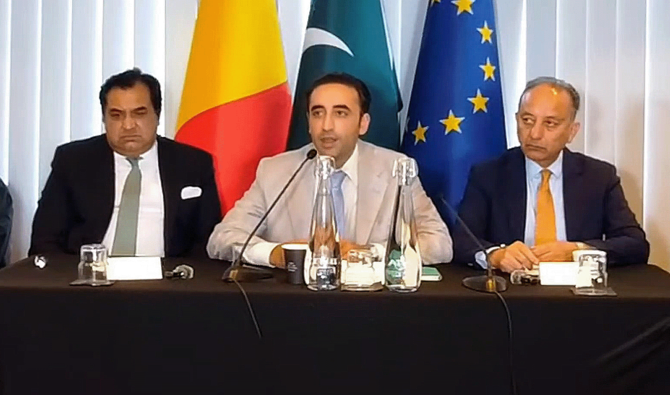
Pakistan's former Foreign Minister, Bilawal Bhutto Zardari (center) addressing to european union think tanks in Brussles, Belgium, on June 13, 2025. (@MediaCellPPP/X)
Short Url
Updated 13 June 2025
Follow

Pakistan warns of ‘first water war’ under nuclear shadow if India cuts off river flows

  • Bilawal Bhutto-Zardari calls Indus Waters Treaty ‘gold standard in diplomacy’ at a think tank in Brussels
  • He condemns Israel’s military strike on Iran, says the region cannot afford the war to continue for long

KARACHI: The head of Pakistan’s diplomatic mission touring world capitals to explain Islamabad’s position on a recent military standoff with New Delhi warned Friday India’s threat to cut off his country’s water supply could lead to the “first water war” between two nuclear-armed states at a think tank in Brussels.

The warning came after New Delhi announced in April it was suspending the 1960 Indus Waters Treaty, a World Bank-brokered agreement seen as a cornerstone of India-Pakistan water cooperation, following a deadly gun attack in Kashmir, which it blamed on Pakistan.

Islamabad denied any involvement and called for an impartial international probe. However, tensions quickly escalated, with both sides deploying fighter jets, missiles, drones and artillery fire before a US-brokered ceasefire was announced by President Donald Trump on May 10.

Bilawal Bhutto-Zardari, Pakistan’s former foreign minister and the current head of the country’s diplomatic outreach, told the European think tank India’s threat to disrupt river flows affecting 240 million people amounted to a “war crime.”

“It would turn this into an existential crisis, and we would be left with no choice but to embark on the first water war… between two nuclear-armed states,” he said.

Bhutto-Zardari described the Indus Waters Treaty as “the gold standard in diplomacy,” noting it had survived multiple wars and had been replicated in over 40 other international water-sharing agreements.

He said recent Indian actions, such as the delayed or excessive release of water, had already damaged Pakistan’s crops and posed a humanitarian risk.

“Just a few days’ delay in water release can have devastating consequences for our agriculture,” he said. “This is the only water supply into Pakistan. In the context of climate vulnerability, the last thing we need is a fault line developing where cooperation once existed.”

His other delegation members maintained undermining the treaty would set a dangerous global precedent, allowing upper riparian states anywhere in the world to disregard binding water-sharing agreements.

“If this treaty is in abeyance, then no treaty signed after World War II is worth the paper it’s written on,” Musadik Malik, the climate change minister, said. “That threatens the rights of lower riparian countries across Africa, South America and beyond.”

Earlier, in a brief exchange with reporters, Bhutto-Zardari welcomed renewed interest from Washington in mediating between India and Pakistan.

“As you have seen, President [Donald] Trump said once again yesterday that he is ready to mediate on Kashmir,” he noted. “At the moment, Pakistan is talking about peace, America is also talking about peace. If anyone is still talking about war, it is India, and, by the grace of God, they will step back from this position soon.”

Responding to a query, Bhutto-Zardari strongly condemned Israel’s military operations against Iran and its broader regional policies.

“We strongly oppose the attack on Iran and the way the war is being waged in this region,” he said. “No amount of condemnation is enough. We demand that this war be stopped and that the entire world plays its role. Peace is very important in our territory. We cannot afford Israel’s war on Iran to continue for long.”


Pakistan says responding to Afghan ‘offensive operations’ after border fire as tensions escalate

Updated 26 February 2026
Follow

Pakistan says responding to Afghan ‘offensive operations’ after border fire as tensions escalate

  • Afghan Taliban spokesperson says “large-scale offensive operations” launched against Pakistani military bases
  • Pakistan says Afghan forces opened “unprovoked” fire across multiple sectors along shared border

ISLAMABAD: Afghanistan’s Taliban authorities said on Thursday they had launched “large-scale offensive operations” against Pakistani military bases and installations, prompting Pakistan to say its forces were responding to what it described as unprovoked fire along the shared border.

The escalation follows Islamabad’s weekend airstrikes targeting what it said were Tehreek-e-Taliban Pakistan (TTP) and Daesh militant camps inside Afghanistan in response to a wave of recent bombings and attacks in Pakistan. Islamabad said the strikes killed over 100 militants, while Kabul said dozens of civilians were killed and condemned the attacks as a violation of its sovereignty.

In a post on social media platform X, Afghan government spokesperson Zabihullah Mujahid said Afghanistan had launched “large-scale offensive operations” in response to repeated violations by the Pakistani military.


Pakistan’s Ministry of Information said Afghan forces had initiated hostilities along multiple points of the frontier.

“Afghan Taliban regime unprovoked action along the Pakistan–Afghanistan border given an immediate, and effective response,” the ministry said in a statement.

The statement said Pakistani forces were targeting Taliban positions in the Chitral, Khyber, Mohmand, Kurram and Bajaur sectors, claiming heavy Afghan casualties and the destruction of multiple posts and equipment. It added that Pakistan would take all necessary measures to safeguard its territorial integrity and the security of its citizens.


Separately, security officials said Pakistani forces had carried out counterattacks in several border sectors.

“Pakistan’s security forces are giving a befitting reply to the unprovoked Afghan aggression with full force,” a security official said, declining to be named. 

“The Pakistani security forces’ counter-attack destroyed Taliban’s hideouts and the Khawarij fled,” they added, referring to TTP militants. 

The claims from both sides could not be independently verified.

Cross-border violence has intensified in recent weeks, with Pakistan blaming a surge in suicide bombings and militant attacks on militants it says are based in Afghanistan. Kabul denies providing safe havens to anti-Pakistan militant groups.

The clashes mark the third major escalation between the neighbors in less than a year. Similar Pakistani strikes last year triggered weeklong clashes before Qatar, Türkiye and other regional actors mediated a ceasefire in October.

The 2,600-kilometer (1,600-mile) frontier, a key trade and transit corridor linking Pakistan to landlocked Afghanistan and onward to Central Asia, has faced repeated closures amid tensions, disrupting commerce and humanitarian movement. Trade between the two nations has remained closed since October 2025.