

Pakistan PM meets UAE president, thanks him for role in defusing India tensions

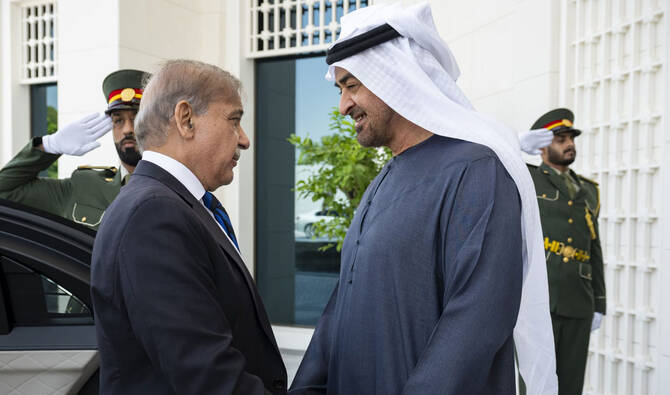
In this handout photo, released by Pakistan Prime Minister Office, United Arab Emirates President Sheikh Mohamed bin Zayed Al Nahyan receives Pakistan Prime Minister Shehbaz Sharif at the Qasr Al Shati in Abu Dhabi, UAE on June 12, 2025. (PMO/Handout)
Short Url
Updated 12 June 2025
Follow

Pakistan PM meets UAE president, thanks him for role in defusing India tensions

  • Leaders agreed to maintain close coordination, work together “to advance shared goals of regional peace and prosperity”
  • Saudi Arabia and the UAE were widely reported to have played a significant role in back-channel diplomacy last month

ISLAMABAD: Pakistani Prime Minister Shehbaz Sharif on Thursday met United Arab Emirates President Sheikh Mohamed bin Zayed Al Nahyan and thanked him for his government’s efforts in defusing last month’s military conflict with India.

Sharif, who arrived in the UAE earlier in the day, held talks with the Emirati leader on bilateral, regional, and global issues. He had previously met Sheikh Mohamed in February while attending the World Government Summit in Dubai.

According to a statement from the PM’s office, Sharif specifically appreciated the UAE’s “constructive role in promoting peace and stability in the region, including its efforts to de-escalate tensions between Pakistan and India.”

“Both sides expressed satisfaction over the positive trajectory of bilateral ties and ongoing engagements at all levels,” the statement added. “The leaders agreed to maintain close coordination and continue working together to advance shared goals of regional peace and prosperity.”


In this handout photo, released by Pakistan Prime Minister Office, Pakistan Prime Minister Shehbaz Sharif speaks during a meeting with United Arab Emirates President Sheikh Mohamed bin Zayed Al Nahyan at the Qasr Al Shati in Abu Dhabi, UAE on June 12, 2025. (PMO/Handout)

Between May 7 and 10, nuclear-armed neighbors India and Pakistan exchanged drone, missile, and artillery strikes in their worst cross-border escalation in years. A ceasefire was later brokered by the United States, but Gulf states, particularly Saudi Arabia and the UAE, were widely reported to have played a quiet but significant role in back-channel diplomacy.

During Thursday’s meeting, Sharif also extended a renewed invitation for Sheikh Mohamed to visit Pakistan.

The UAE is one of Pakistan’s most important regional partners, with cooperation spanning trade, investment, defense, energy, and diaspora affairs. Roughly 1.5 million Pakistanis live in the UAE, making it the second-largest overseas Pakistani population after Saudi Arabia.

The UAE is also the second-largest source of remittances to Pakistan behind Saudi Arabia and in May sent $754.2 million home, according to the State Bank of Pakistan.

Bilateral ties have deepened in recent years, especially in areas like infrastructure, renewable energy and logistics. In May 2024, the UAE pledged to invest $10 billion in Pakistan’s key economic sectors as part of its long-term regional economic strategy.

Pakistan needs foreign investment to boost its economy and shore up its currency reserves to meet rising external repayment obligations as it treads a tricky path to economic recovery under a $7 billion IMF bailout deal.


Pakistan, ADB sign $730 loan agreements to boost SOE reforms, energy infrastructure

Updated 25 December 2025
Follow

Pakistan, ADB sign $730 loan agreements to boost SOE reforms, energy infrastructure

  • Both sign $330 million Power Transmission Strengthening Project and $400 million SOE Transformation Program loan agreements
  • Economic Affairs Division official says Transmission Project will secure Pakistan’s energy future by strengthening national grid’s backbone

KARACHI: Pakistan and the Asian Development Bank (ADB) on Thursday signed two loan agreements totaling $730 million to boost reforms in state-owned enterprises (SOEs) and energy infrastructure in the country, the bank said.

The first of the two agreements pertains to the SOE Transformation Program worth $400 million while the second loan, worth $330 million, is for a Power Transmission Strengthening Project, the lender said. 

The agreements were signed by ADB Country Director for Pakistan Emma Fan and Pakistan’s Secretary of Economic Affairs Division Humair Karim. 

“The agreements demonstrate ADB’s enduring commitment to supporting sustainable and inclusive economic growth in Pakistan,” the ADB said. 

Pakistan’s SOEs have incurred losses worth billions of dollars over the years due to financial mismanagement and corruption. These entities, including the country’s national airline Pakistan International Airlines, which was sold to a private group this week, have relied on subsequent government bailouts over the years to operate.

The ADB approved the $400 million loan for SOE reforms on Dec. 12. It said the program seeks to improve governance and optimize the performance of Pakistan’s commercial SOEs. 

Karim highlighted that the Power Transmission Strengthening Project will enable reliable evacuation of 2,300 MW from Pakistan’s upcoming hydropower projects, relieve overloading of existing transmission lines and enhance resilience under contingency conditions, the Press Information Department (PID) said. 

“The Secretary emphasized that both initiatives are transformative in nature as the Transmission Project will secure Pakistan’s energy future by strengthening the backbone of the national grid whereas the SOE Program will enhance transparency, efficiency and sustainability of state-owned enterprises nationwide,” the PID said. 

The ADB has supported reforms by Pakistan to strengthen its public finance and social protection systems. It has also undertaken programs in the country to help with post-flood reconstruction, improve food security and social and human capital. 

To date, ADB says it has committed 764 public sector loans, grants and technical assistance totaling $43.4 billion to Pakistan.