

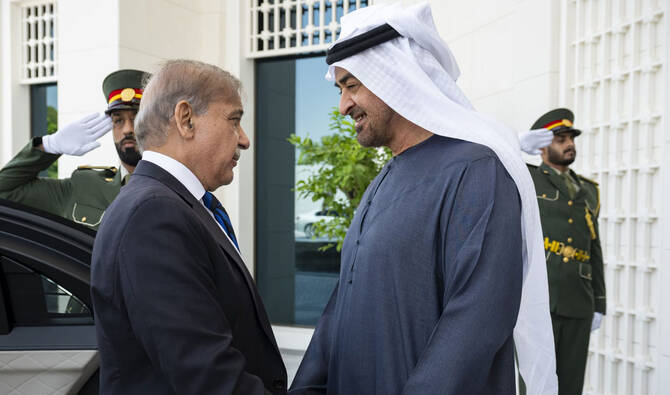

ISLAMABAD: Pakistani Prime Minister Shehbaz Sharif on Thursday met United Arab Emirates President Sheikh Mohamed bin Zayed Al Nahyan and thanked him for his government’s efforts in defusing last month’s military conflict with India.
Sharif, who arrived in the UAE earlier in the day, held talks with the Emirati leader on bilateral, regional, and global issues. He had previously met Sheikh Mohamed in February while attending the World Government Summit in Dubai.
According to a statement from the PM’s office, Sharif specifically appreciated the UAE’s “constructive role in promoting peace and stability in the region, including its efforts to de-escalate tensions between Pakistan and India.”
“Both sides expressed satisfaction over the positive trajectory of bilateral ties and ongoing engagements at all levels,” the statement added. “The leaders agreed to maintain close coordination and continue working together to advance shared goals of regional peace and prosperity.”

In this handout photo, released by Pakistan Prime Minister Office, Pakistan Prime Minister Shehbaz Sharif speaks during a meeting with United Arab Emirates President Sheikh Mohamed bin Zayed Al Nahyan at the Qasr Al Shati in Abu Dhabi, UAE on June 12, 2025. (PMO/Handout)
Between May 7 and 10, nuclear-armed neighbors India and Pakistan exchanged drone, missile, and artillery strikes in their worst cross-border escalation in years. A ceasefire was later brokered by the United States, but Gulf states, particularly Saudi Arabia and the UAE, were widely reported to have played a quiet but significant role in back-channel diplomacy.
During Thursday’s meeting, Sharif also extended a renewed invitation for Sheikh Mohamed to visit Pakistan.
The UAE is one of Pakistan’s most important regional partners, with cooperation spanning trade, investment, defense, energy, and diaspora affairs. Roughly 1.5 million Pakistanis live in the UAE, making it the second-largest overseas Pakistani population after Saudi Arabia.
The UAE is also the second-largest source of remittances to Pakistan behind Saudi Arabia and in May sent $754.2 million home, according to the State Bank of Pakistan.
Bilateral ties have deepened in recent years, especially in areas like infrastructure, renewable energy and logistics. In May 2024, the UAE pledged to invest $10 billion in Pakistan’s key economic sectors as part of its long-term regional economic strategy.
Pakistan needs foreign investment to boost its economy and shore up its currency reserves to meet rising external repayment obligations as it treads a tricky path to economic recovery under a $7 billion IMF bailout deal.


