

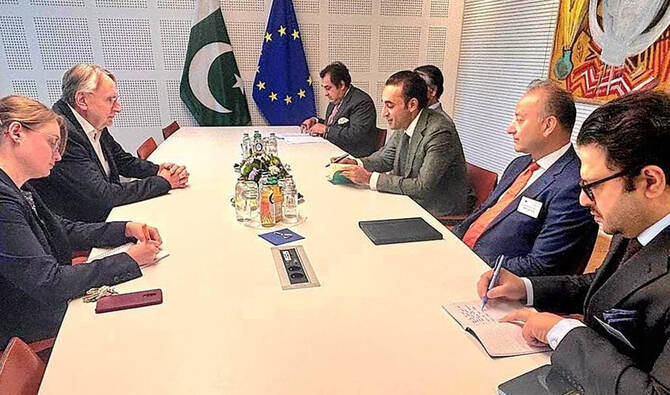

KARACHI: A high-level Pakistani delegation visiting Brussels on Thursday urged European Union officials to support the continuation of Pakistan’s preferential trade access under the GSP+ scheme, while also raising concern over India’s alleged violations of the Indus Waters Treaty.
The delegation, led by former foreign minister Bilawal Bhutto Zardari, met with Bernd Lange, chair of the European Parliament’s International Trade Committee, to discuss regional tensions following a recent military escalation with India, the worst confrontation between the nuclear-armed neighbors in decades.
The group previously visited Washington and London as part of a broader diplomatic effort to rally international support after the conflict in which the two nations exchanged drones, missiles, and artillery strikes between May 7-10 before a ceasefire was announced. Since then, both countries have launched diplomatic offensives to present their narratives on the conflict and its causes.
“We just had a meeting with their [EU] trade representative, where we conveyed Pakistan’s message of peace,” Bhutto Zardari told reporters after the meeting.
“In that context, we specifically raised the decisions related to the Indus Waters Treaty, which are violations of international law, and in the EU context, they strongly believe in respecting treaties and adhering to international law. So, in that context, we pitched our case.”
The 1960 Indus Waters Treaty, brokered by the World Bank, governs the distribution of water from the Indus River system between India and Pakistan. Islamabad has expressed alarm in recent months over what it sees as India’s unilateral actions affecting river flows, warning that any withdrawal from or violation of the treaty could destabilize water access for millions of people in the region.
Bhutto Zardari emphasized that Pakistan seeks engagement over confrontation with India, citing terrorism, the longstanding Kashmir territorial dispute, and water issues as areas that require dialogue.
“There should be engagement with India, whether on the issue of terrorism, the Kashmir dispute, or, of course, the critical issue of water, so that solutions can be found,” he said.
Bhutto Zardari also thanked the European Union for expressing condolences over Pakistani casualties in the recent clashes with India and praised the bloc’s commitment to international norms.
“If you look at this recent conflict, the violation of international law has been committed by one side, and that side is not Pakistan,” he said.
Musadiq Malik, Pakistan’s federal minister for water resources and another member of the delegation, warned EU officials of the wider implications of undermining water treaties.
“If India is given the right to exit the Indus Waters Treaty, then 70 percent of the world’s countries that are lower riparian, whose populations depend on drinking water, agriculture, and life itself, will face destruction,” Malik said.
He urged the international community to preserve a rules-based global order.
“Because if we do not, remember, in the Wild West, the one with the faster gun ruled,” he added.
Former ambassador Jalil Abbas Jilani, also part of the delegation, said the team had requested continued EU support for Pakistan under the Generalized Scheme of Preferences Plus (GSP+), which allows duty-free or low-duty access for developing countries to the European market in exchange for progress on human rights, labor standards, environmental protection, and good governance.
“We requested them to continue their support for GSP+, as they have in the past,” Jilani said. “We hope the European Union will take into consideration Pakistan’s need for the GSP+ status and will play a role in its continuation.”
The current GSP+ arrangement, which has significantly boosted Pakistan’s textile exports to the EU, is due for review as the bloc finalizes the next phase of its trade preference program. The scheme has played a key role in supporting Pakistan’s exports, particularly in the garment sector, which employs millions.
Pakistan GSP+ benefits were extended last year until 2027.


