

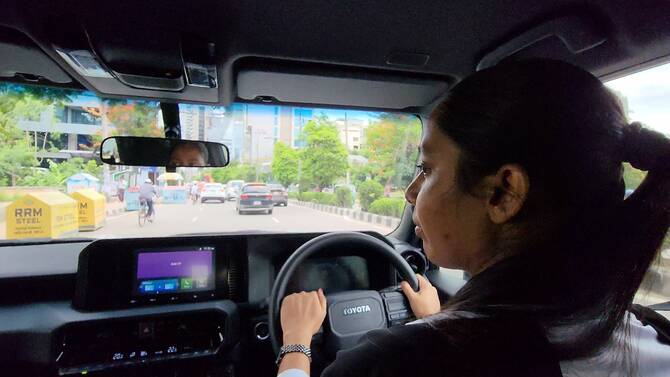

DHAKA: When Sharmin Akter Pinky sat behind the steering wheel for the first time, it was because of her aunt, who encouraged her to venture into a field which, in Bangladesh, had traditionally been dominated by men.
“She used to inspire me to be an independent woman and to do something with my own abilities,” Pinky told Arab News.
Her aunt saw women learning to drive at a school in Dhaka and convinced the rest of the family that it would be the right path for her niece as well.
“She kept insisting that if the other girls could do it, I would also be able to do the same,” Pinky said.
“This is how I stepped into this driving career, with the support of my parents, uncle, and aunt.”
Pinky was 20 at the time. Now, eight years later, she is a professional driver working with the Food and Agriculture Organization of the UN.
The all-female driving school she enrolled in was opened by BRAC (Bangladesh Rural Advancement Committee), Bangladesh’s largest development organization, in 2012. Each year, more and more women have been taking the classes — making the wheel their tool for earning a livelihood and building a career.
“There was a time when people had a very negative mindset about girls entering the driving profession, but things have improved a lot since then. I would encourage more women to take it up. Girls should be independent and explore the world around them,” Pinky said.
For her, it also comes with a personal mission to help empower others who may not have had as much support from their families as she did.
In Pinky’s village, it was not widely accepted that women could work.
She said: “In the early days, when I went back to the village during holidays, people would say things like ‘This isn’t a respectable job,’ or ‘You’ll have trouble getting married,’ or ‘You might fall in with the wrong crowd.’
“But my father always stood by me. He told me not to listen to what people around us said. He encouraged me to focus on being a good human being, doing honest work, and helping others improve their lives.
“Later, I brought two other girls from my village, arranged driving training for them, and helped them find jobs. Now, people admit that driving can be a good job for women too. I feel proud I have started something.”
For Sharmina Akter Banu, who now also works at FAO, driving offered a means of survival.
When her father and husband passed away, she was left alone caring for her 18-month-old child, younger siblings, and mother.
“I received an offer from the BRAC Driving School to take driving training. I completed the training over a period of three months. After that, I got a job as a professional driver,” she said.
“At that time all of my siblings were still attending school. With the income from my driving job, I took on the responsibility of supporting my younger siblings. Thanks to that, all of them were able to complete their education.”
Banu’s younger brother is now pursuing his honors degree, and her son is completing high school.
The job has become a source of pride for her. She has a stable profession, is financially independent, has been able to support her family, and feels like an equal member of society.
“I’m surrounded by many male drivers and, among them, I am the only female. It’s a matter of pride for me, because as a woman I’ve been able to work in this challenging profession alongside men,” she said.
“Wherever I notice a female driver, it fills my heart with joy. More and more girls are coming into this profession. And they are doing well.”
Banu and Pinky are among more than 3,500 professional women drivers trained by BRAC. They come from various parts of Bangladesh and different backgrounds.
“We have BRAC’s network in the remotest parts of the country … We receive applications from minorities and underprivileged women,” Abdul Quddus, who is in charge of the organization’s driving schools, told Arab News.
“After receiving training, the female drivers start working at different organizations, especially with international NGOs … To date, all the women who received professional driving training from us are doing well at their workplaces.”
They are contributing not only to the workforce and efforts to change social norms, but also to improving road safety in a country where traffic accidents are common.
“The society has now mostly overcome the stereotype that driving is mostly a male job,” Quddus said.
“Women can play a significant role in ensuring road safety. They don’t get involved in risky driving like men, and they are more respectful of the traffic rules.”


