

Bangladesh’s Yunus says will step down after polls

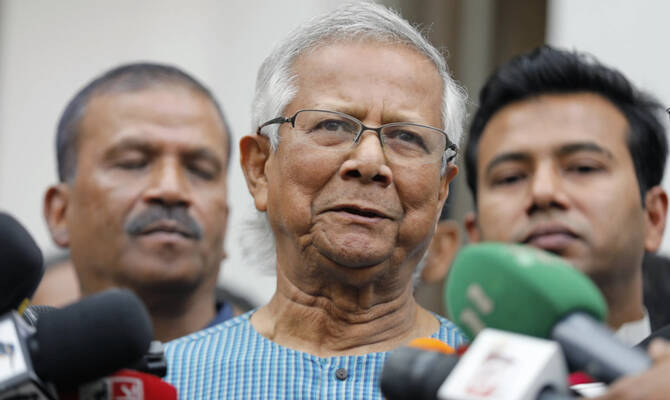
Bangladesh interim leader Mohammed Yunus said Wednesday that there was “no way” he wanted to continue in power after elections. (AP)
Short Url
Updated 11 June 2025
Follow

Bangladesh’s Yunus says will step down after polls

  • Yunus has long said elections will be held before June 2026, but says the more time the interim administration had to enact reforms, the better

LONDON: Bangladesh interim leader Mohammed Yunus said Wednesday that there was “no way” he wanted to continue in power after elections he has announced for April, the first since a mass uprising overthrew the government.

The South Asian nation of around 170 million people has been in political turmoil since a student-led revolt ousted then-Prime Minister Sheikh Hasina in August 2024, ending her 15-year rule.

Speaking in London, Yunus, asked if he himself was seeking any political post, the 84-year-old Nobel Peace Prize winner said there was “no way,” waving his hands in the air for emphasis.

“I think none of our Cabinet members would like to do that, not only me,” he said.

Yunus was answering questions after speaking at London’s foreign policy think tank Chatham House, the Royal Institute of International Affairs.

He also said he wanted to unveil a “big package” of proposals next month that he dubbed a “July Charter” — one year on since the students launched the demonstrations that toppled Hasina.

The aim of the package, he added, was to overhaul democratic institutions after Hasina’s tenure.

“We want to say goodbye to the old Bangladesh and create a new Bangladesh,” Yunus said.

The charter is being drafted by a government “consensus commission,” talking to political parties to “find that which are the recommendations they will accept,” he added.

Yunus has long said elections will be held before June 2026, but says the more time the interim administration had to enact reforms, the better.

But after political parties jostling for power repeatedly demanded he fix a timetable, he said earlier this month that elections would be held in April 2026.

“Our job is to make sure that the transition is managed well, and that people are happy when we hand over power to the elected government,” he said.

“So we want to make sure that the election is right, that is a very critical factor for us. If the election is wrong, this thing will never be solved again.”

Yunus is also expected to meet in London with Tarique Rahman, acting chairman of Bangladesh Nationalist Party, which is widely seen as likely to sweep the elections.

Rahman, 59, the son of former Prime Minister Khaleda Zia, has lived in London since 2008 after being sentenced in absentia under Hasina — convictions since quashed.

He is widely expected to return to Dhaka to lead the party in polls.


Al-Shabab extremists are greatest threat to peace in Somalia and the region, UN experts say

Updated 5 sec ago
Follow

Al-Shabab extremists are greatest threat to peace in Somalia and the region, UN experts say

  • The UN Security Council on Tuesday voted unanimously to extend authorization for the African Union’s “support and stabilization” force in Somalia until Dec. 31, 2026

UNITED NATIONS: The Al-Shabab extremist group remains the greatest immediate threat to peace and stability in Somalia and the region, especially Kenya, UN experts said in a report released Wednesday.
Despite ongoing efforts by Somali and international forces to curb operations by Al-Qaeda-linked Al-Shabab, “the group’s ability to carry out complex, asymmetric attacks in Somalia remains undiminished,” the experts said.
They said the threat comes not only from Al-Shabab’s ability to strike — including within the capital, Mogadishu, where it attempted to assassinate the president on March 18 — but from its sophisticated extortion operations, forced recruitment and effective propaganda machine.
The UN Security Council on Tuesday voted unanimously to extend authorization for the African Union’s “support and stabilization” force in Somalia until Dec. 31, 2026. The force includes 11,826 uniformed personnel, including 680 police.
The extremist group poses a significant threat to neighboring Kenya “by conducting attacks that vary from attacks with improvised explosive devices, which predominantly target security personnel, to attacks on infrastructure, kidnappings, home raids and stealing of livestock,” the experts said.
This year, Al-Shabab averaged around six attacks a month in Kenya, mostly in Mandera and Lamu counties, which border Somalia in the northeast, the panel said.
The experts said Al-Shabab’s goal remains to remove Somalia’s government, “rid the country of foreign forces and establish a Greater Somalia, joining all ethnic Somalis across east Africa under strict Islamic rule.”
The panel of experts also investigated the Islamic State’s operations in Somalia and reported that fighters were recruited from around the world to join the extremist group, the majority from east Africa. At the end of 2024, they said the group known as ISIL-Somalia had a fighting force of over 1,000, at least 60 percent of them foreign fighters.
“Although small in terms of numbers and financial resources compared with Al-Shabab, the group’s expansion constituted a significant threat to peace and security in Somalia and the broader region,” the panel said.