

Bangladesh’s Yunus says will step down after polls

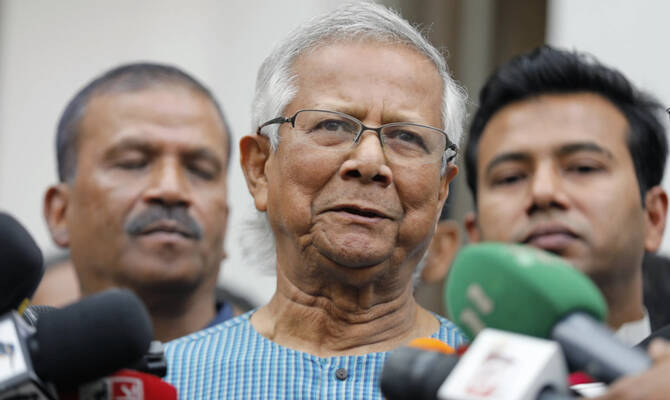
Bangladesh interim leader Mohammed Yunus said Wednesday that there was “no way” he wanted to continue in power after elections. (AP)
Short Url
Updated 11 June 2025
Follow

Bangladesh’s Yunus says will step down after polls

  • Yunus has long said elections will be held before June 2026, but says the more time the interim administration had to enact reforms, the better

LONDON: Bangladesh interim leader Mohammed Yunus said Wednesday that there was “no way” he wanted to continue in power after elections he has announced for April, the first since a mass uprising overthrew the government.

The South Asian nation of around 170 million people has been in political turmoil since a student-led revolt ousted then-Prime Minister Sheikh Hasina in August 2024, ending her 15-year rule.

Speaking in London, Yunus, asked if he himself was seeking any political post, the 84-year-old Nobel Peace Prize winner said there was “no way,” waving his hands in the air for emphasis.

“I think none of our Cabinet members would like to do that, not only me,” he said.

Yunus was answering questions after speaking at London’s foreign policy think tank Chatham House, the Royal Institute of International Affairs.

He also said he wanted to unveil a “big package” of proposals next month that he dubbed a “July Charter” — one year on since the students launched the demonstrations that toppled Hasina.

The aim of the package, he added, was to overhaul democratic institutions after Hasina’s tenure.

“We want to say goodbye to the old Bangladesh and create a new Bangladesh,” Yunus said.

The charter is being drafted by a government “consensus commission,” talking to political parties to “find that which are the recommendations they will accept,” he added.

Yunus has long said elections will be held before June 2026, but says the more time the interim administration had to enact reforms, the better.

But after political parties jostling for power repeatedly demanded he fix a timetable, he said earlier this month that elections would be held in April 2026.

“Our job is to make sure that the transition is managed well, and that people are happy when we hand over power to the elected government,” he said.

“So we want to make sure that the election is right, that is a very critical factor for us. If the election is wrong, this thing will never be solved again.”

Yunus is also expected to meet in London with Tarique Rahman, acting chairman of Bangladesh Nationalist Party, which is widely seen as likely to sweep the elections.

Rahman, 59, the son of former Prime Minister Khaleda Zia, has lived in London since 2008 after being sentenced in absentia under Hasina — convictions since quashed.

He is widely expected to return to Dhaka to lead the party in polls.


Archbishop of York says he was ‘intimidated’ by Israeli militias during West Bank visit

Archbishop of York Stephen Cottrell poses for a photograph with York Minster’s Advent Wreath.
Updated 26 December 2025
Follow

Archbishop of York says he was ‘intimidated’ by Israeli militias during West Bank visit

  • “We were … intimidated by Israeli militias who told us that we couldn’t visit Palestinian families in the occupied West Bank,” the archbishop said

LONDON: The Archbishop of York has revealed that he felt “intimidated” by Israeli militias during a visit to the Holy Land this year.

“We were stopped at various checkpoints and intimidated by Israeli militias who told us that we couldn’t visit Palestinian families in the occupied West Bank,” the Rev. Stephen Cottrell told his Christmas Day congregation at York Minster.

The archbishop added: “We have become — and really, I can think of no other way of putting it — we have become fearful of each other, and especially fearful of strangers, or just people who aren’t quite like us.

“We don’t seem to be able to see ourselves in them, and therefore we spurn our common humanity.”

He recounted how YMCA charity representatives in Bethlehem, who work with persecuted Palestinian communities in the West Bank, gave him an olive wood Nativity scene carving.

The carving depicted a “large gray wall” blocking the three kings from getting to the stable to see Mary, Joseph and Jesus, he said.

He said it was sobering for him to see the wall in real life during his visit.

He continued: “But this Christmas morning here in York, as well as thinking about the walls that divide and separate the Holy Land, I’m also thinking of all the walls and barriers we erect across the whole of the world and, perhaps most alarming, the ones we build around ourselves, the ones we construct in our hearts and minds, and of how our fearful shielding of ourselves from strangers — the strangers we encounter in the homeless on our streets, refugees seeking asylum, young people starved of opportunity and growing up without hope for the future — means that we are in danger of failing to welcome Christ when he comes.”