

UK to trim asylum backlog, saving ‘$1.3 billion a year’

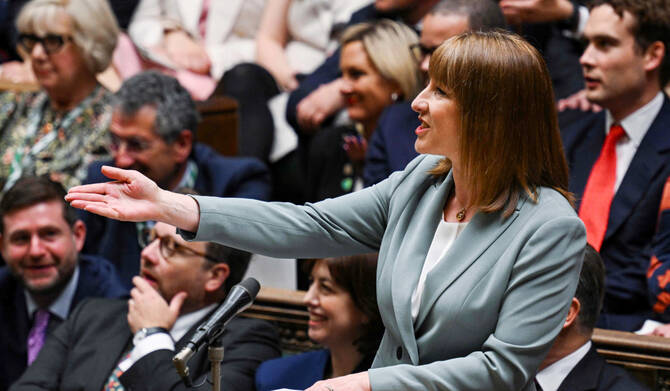
Britain's Chancellor of the Exchequer Rachel Reeves presenting her Spending Review to members of Parliament after the weekly session of Prime Minister's Questions (PMQs), in the House of Commons, in London, on June 11, 2025. (AFP)
Short Url
Updated 11 June 2025
Follow

UK to trim asylum backlog, saving ‘$1.3 billion a year’

LONDON: Britain’s Labour government pledged to cut a backlog in asylum applications and end “the costly use of hotels to house asylum seekers,” saving £1 billion ($1.3 billion) annually, Chancellor of the Exchequer Rachel Reeves announced on Wednesday.
“Funding that I have provided today ... will cut the asylum backlog, hear more appeal cases and return people who have no rights to be here, saving the taxpayer a billion pounds a year,” Reeves said in her Spending Review that sets out Treasury expenditure and savings over the next few years.
The number of UK asylum seekers has risen sharply in recent years, with tens of thousands of applications waiting to be decided, according to official figures.
Labour, which came to power last July, has set about tackling the situation.
Prime Minister Keir Starmer has started formal talks with unspecified countries to create “return centers” outside the UK for those who have exhausted all legal avenues to remain in the country.
The number of asylum seekers in the UK tripled to 84,200 in 2024 from an average of 27,500 between 2011 and 2020.
In 2022, there were approximately 13 asylum applications per 10,000 people in the UK, compared with 25 applications per 10,000 people in the EU at the same time.
Some 11 percent of migrants in the UK were asylum seekers or refugees in 2023 — almost twice as high as the 2019 figure of six percent.
The number of people crossing the Channel in makeshift boats, a route that virtually did not exist before 2018, has meanwhile increased sharply in recent years.
In 2024, the largest group of asylum seekers hailed from Pakistan, followed by Afghanistan.
In previous years, they came mainly from Syria and Iran.


Israel defends Somaliland move at UN amid concerns over Gaza motives

Women walk in front of a gas station, in the city of Hargeisa, Somaliland. (AFP file photo)
Updated 7 sec ago
Follow

Israel defends Somaliland move at UN amid concerns over Gaza motives

  • Some states question if recognition part of a bid to relocate Palestinians or establish military bases
  • US President Donald Trump's peace plan for Gaza states: "No one will be forced to leave Gaza, and ⁠those who wish to leave will be free to do so and free to return"
  • US accuses Security Council of double standards after Western countries recognized Palestinian state

UNITED NATIONS: Israel defended on Monday its formal recognition of the self-declared Republic of Somaliland, but several countries at the ​United Nations questioned whether the move aimed to relocate Palestinians from Gaza or to establish military bases.
Israel became the first country to recognize Somaliland as an independent and sovereign state on Friday.
The 22-member Arab League, a regional organization of Arab states in the Middle East and parts of Africa, rejects “any measures arising from this illegitimate recognition aimed at facilitating forced displacement of the Palestinian people or exploiting northern Somali ports to establish military bases,” Arab League UN Ambassador Maged Abdelfattah Abdelaziz told the UN Security Council.
“Against the backdrop of Israel’s previous references to Somaliland of the ‌Federal Republic of ‌Somalia as a destination for the deportation of Palestinian people, ‌especially ⁠from ​Gaza, its unlawful ‌recognition of Somaliland region of Somalia is deeply troubling,” Pakistan’s Deputy UN Ambassador Muhammad Usman Iqbal Jadoon told the council.
Israel’s UN mission did not immediately respond to a request for comment on the remarks or address any of them in its statement at the council meeting. In March, the foreign ministers of Somalia and Somaliland said they had not received any proposal to resettle Palestinians from Gaza.
US President Donald Trump’s peace plan for Gaza states: “No one will be forced to leave Gaza, and ⁠those who wish to leave will be free to do so and free to return.”
Israel’s coalition government, the most right-wing ‌and religiously conservative in its history, includes far-right politicians who advocate the ‍annexation of both Gaza and the West ‍Bank and encouraging Palestinians to leave their homeland.
Somalia’s UN Ambassador Abukar Dahir Osman said ‍council members Algeria, Guyana, Sierra Leone and Somalia “unequivocally reject any steps aimed at advancing this objective, including any attempt by Israel to relocate the Palestinian population from Gaza to the northwestern region of Somalia.”

SOMALILAND VS PALESTINIAN STATE
Somaliland has enjoyed effective autonomy — and relative peace and stability — since 1991 when Somalia descended into civil war, but ​the breakaway region has failed to receive recognition from any other country.
“It is not a hostile step toward Somalia, nor does it preclude future dialogue between ⁠the parties. Recognition is not an act of defiance. It is an opportunity,” Israel’s Deputy UN Ambassador Jonathan Miller told the council.
In September, several Western states, including France, Britain, Canada and Australia announced they would recognize a Palestinian state, joining more than three-quarters of the 193 UN members who already do so.
Deputy US Ambassador to the UN Tammy Bruce said: “This council’s persistent double standards and misdirection of focus distract from its mission of maintaining international peace and security.”
Slovenia’s UN Ambassador Samuel Zbogar disputed her argument, saying: “Palestine is not part of any state. It is illegally occupied territory ... Palestine is also an observer state in this organization.”
He added: “Somaliland, on the other hand, is a part of a UN member state and recognizing it goes against ... the UN Charter.”
Israel said last week that it would seek immediate cooperation with ‌Somaliland in agriculture, health, technology and the economy. The former British protectorate hopes Israeli recognition will encourage other nations to follow suit, increasing its diplomatic heft and access to global markets.