

UK to trim asylum backlog, saving ‘$1.3 billion a year’

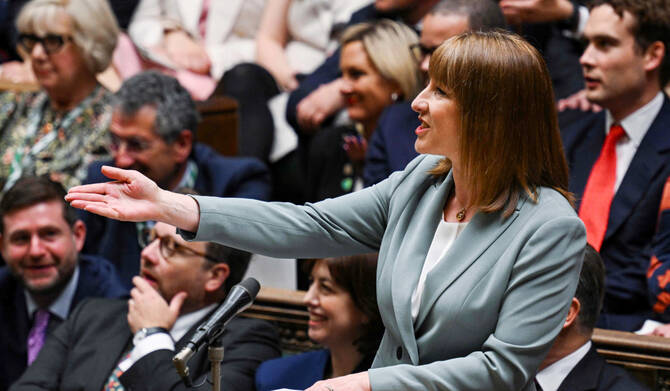
Britain's Chancellor of the Exchequer Rachel Reeves presenting her Spending Review to members of Parliament after the weekly session of Prime Minister's Questions (PMQs), in the House of Commons, in London, on June 11, 2025. (AFP)
Short Url
Updated 11 June 2025
Follow

UK to trim asylum backlog, saving ‘$1.3 billion a year’

LONDON: Britain’s Labour government pledged to cut a backlog in asylum applications and end “the costly use of hotels to house asylum seekers,” saving £1 billion ($1.3 billion) annually, Chancellor of the Exchequer Rachel Reeves announced on Wednesday.
“Funding that I have provided today ... will cut the asylum backlog, hear more appeal cases and return people who have no rights to be here, saving the taxpayer a billion pounds a year,” Reeves said in her Spending Review that sets out Treasury expenditure and savings over the next few years.
The number of UK asylum seekers has risen sharply in recent years, with tens of thousands of applications waiting to be decided, according to official figures.
Labour, which came to power last July, has set about tackling the situation.
Prime Minister Keir Starmer has started formal talks with unspecified countries to create “return centers” outside the UK for those who have exhausted all legal avenues to remain in the country.
The number of asylum seekers in the UK tripled to 84,200 in 2024 from an average of 27,500 between 2011 and 2020.
In 2022, there were approximately 13 asylum applications per 10,000 people in the UK, compared with 25 applications per 10,000 people in the EU at the same time.
Some 11 percent of migrants in the UK were asylum seekers or refugees in 2023 — almost twice as high as the 2019 figure of six percent.
The number of people crossing the Channel in makeshift boats, a route that virtually did not exist before 2018, has meanwhile increased sharply in recent years.
In 2024, the largest group of asylum seekers hailed from Pakistan, followed by Afghanistan.
In previous years, they came mainly from Syria and Iran.


Japan ruling party approves plans to beef up intelligence

Updated 5 sec ago
Follow

Japan ruling party approves plans to beef up intelligence

TOKYO: Japanese Prime Minister Sanae Takaichi’s ruling party has approved plans to beef up the country’s intelligence capability, a party official said Friday, as the premier pushes ahead with a defense overhaul.
Newly empowered after a landslide victory in snap elections this month, Takaichi has vowed to make Japan “strong and prosperous” through key policy changes including in defense and intelligence.
The plans come as a months-long diplomatic row between Japan and China over comments Takaichi made on Taiwan rumbles on.
The proposal, agreed by the intelligence strategy headquarters of the Liberal Democratic Party (LDP), includes establishing an upgraded intelligence bureau and strengthening “foreign intelligence collection capabilities,” an LDP official told AFP.
It calls for a mandatory registration system for foreign agents — such as individuals and corporations lobbying within Japan on behalf of other governments — as part of counterintelligence measures.
The plan, which also includes a ban on the use of mobile phones in key government buildings, is expected to be submitted to Takaichi next week, the Asahi Shimbun and other local media reported.
“One of the central pillars of the major policy shift (under Takaichi) is a fundamental strengthening of intelligence,” the LDP’s policy chief Takayuki Kobayashi said at the meeting Thursday where plans were approved.
“Simply creating an organization on paper is utterly meaningless; the question is how we can turn it into a truly living, functioning body,” he said.
Separately, the LDP on Wednesday proposed changes to Japan’s stringent rules on exporting military equipment so as to enable exports of lethal weapons, local reports said.
The LDP official could not immediately confirm the proposal.
Takaichi has also said that she plans to revise three key national security policy documents this year to reflect the changing security environment.
The premier, seen as a China hawk before becoming premier in October, suggested in November that Japan could intervene militarily if Beijing sought to take Taiwan by force.
China, which regards the democratic island as part of its territory and has not ruled out force to annex it, was furious.
It summoned Tokyo’s ambassador, warned Chinese citizens against visiting Japan and in December J-15 jets from China’s Liaoning aircraft carrier twice locked radar on Japanese aircraft in international waters near Okinawa, according to Japan.
Takaichi has vowed that Japan will steadfastly protect its territory, territorial waters and airspace.
Beijing’s top diplomat Wang Yi told the Munich Security Conference earlier this month that forces in Japan were seeking to “revive militarism.”
While she has said in parliament she will not change the rules, local media have reported that Takaichi is considering allowing US nuclear weapons into Japanese territory, a revision to the country’s non-nuclear principles of not producing, possessing or permitting the introduction of the weapons into the country.