

Several arrests made in drug crackdown across Saudi Arabia

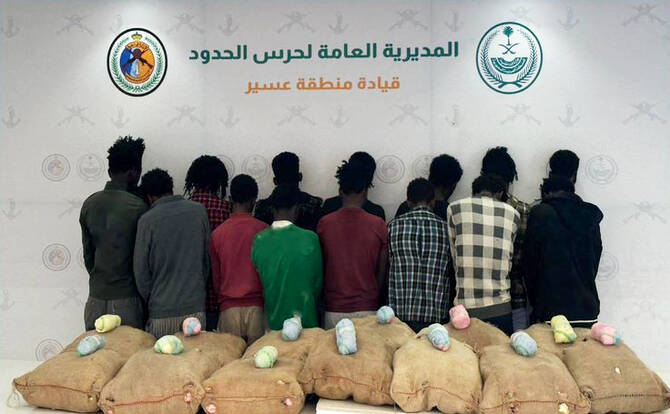
Border Guard patrols in the Al-Raboah sector of the Asir region arrested 14 Ethiopians for smuggling 260 kg of qat. (@BG994)
Short Url
Updated 11 June 2025
Follow

Several arrests made in drug crackdown across Saudi Arabia

  • Border Guard patrols in the Al-Raboah sector of the Asir region arrested 14 Ethiopians for smuggling 260 kg of qat
  • In a separate incident, four Ethiopians were arrested for smuggling 28 kg of qat in Al-Farsha governorate

RIYADH: Saudi authorities have made numerous drug-related arrests throughout the Kingdom, the Saudi Press Agency reported on Wednesday.

Border Guard patrols in the Al-Raboah sector of the Asir region arrested 14 Ethiopians for smuggling 260 kg of qat. In a separate incident, four Ethiopians were arrested for smuggling 28 kg of qat in Al-Farsha governorate.

Security patrols in Asir also arrested a citizen with 11 kg of qat in the same governorate.

In the Al-Dayer sector of the Jazan region, authorities thwarted an attempt to smuggle 600 kg of qat. In another case, Border Guard patrols arrested an Ethiopian trying to smuggle 80 kg of qat.

The General Directorate of Mujahideen in Jazan arrested two citizens for selling hashish, while the General Directorate of Narcotics Control arrested two Pakistanis and an Indonesian in Jeddah with 1.5 kg of methamphetamine, locally known as shabu.

A citizen was also arrested in the Baha region for selling amphetamine.

Preliminary legal procedures have been completed for all individuals, and the seized narcotics have been handed over to the authorities.

The Saudi government urges anyone with information about smuggling or customs offenses to call the confidential hotline 1910, the international number +966114208417, or email [email protected].

All information is treated with strict confidentiality. Financial rewards are offered for valid information.


Pioneering electric bus service takes to the road in Makkah

Updated 19 December 2025
Follow

Pioneering electric bus service takes to the road in Makkah

  • The bus rapid transit project, a system designed to have higher capacity and reliability than conventional bus services, is said to be the first of its kind in the Kingdom
  • The vehicles operate in dedicated bus lanes within a network that includes two main bus stations and 11 stops along the route connecting them

MAKKAH: A pioneering electric bus service took to the road in Makkah this week.

Electromin, the developer and operator of the service in partnership with Umm Al-Qura for Development and Construction, said it is expected to serve more than 125 million passengers over the next 15 years, while cutting carbon dioxide emissions by more than 31,500 tonnes compared with traditional vehicles.

The bus rapid transit project, a system designed to have higher capacity and reliability than conventional bus services, is said to be one of the first of its kind in the Kingdom. It was inaugurated on Wednesday by Amr Al-Dabbagh, chairperson of Al-Dabbagh Group; Samir Nawar, managing director of Petromin; and Yasser Abu Ateeq, CEO of Umm Al-Qura.

The bus rapid transit project is designed to have higher capacity and reliability than conventional bus services. (Supplied)

Electromin, a subsidiary of Petromin specializing in energy and mobility solutions, said the new service, which forms part of the Masar Destination mixed-use real estate development project in Makkah, is one the first transport networks of its kind in the country, and represents a significant shift toward a cleaner, more efficient urban transport model.

It operates in dedicated bus lanes, connecting key hubs within Masar and providing safe, reliable and environmentally friendly transportation for residents and visitors, the company added. The network includes two main bus stations and 11 stops along the route connecting them. It has been designed to serve more than 5 million visitors and pilgrims annually, and to be easily accessible to all users.

Operators say the service is designed as a foundation for Makkah’s future transportation system, through its integration with the broader Masar project, which includes pedestrian walkways, more than 5,000 parking spaces, metro services and other urban infrastructure.