

Saudi Arabia leads surge as Pakistan’s May remittances hit $3.7 billion

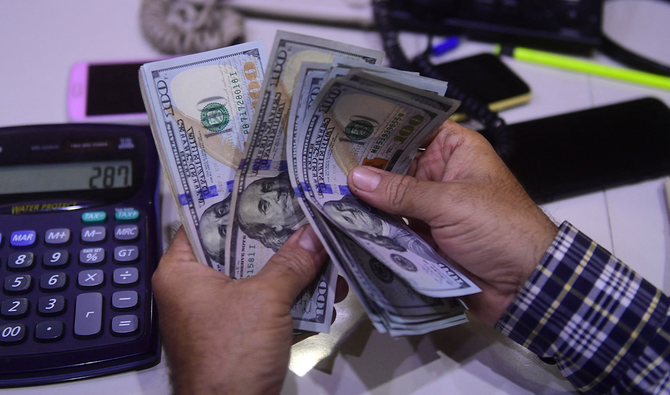
A dealer counts US dollars at a money exchange market in Karachi on March 2, 2023. (AFP/File)
Short Url
Updated 11 June 2025
Follow

Saudi Arabia leads surge as Pakistan’s May remittances hit $3.7 billion

  • Inflows bring total remittances for July-May FY2024-25 to $34.9 billion, a 28.8 percent increase from $27.1 billion in same period last year
  • Saudi Arabia remained largest contributor in May, sending $913.9 million, followed by UAE ($754.2 million), UK ($588.1 million), US ($314.7 million)

KARACHI: Pakistan received $3.7 billion in workers’ remittances in May 2025, a strong 16 percent increase month-on-month and 13.7 percent year-on-year, the State Bank of Pakistan (SBP) said on Wednesday, with Saudi Arabia remaining the largest contributor, sending $913.9 million.

The inflows brought total remittances for July-May FY2024-25 to $34.9 billion, marking a 28.8 percent increase from $27.1 billion in the same period last year. The rise follows a record breaking $4.1 billion in March, the highest-ever single-month inflow, and a robust $3.2 billion in April. 

The strong performance has helped offset Pakistan’s trade deficit and support its fragile foreign exchange reserves amid continued macroeconomic pressure.

“This is the highest level of remittances recorded in recent months,” the SBP said in a statement, noting that the increase reflected stronger flows from key corridors and a growing shift toward formal remittances channels. 

Analysts attribute the surge to a combination of factors, including improved exchange rate management, government crackdowns on hawala and hundi informal systems for transferring money internationally, and seasonal flows during Ramadan and Eid.

Saudi Arabia remained the largest contributor in May, sending $913.9 million, followed by the United Arab Emirates ($754.2 million), the United Kingdom ($588.1 million), and the United States ($314.7 million).

Remittances remain a critical source of foreign exchange for Pakistan, which is currently under a $7 billion IMF program and facing over $24 billion in external debt repayments over the next fiscal year.

The central bank has raised its full-year remittance forecast to $38 billion, reflecting optimism that flows will continue to support economic stabilization.

The surging remittances, especially from Saudi Arabia, help cushion Pakistan’s chronic current‑account deficit and bolster its foreign exchange reserves, offering relief ahead of major debt repayments. With global commodity prices still volatile and external financing constrained, continued inflows from overseas workers, particularly from the Gulf, are seen as crucial to maintaining macroeconomic stability and supporting Pakistan’s growth outlook under IMF conditions.


EU, Pakistan sign €60 million loan agreement for clean drinking water in Karachi

Updated 17 December 2025
Follow

EU, Pakistan sign €60 million loan agreement for clean drinking water in Karachi

  • Project will finance rehabilitation, construction of water treatment facilities in Karachi city, says European Investment Bank
  • As per a report in 2023, 90 percent of water samples collected from various places in city was deemed unfit for drinking

ISLAMABAD: The European Investment Bank (EIB) and Pakistan’s government on Wednesday signed a €60 million loan agreement, the first between the two sides in a decade, to support the delivery of clean drinking water in Karachi, the EU said in a statement. 

The Karachi Water Infrastructure Framework, approved in August this year by the EIB, will finance the rehabilitation and construction of water treatment facilities in Pakistan’s most populous city of Karachi to increase safe water supply and improve water security. 

The agreement was signed between the two sides at the sidelines of the 15th Pak-EU Joint Commission in Brussels, state broadcaster Radio Pakistan reported. 

“Today, the @EIB signed its first loan agreement with Pakistan in a decade: a €60 million loan supporting the delivery of clean drinking water for #Karachi,” the EU said on social media platform X. 

Radio Pakistan said the agreement reflects Pakistan’s commitment to modernize essential urban services and promote climate-resilient infrastructure.

“The declaration demonstrates the continued momentum in Pakistan-EU cooperation and highlights shared priorities in sustainable development, public service delivery, and climate and environmental resilience,” it said. 

Karachi has a chronic clean drinking water problem. As per a Karachi Water and Sewerage Corporation (KWSC) study conducted in 2023, 90 percent of water from samples collected from various places in the city was deemed unsafe for drinking purposes, contaminated with E. coli, coliform bacteria, and other harmful pathogens. 

The problem has forced most residents of the city to get their water through drilled motor-operated wells (known as ‘bores’), even as groundwater in the coastal city tends to be salty and unfit for human consumption.

Other options for residents include either buying unfiltered water from private water tanker operators, who fill up at a network of legal and illegal water hydrants across the city, or buying it from reverse osmosis plants that they visit to fill up bottles or have delivered to their homes.

The EU provides Pakistan about €100 million annually in grants for development and cooperation. This includes efforts to achieve green inclusive growth, increase education and employment skills, promote good governance, human rights, rule of law and ensure sustainable management of natural resources.