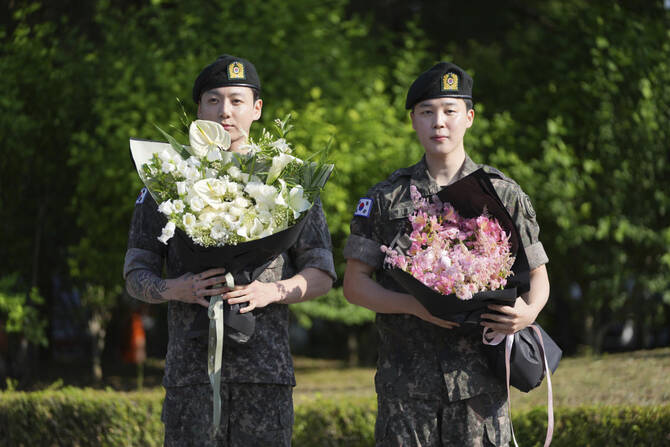
Fans greet K-pop stars Jimin and Jung Kook of BTS discharged from military service

The seven singers of the popular K-pop band plan to reunite as a group sometime in 2025 after they finish their service. (AP)
Short Url
Updated 11 June 2025
Follow

Fans greet K-pop stars Jimin and Jung Kook of BTS discharged from military service

  • The pair wore their military uniforms Wednesday, saluted and addressed fans who had assembled to see the pair after their discharge
  • The seven singers of the popular K-pop band plan to reunite as a group sometime in 2025 after they finish their service

YEONCHEON: Hundreds of fans gathered in the early morning hours to catch a glimpse of K-pop superstars Jimin and Jung Kook, the latest and final members of BTS to be discharged from South Korea’s mandatory military service.
The pair wore their military uniforms Wednesday, saluted and addressed fans who had assembled to see the pair after their discharge.
Jung Kook thanked the journalists and fans who traveled to see him and Jimin after their discharge and acknowledged how different it was to be back in the spotlight. “Actually, it’s been so long since I’ve been in front of cameras, and I didn’t even put on makeup, so I’m a bit embarrassed,” he said. “I don’t know what to say.”
The pair enlisted in December 2023, one day after RM and V did the same. The latter were discharged on Tuesday.
Supporters traveled from around the world to the public sports ground where the meet-and-greet took place. It was moved from the military base’s gate for safety reasons. Color-wrapped buses bearing BTS members’ faces lined the streets while red and yellow balloons floated above and a decorated food truck provided free coffee and water, adding to the festive atmosphere.
Many supporters wore masks, conscious of potential backlash after the band’s label discouraged attendance citing safety concerns. Despite the challenges, fans like Anaesi from Portugal said the 20-hour journey to Yeoncheon, a town near the tense border with North Korea, was worth it.
“Portugal is a small country, but inside of Portugal, BTS is a king,” she said. Anaesi, who discovered BTS on YouTube, said the group “saved” her from depression. “So for me BTS is my angel,” she said. She displayed a colorful upper arm tattoo featuring a golden shield emblazoned with “ARMY” and an eagle above it, complemented by Korean text listing BTS members’ names and those of her friends.
V thanked fans Tuesday for their patience in waiting for him and RM’s return and teased the band’s reunion. “If you can just wait a little bit longer, we will return with a really amazing performance.”
The seven singers of the popular K-pop band plan to reunite as a group sometime in 2025 after they finish their service.
Six of the group’s seven members served in the army, while Suga is fulfilling his duty as a social service agent, an alternative form of military service. He will be discharged later this month.
Jin, the oldest BTS member, was discharged in June 2024. J-Hope was discharged in October.
In South Korea, all able-bodied men aged 18 to 28 are required by law to perform 18-21 months of military service under a conscription system meant to deter aggression from rival North Korea.
The law gives special exemptions to athletes, classical and traditional musicians, and ballet and other dancers if they have obtained top prizes in certain competitions and are assessed to have enhanced national prestige. K-pop stars and other entertainers aren’t subject to such privileges.
However, in 2020, BTS postponed their service until age 30 after South Korea’s National Assembly revised its Military Service Act, allowing K-pop stars to delay their enlistment until age 30.
There was heated public debate in 2022 over whether to offer special exemptions of mandatory military service for BTS members, until the group’s management agency announced in October 2022 that all seven members would fulfill their duties.


Fear grips Congo’s Uvira as M23 rebels take control, displacing 200,000

Updated 4 sec ago
Follow

Fear grips Congo’s Uvira as M23 rebels take control, displacing 200,000

  • On Saturday, the situation in Uvira still had not returned to normal
  • “Some people left the city, but we stayed,” Maria Esther, a 45-year-old mother of 10, told AP

UVIRA, CONGO: A climate of fear reigned Saturday in Uvira, a strategic city in eastern Congo, days after it fell to the Rwanda -backed M23 group, as fighting in the region escalated despite a US mediated peace deal.
The Associated Press gained rare access to the city, which was the Congo government’s last major foothold in South Kivu province after the provincial capital of Bukavu fell to the rebels in February. Its capture allows the rebels to consolidate a broad corridor of influence across the east.
M23 said it took control of Uvira earlier this week, following a rapid offensive launched at the start of the month. Along with the more than 400 people killed, about 200,000 have been displaced, regional officials say.
On Saturday, the situation in Uvira still had not returned to normal. There was absolute silence and no traffic, apart from military jeeps circulating on the empty streets. The banks were closed and people have not resumed their jobs — only a few dared to go out during the day, and no one ventured outside after sunset, with armed M23 fighters patrolling the city.
“Some people left the city, but we stayed,” Maria Esther, a 45-year-old mother of 10, told AP. “But the situation hasn’t returned to normal, we haven’t resumed our usual activities because there’s no money circulating.”
Joli Bulambo, another resident of Uvira, said: “People thought that the situation that had happened in Goma with the deaths would be the same here in Uvira, but fortunately, there were not many deaths because God helped.”
M23’s latest push
The rebels’ latest offensive comes despite a US-mediated peace agreement signed last week by the Congolese and Rwandan presidents in Washington.
The United States accused Rwanda of violating the agreement by backing a deadly new rebel offensive in the mineral-rich eastern Congo, and warned that the Trump administration will take action against “spoilers” of the deal.
The accord didn’t include the rebel group, which is negotiating separately with Congo and agreed earlier this year to a ceasefire that both sides accuse the other of violating. However, it obliges Rwanda to halt support for armed groups like M23 and work to end hostilities.
Marco Rubio, US Secretary of State, said on X on Saturday: “Rwanda’s actions in eastern DRC are a clear violation of the Washington Accords signed by President Trump, and the United States will take action to ensure promises made to the President are kept.”
There was no immediate reaction from Rwanda.
The rebels’ advance pushed the conflict to the doorstep of neighboring Burundi, which has maintained troops in eastern Congo for years, heightening fears of a broader regional spillover.
A struggle for mineral rich territory
More than 100 armed groups are vying for a foothold in mineral-rich eastern Congo, near the border with Rwanda, most prominently M23. The conflict has created one of the world’s most significant humanitarian crises, with more than 7 million people displaced, according to the UN agency for refugees.
Local UN partners report that more than 200,000 people have been displaced across the province since Dec. 2. Civilians also have crossed into Burundi, and there have been reports of shells falling in the town of Rugombo, on the Burundian side of the border, raising concerns about the conflict spilling over into Burundian territory.
Congo, the US and UN experts accuse Rwanda of backing M23, which has grown from hundreds of members in 2021 to around 6,500 fighters, according to the UN
Rwanda, Congo and M23 trade accusations

Congo’s Foreign Minister Thérèse Kayikwamba Wagner on Friday accused Rwanda of trampling on the peace agreement, which she described as bringing “hope of a historic turning point.”
She warned, however, that the “entire process … is at stake,” and urged the Security Council to impose sanctions against military and political leaders responsible for the attacks, ban mineral exports from Rwanda and prohibit it from contributing troops to UN peacekeeping missions.
“Rwanda continues to benefit, especially financially but also in terms of reputation, from its status as a troop-contributing country to peacekeeping missions,” Wagner told AP.
Bertrand Bisimwa, deputy coordinator of the AFC/M23 rebel movement told AP in an exclusive interview Friday that peace commitments have remained largely theoretical. “Regardless of the ceasefire agreements we sign and the mutual commitments we make, nothing is implemented on the ground,” he said.
Asked about the expansion of M23 operations toward the Uvira region, Bisimwa said the region was a long-standing hot spot of ethnic tensions and violence. “For a long time, people were attacked and killed because of their community affiliation,” he said.
On Friday, Rwanda’s Foreign Minister Olivier Nduhungirehe told diplomats that Congo had declared it would continue fighting in M23 recaptured territories and it was only after M23 retaliated that the international community “suddenly woke up.”
“The DRC has openly declared that it would not observe any ceasefire and would instead continue fighting to recapture territories held by the AFC/M23, even as the peace process unfolded,” he said.
While Rwanda denies the claim that it backs M23, it acknowledged last year that it has troops and missile systems in eastern Congo, allegedly to safeguard its security. UN experts estimate there are up to 4,000 Rwandan forces in Congo.