

Pakistan urges urgent water reforms as India tensions escalate, climate risks mount

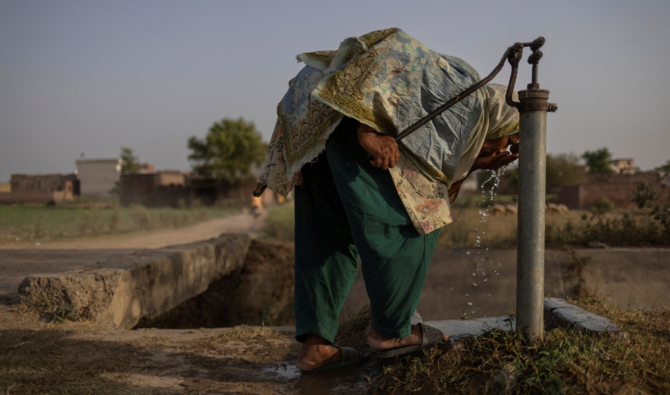
Shida drinks directly from a water well as temperatures soar above 48°C (118°F) during a heatwave in Daska, located in the Sialkot District of Punjab province, in Pakistan, June 10, 2025. (REUTERS)
Short Url
Updated 11 June 2025
Follow

Pakistan urges urgent water reforms as India tensions escalate, climate risks mount

  • In the outgoing fiscal year, government completed 34 of 59 water-related projects at a cumulative cost of $1.06 billion
  • Additional $368 million had been allocated for continued investment in ongoing schemes, finance minister says

ISLAMABAD: Pakistan must overhaul its water management system “on a war footing,” Finance Minister Muhammad Aurangzeb said on Tuesday, as the country grapples with intensifying climate threats and renewed tensions with neighboring India over transboundary river flows.

Hostility between nuclear-armed neighbors Pakistan and India is high after they struck a ceasefire on May 10 following their most intense military confrontation in decades. The latest escalation, in which the two countries’ militaries traded missile, drones and artillery fire, was sparked after India accused Pakistan of supporting militants who attacked dozens of tourists in Indian-administered Kashmir on April 22, killing 26. Islamabad denies involvement.

Following the attack, Delhi unilaterally “put in abeyance” the Indus Waters Treaty of 1960, which governs the usage of the Indus river system. The accord has not been revived despite the rivals agreeing on a ceasefire on May 10.

Delivering the federal budget speech for fiscal year 2025–26, the finance minister said India’s decision to suspend the decades-old water sharing mechanism had added urgency to the longstanding issue of water security. 

“In recent days, following the Pakistan-India war, India has threatened to block the waters meant for Pakistan. India is trying to use water as a weapon. I want to make it clear that water is vital to Pakistan’s survival and no stoppage in this regard will be tolerated,” Aurangzeb told parliament during the budget speech. 

“At the same time, it is essential that we expand our water reservoirs on a war footing. The government, despite its limited resources, will ensure the implementation of its water reservoir projects.”

Islamabad had said after India suspended the Indus Waters Treaty that it considered any attempt to stop or divert the flow of water belonging to Pakistan to be an “act of war.”

About 80 percent of Pakistani farms depend on the Indus system, as do nearly all hydropower projects serving the country of some 250 million.

Despite resource constraints, Aurangzeb said the government was committed to expanding its storage capacity and revamping its water infrastructure, adding that a detailed implementation plan would be announced in the coming days.

The minister also described climate change as an “existential threat” to Pakistan, saying the country was among the most affected nations due to its impact.

Aurangzeb said the government had given significant attention to climate finance in the last 16 months and issued green sukuk not only to lower its carbon footprint but also provide investors with a chance to support environmental initiatives.

Aurangzeb cited Pakistan’s 2018 National Water Policy as the foundation for a renewed push to manage water resources more efficiently and equitably.

Among key goals, he said, was expanding water storage by 10 million acre-feet, increasing water-use efficiency by 30 percent and deploying real-time discharge monitoring systems to reduce wastage, which is currently estimated at 33 percent.

He also said in the outgoing fiscal year, the government completed 34 of 59 water-related projects at a cumulative cost of Rs295 billion ($1.06 billion).

An additional Rs102 billion ($368 million) had been allocated for continued investment in ongoing schemes, the finance minister added. 


Pakistan, Muslim countries reject Israel’s plan to expel Palestinians from Gaza

Updated 4 sec ago
Follow

Pakistan, Muslim countries reject Israel’s plan to expel Palestinians from Gaza

  • Israel has announced plans to open the Rafah crossing with Egypt for Gaza residents fleeing the enclave
  • Muslim nations seek implementation of Trump’s peace plan, establishment of independent Palestinian state

ISLAMABAD: Pakistan, together with seven other Arab and Muslim countries, on Friday rejected Israel’s attempt to expel Palestinians by opening the Rafah border crossing with Egypt solely for fleeing Gaza residents, and called for adherence to the peace plan proposed by US President Donald Trump’s administration.

Trump’s Gaza plan calls on Israel to allow humanitarian aid into the territory and keep the Rafah crossing open from both sides.

However, Israel has continued to restrict aid flows, and its military said on Wednesday the crossing would open in the coming days “exclusively for the exit of residents from the Gaza Strip to Egypt.”

“The Foreign Ministers of the Islamic Republic of Pakistan, the Arab Republic of Egypt, the Hashemite Kingdom of Jordan, the United Arab Emirates, the Republic of Indonesia, the Republic of Türkiye, the Kingdom of Saudi Arabia, and the State of Qatar express their deep concern regarding the Israeli statements concerning the opening of the Rafah Crossing in one direction, with the aim of transferring residents of the Gaza Strip into the Arab Republic of Egypt,” said the joint statement circulated in Pakistan by the foreign office.

“The Ministers underscore their absolute rejection of any attempts to expel the Palestinian people from their land and stress the necessity of the full adherence to the plan proposed by US President Donald Trump, including its provisions on keeping the Rafah Crossing open in both directions, ensuring the freedom of movement for the population, and refraining from compelling any resident of the Gaza Strip to leave,” it continued.

The statement appreciated the US president’s commitment to establishing peace in the region and emphasized the importance of implementing his plan “without delay or obstruction” to help consolidate regional stability.

“The Ministers underscore the need to fully sustain the ceasefire, alleviate civilian suffering, ensure the unrestricted entry of humanitarian assistance into the Gaza Strip, initiate early recovery and reconstruction efforts, and create the conditions necessary for the Palestinian Authority to resume its responsibilities in the Gaza Strip,” the statement added.

They reaffirmed their countries’ readiness to work with the United States and all concerned regional and international actors to achieve “a just, comprehensive, and sustainable peace in accordance with international legitimacy and the two-state solution,” including the establishment of an independent Palestinian state on the pre-1967 lines with East Jerusalem as its capital.

Pakistan’s foreign office circulated the statement after Deputy Prime Minister Ishaq Dar held a telephone conversation with Saudi Foreign Minister Prince Faisal bin Farhan to discuss regional developments, particularly Gaza.

Dar condemned Israel’s plan to partially reopen the Rafah crossing only for fleeing Gaza residents, calling it a “clear violation” of the region’s peace plan.