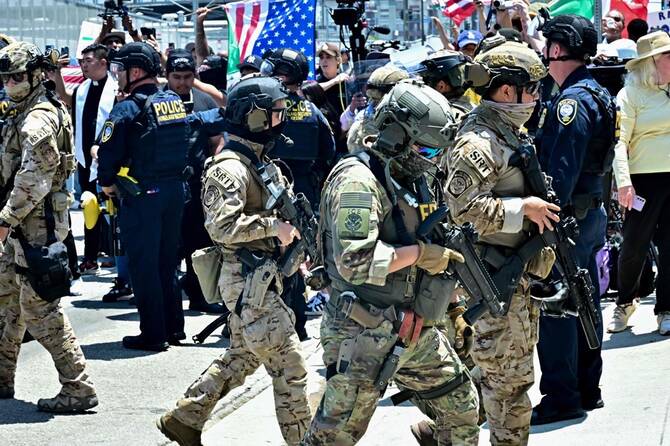
The images of cars set ablaze, protesters tossing rocks at police and officers firing nonlethal rounds and tear gas at protesters hearkens back to the last time a president sent the National Guard to respond to violence on Los Angeles streets.
But the unrest during several days of protests over immigration enforcement is far different in scale from the 1992 riots that followed the acquittal of white police officers who were videotaped beating Black motorist Rodney King.
President George H.W. Bush used the Insurrection Act to call in the National Guard after requests from Mayor Tom Bradley and Gov. Pete Wilson. After the current protests began Friday over Immigration and Customs Enforcement raids, President Donald Trump ordered the deployment of 4,100 National Guard troops and 700 Marines despite strident opposition from Mayor Karen Bass and Gov. Gavin Newsom.
Trump cited a legal provision to mobilize federal service members when there is “a rebellion or danger of a rebellion against the authority of the Government of the United States.” California Attorney General Rob Bonta filed a lawsuit Monday saying Trump had overstepped his authority. On Tuesday, Newsom filed an emergency motion in federal court to block the troops from assisting with immigration raids in Los Angeles.
Unlike the 1992 riots, protests have mainly been peaceful and been confined to a roughly five-block stretch of downtown LA, a tiny patch in the sprawling city of nearly 4 million people. No one has died. There’s been vandalism and some cars set on fire but no homes or buildings have burned.
More than 100 people have been arrested over the past several days of protests. The vast majority of arrests were for failing to disperse, while a few others were for assault with a deadly weapon, looting, vandalism and attempted murder for tossing a Molotov cocktail.
Several officers have had minor injuries and protesters and some journalists have been struck by some of the more than 600 rubber bullets and other “less-lethal” munitions fired by police.
Outrage over the verdicts on April 29, 1992 led to nearly a week of widespread violence that was one of the deadliest riots in American history. Hundreds of businesses were looted. Entire blocks of homes and stores were torched. More than 60 people died in shootings and other violence, mostly in South Los Angeles, an area with a heavily Black population at the time.
The 1992 uprising took many by surprise, including the Los Angeles Police Department, but the King verdict was a catalyst for racial tensions that had been building in the city for years.
In addition to frustration with their treatment by police, some directed their anger at Korean merchants who owned many of the local stores. Black residents felt the owners treated them more like shoplifters than shoppers. As looting and fires spread toward Koreatown, some merchants protected their stores with shotguns and rifles.


![]()

LA protests far different from ‘92 Rodney King riots
Short Url
https://arab.news/24sv4
LA protests far different from ‘92 Rodney King riots
Latest updates


© 2026 SAUDI RESEARCH & PUBLISHING COMPANY, All Rights Reserved And subject to Terms of Use Agreement.