

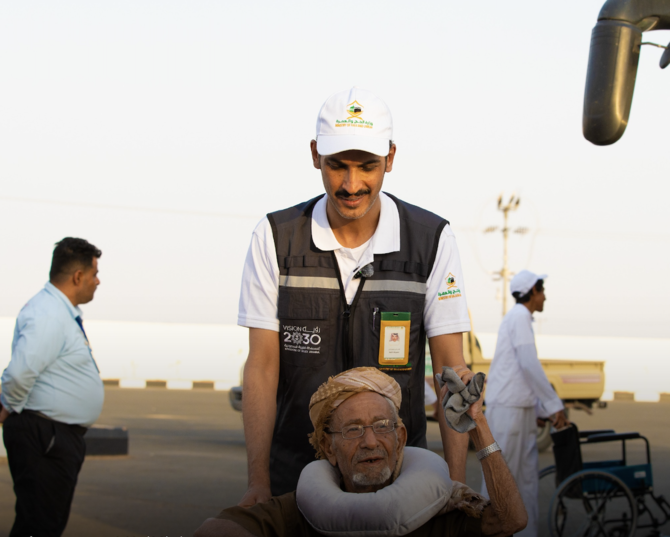
More than 94,000 individuals worked in organizing this year’s Hajj

Over 94,000 people participated in organizing this year’s Hajj season in Saudi Arabia. (@HajMinistry)
Short Url
Updated 11 June 2025
Follow

More than 94,000 individuals worked in organizing this year’s Hajj

  • People were involved in serving pilgrims in various fields and organizational locations in Makkah and Madinah
  • The Ministry of Hajj and Umrah conducted over 70,000 field inspections during Hajj, examining pilgrims’ accommodation

RIYADH: Over 94,000 people participated in organizing the Hajj season in Saudi Arabia, where 1.4 million Muslims performed the pilgrimage in early June.

The Ministry of Hajj and Umrah reported on Tuesday that individuals served pilgrims in various fields and organizational locations in Makkah and Madinah as part of the ministry’s efforts in running the Hajj.

The ministry said its Compliance Center conducted over 70,000 field inspections during Hajj, examining pilgrim accommodation, camps, central kitchens, and operational facilities.

The Nusuk Care initiative offered over 845,000 direct services, including health, psychological, and language support, it added. Over 3,000 volunteers supported government efforts during the Hajj season, serving pilgrims at over 107 contact points and distributed across six tracks.

The ministry said these field indicators demonstrate the level of planning, precision, and investment in human resources and technology, which is aligned with the goals of Saudi Vision 2030, the Saudi Press Agency reported.


Japanese researchers hope to restore coral from Saudi-made structures

Updated 05 January 2026
Follow

Japanese researchers hope to restore coral from Saudi-made structures

  • Coral skeletons made for Saudi Pavilion at Japan expo last year
  • Results of Japanese study to be revealed at Riyadh Expo 2030

TOKYO: Japanese universities are seeking to restore coral reefs and marine ecosystems after receiving artificial structures that Saudi Arabia made and showcased at last year’s Osaka-Kansai Expo.

The coral skeletons were donated to the University of the Ryukyus in Okinawa and Kansai University in Osaka Prefecture, Kyodo News reported at the weekend.

The structures are made from calcium carbonate, a material on which corals are believed to grow more easily compared to artificial alternatives such as concrete or metal.

The skeletal structures were created using 3-D printers, with one piece produced a day during the expo, and displayed across an entire wall in the Saudi Arabia Pavilion, which had an area focusing on sustainable marine environments.

Coral reefs serve as habitats for much marine life, but over 40 percent of the world’s 892 species face possible extinction, according to the International Union for Conservation of Nature.

The University of the Ryukyus, which received about 150 of the artificial coral skeletons, will place them in waters off the eastern coast of Okinawa’s main island and then examine their impact on the ecosystem.

Kansai University has placed theirs in the sea around Kagoshima Prefecture’s Yoron Island to observe their growth after transplanting coral polyps onto the structures.

The results of the research are expected to be revealed at the Riyadh Expo in 2030.

“I had never imagined that Japan and Saudi Arabia would cooperate on coral research,” said Masato Ueda, a professor specializing in regenerative medicine at Kansai University.

Ueda said he wants to demonstrate to children that “humanity is attempting to restore the environment.”