

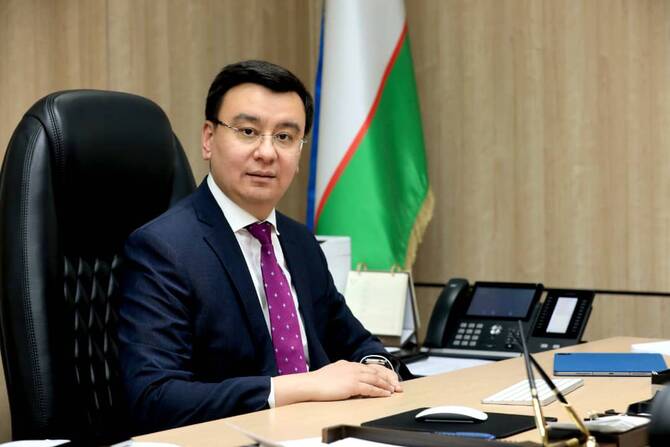

TASHKENT: As Uzbekistan undergoes an economic transformation, tourism has emerged as both a cultural ambassador and a powerful growth engine.
At the forefront is Umid Rustamovich Shadiyev, chairman of the Tourism Committee under the Ministry of Ecology.
Formerly Uzbekistan’s Permanent Representative to UNESCO, Shadiyev brings both diplomatic experience and a deep understanding of the nation’s rich heritage.
Arab News spoke with Shadiyev during the Tashkent International Investment Forum 2025, a flagship platform bringing together global investors, policymakers, and innovators to explore Uzbekistan’s investment landscape.

Saudi Arabia’s Crown Prince Mohammed bin Salman meets with Uzbekistan’s President Shavkat Mirziyoyev on the sidelines of the Gulf Summit with Central Asian countries in Jeddah on July 19, 2023. File/SPA
Now in its fourth edition, the forum has become a cornerstone of the country’s reform agenda, highlighting strategic sectors such as energy, infrastructure, agriculture, and tourism.
This year’s event welcomed over 2,500 delegates from 70 countries, with tourism receiving special focus as a driver of inclusive and sustainable development.
Saudi-Uzbek tourism ties deepen
The conversation turned to Saudi Arabia, where tourism is undergoing a historic transformation under Vision 2030. Shadiyev praised the Kingdom’s diversification efforts, calling it “a new center of global tourism.”
Uzbekistan sees an opportunity for synergy, and a memorandum of cooperation in tourism was signed in 2022, followed by joint forums and high-level meetings in 2023 and 2024.
“Our relationship with Saudi Arabia is growing stronger each year,” said the official.

Uzbekistan’s President Shavkat Mirziyoyev received Saudi Arabia’s Foreign Minister Prince Faisal bin Farhan at the headquarters of the International Conference on Central Asia and South Asia, held in Tashkent on July 16, 2021. File/SPA
The results are visible. Saudi tourist arrivals in Uzbekistan rose from 1,731 in 2022 to over 4,100 in 2024, reflecting growing interest in cultural, gastronomic, and mountain tourism.
“There’s huge potential in developing family-oriented tours, heritage trails, and collaborative media campaigns,” Shadiyev noted.
Tourism university exchanges, journalist visits, and influencer collaborations are also being explored.
In 2025, Uzbekistan is emphasizing sustainable tourism and aims to increase the average stay of foreign visitors to 10 to 12 days. Strategic partnerships — such as with Saudi Arabia — are seen as central to achieving this goal.
Tourism emerges as economic pillar
“Tourism is currently one of the key sectors of Uzbekistan’s economy,” Shadiyev noted. “In 2024, we saw a significant leap forward: the export of tourism services increased by 1.6 times, reaching $3.5 billion.”
This performance is backed by a rise in entrepreneurship, with more than 2,000 new tourism businesses launched in the past year alone. From boutique hotels to eco-lodges and cultural tour operators, a new generation of investors is responding to supportive government policies and the sector’s strong profitability.

Uzbekistan is also rolling out a UN tourism platform and a unified tourist card integrating visa services, tickets, and discounts. Pexels
The transformation is evident across the country. Over the past eight years, Uzbekistan has attracted $6.5 billion in tourism-related investments and added 130,000 new hotel beds.
“These achievements reflect our commitment to building a world-class tourism ecosystem,” Shadiyev said.
A major milestone came in April, when over 1 million foreign tourists visited Uzbekistan in a single month — a national record.
Shadiyev attributes this growth to visa policy reforms, infrastructure upgrades, and active global engagement. “We’re not only opening our doors wider; we’re creating lasting experiences for visitors,” he said.
Looking ahead, Uzbekistan aims to further increase both international arrivals and tourism export volumes in 2025. The government is systematically working toward these goals by investing in digital transformation, human capital, and diversified tourism offerings.
Speaking at the opening of the investment forum, Uzbekistan’s President Shavkat Mirziyoyev highlighted his country’s resource developments in the Fourth Industrial Revolution, which he said “is sharply increasing global demand for so-called ‘technological minerals’.”
He added: “Uzbekistan is home to substantial reserves of minerals, including tungsten, molybdenum, magnesium, lithium, graphite, vanadium, titanium, and others. In total, the potential of our subsoil resources is valued at $ 3 trillion.”
Mirziyoyev said they are establishing techno parks in the Tashkent and Samarkand regions to use their capabilities to transform the region into a hub that produces “high value-added goods” from their resources.
“In this context, I would like to put forward an initiative: investors implementing a full-cycle operation – from geological exploration to the production of finished goods – will be granted a rent tax refund for 10 years,” he also said.
Uzbekistan’s gross domestic product has doubled in the last eight years, and the government expects to increase it to $200 billion by 2030, Mirziyoyev said
“Last year, the volume of investments into the national economy reached $35 billion, and exports amounted to $27 billion. This is also a practical result of the Tashkent International Investment Forum, now being held for the fourth consecutive year,” he noted.
Four seasons, one destination
Positioned at the crossroads of the Great Silk Road, Uzbekistan has long served as a bridge between East and West. Shadiyev highlighted the country’s unique geographic and cultural positioning: “We’re the heart of Central Asia — no regional tour is complete without including Uzbekistan.”

Uzbekistan aims to further increase both international arrivals and tourism export volumes in 2025. Uzbek Tourism
What makes Uzbekistan truly special, he said, is its year-round appeal. In spring, visitors celebrate Navruz, the festival of renewal, and explore blooming gardens, vibrant bazaars, and the historic cities of Tashkent, Samarkand, Bukhara, and Khiva.
Summer brings tourists to mountain resorts and natural lakes, rich fruit harvests, and traditional crafts festivals.
Winter offers skiing and tranquil nature retreats, while autumn is ideal for cultural immersion and warm Uzbek hospitality.
“Every season offers a new story, a new flavor,” Shadiyev said.
The country’s legacy is underscored by its many UNESCO World Heritage Sites, including Samarkand, Bukhara, and Khiva. Uzbekistan is also witnessing a boom in niche tourism markets, including ziyarat, or pilgrimage tourism, ecotourism, domestic travel, and culinary tours.
Uzbekistan’s rise on the global travel radar is also backed by international accolades.

Over the past eight years, Uzbekistan has attracted $6.5 billion in tourism-related investments and added 130,000 new hotel beds. Uzbekistan Travel
The country was named the Most Desirable Emerging Destination by Wanderlust, UK; won the tourism in the CIS award from Russian Traveler; and was featured among the Top 25 Destinations of 2025 by both BBC Travel and The New York Times.
Gulf travelers drawn to shared culture
When asked about Uzbekistan’s appeal to Arab travelers, particularly from the Gulf region, Shadiyev emphasized deep-rooted cultural and spiritual ties.
“Our shared Islamic heritage and atmosphere of religious respect make Uzbekistan especially attractive to Gulf visitors,” he said.
Khiva’s designation as the 2024 Tourism Capital of the Organization of Islamic Cooperation reflects this connection.
Other key events include the Economic Cooperation Organization’s tourism forum in Shakhrisabz, which spotlighted opportunities in religious and cultural travel.
Uzbekistan is enhancing its appeal through substance and strategy.

In 2025, Uzbekistan is emphasizing sustainable tourism and aims to increase the average stay of foreign visitors to 10 to 12 days. Getty
A 30-day visa-free regime now applies to citizens of Saudi Arabia, the UAE, and Qatar, as well as those of Oman, Bahrain, and Kuwait.
Direct flights from Gulf capitals are expanding, and tour operators are curating experiences tailored to Arab travelers.
The country offers a rich mix of gastronomy — including signature dishes like plov, manti, and shurpa — as well as ethno-tourism experiences in traditional villages, and a vibrant calendar of music, art, and food festivals.
Uzbekistan is also rolling out a UN tourism platform and a unified tourist card integrating visa services, tickets, and discounts.
“We’re not just promoting Uzbekistan; we’re building a seamless visitor experience,” Shadiyev added.
Vision rooted in heritage and openness
As the interview concluded, Shadiyev returned to a theme central to Uzbekistan’s tourism push: openness. “We are a country that welcomes the world — with history in our stones and hospitality in our hearts,” he said.
The Tashkent International Investment Forum served as the perfect setting for this conversation, reflecting Uzbekistan’s economic momentum and its growing network of global partnerships — none more vibrant than those flourishing through tourism.
As Shadiyev put it, quoting an old proverb: “It’s better to see something once than hear about it a hundred times.”


