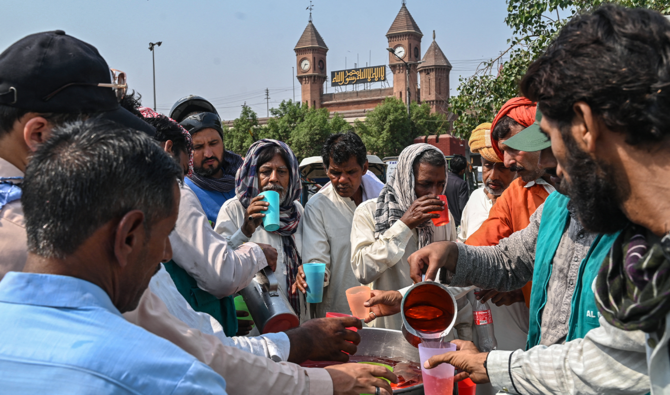

ISLAMABAD: The Pakistan Meteorological Department (PMD) said on Tuesday an ongoing heatwave in several parts of the country was expected to continue until June 12, while a blistering heat wave also swept through northern India with temperatures soaring above the normal, disrupting daily life and raising health concerns.
Pakistan ranks among the top ten countries most vulnerable to climate change and has faced increasingly frequent extreme weather events in recent years, including deadly heatwaves and floods.
Temperatures in the upper parts of the country including parts of Punjab, Islamabad, northwestern Khyber Pakhtunkhwa and the northern regions of Kashmir and Gilgit-Baltistan are expected to remain 5°C to 7°C above normal, the PMD said in a press release.
Temperatures in the southern Sindh, eastern Punjab and southwestern Balochistan provinces are likely to stay 4°C to 6°C above normal.
“The ongoing heatwave is expected to persist until Thursday,” the PMD said. “The general public is advised to take precautionary measures by avoiding direct sunlight between 11:00 am and 4:00 p.m. and increasing water intake.”
Most parts of the country would experience dry weather with extreme heat conditions on June 10-11, the report said. It added that strong, dusty winds are expected in some parts of Islamabad, Punjab, and Balochistan during the afternoon.
According to state media, Provincial Disaster Management Authority Punjab’s Director General Irfan Ali Kathia said under the directions of the chief minister, water supply is being ensured in the Cholistan desert region in southern Punjab.
He warned that special care of the children, elderly and the sick should be taken during this time.
Last week, the PMD forecast that the ongoing heatwave in the country would continue throughout the Eid Al-Adha holidays.
Pakistan experienced its most recent heatwave in May but no loss of life was reported.
In June 2024, nearly 700 people died in less than a week during a severe heatwave in the country, with most fatalities reported in the port city of Karachi and other parts of the southern Sindh province.
A similar heatwave in 2015 claimed over 2,000 lives in Pakistan’s largest city Karachi alone, while catastrophic floods in 2022 left more than 1,700 people dead and displaced over 33 million across the country.
SEARING HEAT IN INDIA
In neighboring India, the mercury shot up to 47.3 C (117 F) in Sri Ganganagar, a desert city in the northwestern state of Rajasthan on Monday, according to the Indian Meteorological Department.
The record for the country is 51 C (124 F), set in May 2016 in Rajasthan’s city of Phalodi.
The searing heat is not just a seasonal discomfort but underscores a growing challenge for the country’s overwhelmed health infrastructure. A prolonged exposure to extreme temperatures often causes heat strokes, mainly impacting the poor, outdoor workers, children, and the elderly.
Last year, a monthslong heatwave across swathes of India killed more than 100 people and led to over 40,000 suspected cases of heat stroke, according to data from the health ministry.
The Indian capital, New Delhi, saw its first heatwave of the season with temperatures soaring past 45 C (113 F) in one of its neighborhoods on Monday. The swelter wasn’t just numerical as the real-feel temperature, the heat index factoring in relative humidity, was a couple of notches higher.
For autorickshaw driver Pradeep Kumar, the scorching heat was taking a toll on his health and impacting household income as people avoided daytime commuting.
“This heat makes us very tired. We drink water to keep up. But many times our health gets affected,” Kumar said. “I feel troubled.”
The weather department has issued heatwave warnings for the next couple of days in northern India that include the states of Rajasthan, Uttar Pradesh, Haryana and the New Delhi national capital region. Some parts of those areas may witness light showers from Thursday, bringing relief.
India declares a heat wave whenever temperatures are above 40 C (104 F) in the plains and 30 C (86 F) or more in its hilly regions.
Heatwaves are usually reported from March to June and in some cases in July. The peak month is May, but it was relatively cooler this season due to weather aberrations amid multiple westerly disturbances, said G.P. Sharma, president at private weather forecaster Skymet.
Ryan Rodriguez, a 22-year-old tourist from the US was seen sipping a lemonade to keep himself cool in Delhi.
“It’s pretty hot here. I just came from a trip of the Middle East, so I am sort of adjusting to it. But (this is) much hotter than Virginia. I haven’t seen any worse heat than this in India so far,” said Rodriguez.
In Uttar Pradesh, the country’s most populous state, a punishing heatwave made people’s lives difficult as power grids struggled to keep pace with the soaring electricity demand.
“There is no light for hours in the afternoon, just when the heat is unbearable,” said Shabnam Khan, a homemaker in Lucknow, the state’s capital city. “The fan stops, the cooler doesn’t work, and we are left sitting on the floor, drenched in sweat.”
The state recorded its highest-ever electricity demand of 30,161 megawatts late Sunday as millions of homes and businesses ran cooling systems to beat the heat. Officials expect demand to surpass 32,000 megawatts in the coming weeks.
Atul Kumar Singh, a senior scientist at the Regional Meteorological Center in Lucknow, said the battle against this brutal summer heat was far from over as seasonal monsoon rains were still weeks away.
“We are seeing the worst of both heat and humidity. This is no longer just a matter of discomfort. It is becoming a public health emergency,” said Singh.