

Sana Mir becomes first Pakistani woman to be inducted in ICC Hall of Fame

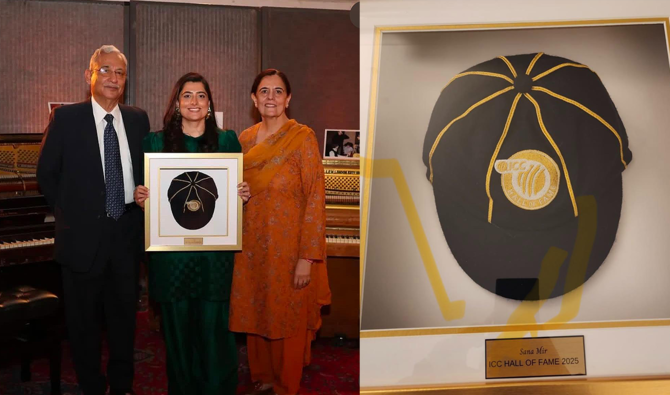
Collage of images shared by Pakistan's former women cricket team captain, Sana Mir on June 10, 2025, shows her posing with the ICC Hall of fame title with her parents (center-left image) and the title itself. (Sana Mir/Instagram)
Short Url
Updated 10 June 2025
Follow

Sana Mir becomes first Pakistani woman to be inducted in ICC Hall of Fame

  • Mir inducted alongside former greats Graeme Smith, Hashim Amla, Matthew Hayden, Daniel Vettori and Sarah Taylor
  • Mir played over 200 white-ball matches for Pakistan, picking up 150 wickets in 121 ODIs and 89 wickets in 106 T20Is

KARACHI: Former Pakistan cricketer Sana Mir made history this week when she became the first woman from her country to be inducted into the International Cricket Council (ICC) Hall of Fame alongside other cricket greats. 

ICC announced the names of the inductees which included Mir, former South African batters Graeme Smith and Hashim Amla, Matthew Hayden of Australia, Daniel Vettori of New Zealand and England’s Sarah Taylor on Monday. 

The ICC Hall of Fame pays tribute to the extraordinary achievements of cricket legends who have shaped the sport’s rich history with players inducted only five years after they have played their last international match. 

“A veteran in over 100 matches in both formats of white-ball cricket, Sana Mir becomes the first Pakistan woman cricketer to be inducted into the ICC Hall of Fame,” the ICC said in a post on its website on Monday. 

Mir has several accolades under her belt. The cricketer remains the highest wicket-taker in ODIs and the second-highest in T20Is among Pakistani women. Mir was also the first Pakistani woman cricketer to pick up 100 ODI wickets.

The former off-spinner has remained a prolific cricket voice off the field as well, amplifying a strong stance on body shaming, prioritizing mental health and helping people affected by the coronavirus pandemic. 

Mir played international cricket for 15 years, captaining Pakistan for eight of those. She picked up 150 wickets in 121 ODIs and 89 wickets in 106 T20Is, scoring 1630 and 820 runs respectively. Her best year was 2014 in which she collected 21 wickets in 11 ODIs while leading the team to an Asian Games gold medal, a feat she had achieved in 2010 as well, one year after being appointed as captain.

In 2018, Mir became the first Pakistani woman to reach the top of the ICC ODI Player Rankings. She was also the first Asian woman cricketer to play 100 T20Is, along with being the first Pakistan woman cricketer to play 100 ODIs.

She was also the first Pakistani woman cricketer to win the Pakistan Cricket Board (PCB) Cricketer of the Year award and now is the first Pakistani woman to be inducted into the ICC Hall of Fame.

The ICC credited Mir for speaking up for women’s rights and pushing women’s cricket in Pakistan. In 2019, she was included in the ICC Women’s committee as one of the three player representatives and was named the ambassador of the ICC Women’s T20 World Cup Qualifier in 2024.

“Mir knew she was doing the right thing and continued to live by her words, inspiring thousands of girls in not just her country but across the globe,” the ICC said. 


Nearly 25% of Pakistan’s primary schools enrolling girls operate as single-teacher ones— report

Updated 13 sec ago
Follow

Nearly 25% of Pakistan’s primary schools enrolling girls operate as single-teacher ones— report

  • Pakistan needs over 115,000 more teachers in primary schools enrolling girls to meet global benchmark of one teacher per 30 students, says report
  • Sixty percent of Pakistani primary schools enrolling girls are overcrowded, while 32% lack clean drinking water or toilets, says Tabadlab report

ISLAMABAD: Nearly 25% of Pakistan’s primary schools that enrolls girls operate as single-teacher ones, a report by a leading think tank said this week, calling on the government to devolve teacher recruitment powers, upskill underutilized teachers and introduce reforms to hire and promote faculty members. 

Pakistan faces an acute education crisis which is reflected in the fact that it has the world’s second-highest number of out-of-school children, an estimated 22.8 million aged 5-16 who are not in educational institutions, according to UNICEF. 

While poverty remains the biggest factor keeping children out of classrooms, Pakistan’s education crisis is exacerbated by inadequate infrastructure and underqualified teachers, cultural barriers and the impacts of frequently occurring natural disasters. 

According to “The Missing Ustaani,” a report published by Islamabad-based think tank Tabadlab and supported by Malala Fund and the Pakistan Institute of Education (PIE), Pakistan needs over 115,000 more teachers in primary schools with girls’ enrolment to meet the basic international benchmark of ensuring one teacher per 30 children. Currently, the average Student-to-Teacher Ratio (STR) across Pakistan’s primary schools with girls’ enrolment is 39:1, it said. 

“Approximately 60% of these schools are overcrowded, necessitating the recruitment of over 115,000 additional teachers nationwide,” the report said on Monday. “Compounding this, nearly 25% of primary schools with girls’ enrolment operate as single-teacher schools, placing immense pressure on the quality of education.”

It said the situation is more dire in Pakistan’s poverty-stricken southwestern Balochistan province, where nearly 52% of the schools are single-teacher only ones while the percentage decreases slightly in the southern Sindh province to 51 percent. 

The report said while the STR improves to 25:1 at the middle school level, acute shortages of subject specialists emerge as the top-priority concern for quality education in these schools.

“Furthermore, around 32% of primary schools with girls’ enrolment and 18% of middle schools face ‘critical infrastructural shortages’— lacking clean drinking water or toilets in addition to high STRs— which significantly affects girls’ attendance and learning, particularly during adolescence,” the report said. 

The report cited a set of priority recommendations to address Pakistan’s systemic teacher deployment challenges and improve educational equity for girls. 

It urged the government to devolve recruitment authority to school or cluster levels to enable timely, context-specific hiring. It also called upon authorities to reform teacher transfer and promotion policies to introduce school-specific postings with minimum service terms. 

This, it said, would reduce arbitrary transfers and improving continuity in classrooms. The report advised authorities to upskill surplus or underutilized primary teachers to support instruction at the middle school level, helping address subject-specialist shortages.

“Together, these reforms offer a pathway toward a more equitable, efficient, and responsive teaching workforce— one capable of improving learning outcomes and ensuring that every girl in Pakistan has access to a qualified teacher,” the report said. 

To tackle Pakistan’s education crisis, Prime Minister Shehbaz Sharif declared an ‘education emeregency’ in September 2024, stressing the importance of education for all.