Israeli left-wing leader calls for immediate end to Gaza war

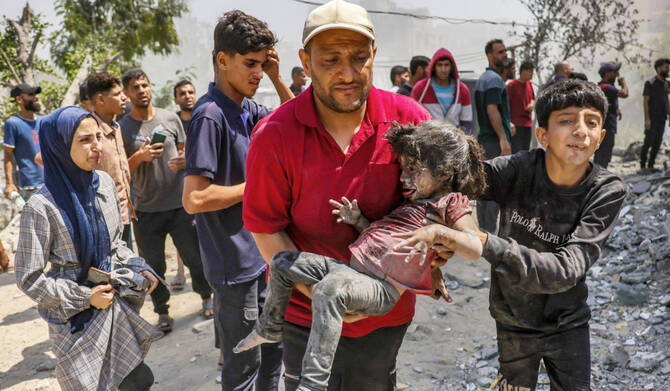
A Palestinian man carries a child pulled from the rubble of the Shaheen family home that was targetted in an Israeli strike in the Saftawi neighbourhood, west of Jabalia, in the northern Gaza Strip on June 9, 2025. (AFP)
Short Url
Updated 09 June 2025
Follow

Israeli left-wing leader calls for immediate end to Gaza war

  • Netanyahu’s government does not represent vast majority of people, Yair Golan says

JERUSALEM: Israeli left-wing opposition leader Yair Golan called on Monday for an immediate end to the Gaza war and said that Prime Minister Benjamin Netanyahu’s government no longer represented most Israelis.

“Today the government of Israel does not represent the vast majority of Israelis,” said Golan, chairman of the Democrats party and a former deputy army chief, days before a planned parliament vote which the opposition hopes would trigger a general election.
He told journalists in a briefing that after more than 20 months of fighting, Israel “should end the war as soon as possible.”
Golan’s party, a conglomeration of left-wing factions, has only four seats in Israel’s 120-member legislature, making it one of its smallest political groups.
But in a country where coalition building is essential to achieving a political majority, even relatively small parties can wield considerable power.

FASTFACT

Yair Golan’s party, a conglomeration of left-wing factions, has only four seats in Israel’s 120-member legislature, making it one of its smallest political groups.

Golan, a former deputy minister in a short-lived administration that replaced Netanyahu in 2021-2022, said that the current government — one of the most right-wing in Israel’s history — was a threat to democracy.
The opposition leader said he represents those “who want to save Israeli democracy ... from a corrupted future” and the “messianic-like and nationalistic and extremist vision of a very small faction in the Israeli society.”
“The vast majority wants to keep Israel as the homeland of the Jewish people and at the same time a free, egalitarian and democratic state,” Golan said.
He said that the vast majority of Israelis wanted to see an immediate end to the war in Gaza, the return of all hostages held by Palestinian militants in a single exchange deal, and the establishment of a national commission of inquiry into Hamas’s unprecedented 2023 attack, arguing that the Netanyahu government was opposed to these objectives.
“I believe that we can reach a hostage deal in a matter of days,” Golan said.
“I believe that by ending the war and freeing the hostages, we will be able to build an alternative to Hamas inside the Gaza Strip.”
Criticizing the government’s Gaza war policies, the former army general has recently drawn condemnation in Israel for saying that “a sane country ... does not kill babies for a hobby.”
Golan on Monday also said that most Israelis support legislation that would require ultra-Orthodox Jewish men, who are currently largely exempt from military service, to enlist.
The issue has sparked tension between Netanyahu and ultra-Orthodox parties in his government, with lawmakers threatening to topple the prime minister if no agreement is reached this week.
Some opposition parties are seeking to place a bill to dissolve parliament on Wednesday’s plenary agenda, hoping to capitalize on the ultra-Orthodox revolt.
“The vast majority wants new elections as soon as possible,” Golan said.


Palestinians wait at border between Gaza and Egypt as uncertainty clouds reopening of Rafah crossing

Updated 04 February 2026
Follow

Palestinians wait at border between Gaza and Egypt as uncertainty clouds reopening of Rafah crossing

  • At that pace, long waits are facing most of the roughly 20,000 sick and wounded people who Gaza’s Health Ministry has said need treatment abroad
  • Reopening the crossing is considered key as the ceasefire agreement moves into a complicated second phase
  • The bus with about 40 Palestinians that entered Gaza via Rafah on Tuesday arrived at Nasser hospital in Khan Younis early Wednesday morning, where their families welcomed them after spending the entire day waiting

KHAN YOUNIS, Gaza Strip: Palestinians gathered on both sides of Gaza’s border with Egypt on Tuesday hoping to pass through the Rafah crossing, after its reopening the previous day was marred by delays, interrogations and uncertainty over who would be allowed to cross.
On the Egyptian side were Palestinians who fled Gaza earlier in the Israel-Hamas war to seek medical treatment, according to Egypt’s state-run Al-Qahera News television. On the Gaza side, Palestinians in need of medical care that is unavailable in Gaza gathered at a hospital before ambulances moved toward Rafah, hoping for word that they would be allowed to cross the other way.
The office of the North Sinai governor confirmed Tuesday that an unknown number of patients and their companions had crossed from Gaza into Egypt.
The bus with about 40 Palestinians that entered Gaza via Rafah on Tuesday arrived at Nasser hospital in Khan Younis early Wednesday morning, where their families welcomed them after spending the entire day waiting.
Though hailed as a step forward for the fragile ceasefire struck in October, it took more than 10 hours for only about a dozen returnees and a small group of medical evacuees to cross in each direction on the first day Rafah reopened.
Three women who crossed into Gaza on Monday told The Associated Press on Tuesday that Israeli troops blindfolded and handcuffed them, then interrogated and threatened them, holding them for several hours before they were released.
The numbers permitted to cross on Monday fell well short of the 50 people that officials had said would be allowed each way and barely began to address the needs of tens of thousands of Palestinians who are hoping to be evacuated for treatment or to return home.
The import of humanitarian aid or goods through Rafah remains prohibited.
’Not a solution to the crisis’
Evacuation efforts on Tuesday morning converged around a Red Crescent hospital in Khan Younis, where a World Health Organization team arrived and a vehicle carrying patients and their relatives rolled in from another hospital. Then the group of WHO vehicles and Palestinian ambulances headed toward Rafah to await crossing.
As the sick, wounded and displaced waited to cross in both directions, health officials said the small number allowed to exit so far paled beside Gaza’s tremendous needs. Two years of fighting destroyed much of its medical infrastructure and left hospitals struggling to treat trauma injuries, amputations and chronic conditions like cancer.
In Gaza City, Shifa Hospital director Mohamed Abu Selmiya called the pace “crisis management, not a solution to the crisis,” imploring Israel to permit the importing of medical supplies and equipment. He wrote on Facebook: “Denying the evacuation of patients and preventing the entry of medicines is a death sentence for them.”
UN and WHO officials said the trickle of patients allowed out and restrictions on bringing in desperately needed supplies are prolonging a disastrous situation in Gaza.
“Rafah must function as a real humanitarian corridor so we can have a surge in aid deliveries,” said Tom Fletcher, the UN’s top relief official.
Palestinian Red Crescent spokesperson Raed Al-Nims told AP that only 16 patients with chronic conditions or war wounds, accompanied by 40 relatives, were brought from Khan Younis to the Gaza side of Rafah on Tuesday — less than the 45 patients and wounded the Red Crescent was told would be allowed.
After days of anticipation over the reopening, hope lingered that it might mark a meaningful first step. In Khan Younis, Iman Rashwan waited for hours until her mother and sister returned from Egypt, hoping others would soon see their loved ones again.
Waiting on both sides
Officials say the number of crossings could gradually increase if the system works, with Israel and Egypt vetting those allowed in and out. But security concerns and bureaucratic snags quickly tempered expectations raised by officials who for weeks had cast reopening as a major step in the ceasefire deal.
There were delays on Monday over disagreements about luggage allowances. Returnees were carrying more than anticipated with them, requiring additional negotiations, a person familiar with the situation told the AP, speaking on condition of anonymity to discuss the diplomatic matter.
“They didn’t let us cross with anything,” Rotana Al-Regeb said as she returned around midnight Monday to Khan Younis. “They emptied everything before letting us through. We were only allowed to take the clothes on our backs and one bag per person.”
The initial number of Palestinians allowed to cross is mostly symbolic. Israeli and Egyptian officials have said that 50 medical evacuees would depart — along with two caregiver escorts — and 50 Palestinians who left during the war would return.
At that pace, long waits are facing most of the roughly 20,000 sick and wounded people who Gaza’s Health Ministry has said need treatment abroad. About 150 hospitals across Egypt are ready to receive patients, authorities said.
Who and what would be allowed through Rafah was a central concern for both Israel and Egypt.
Israeli Prime Minister Benjamin Netanyahu has said that anyone who wants to leave will eventually be permitted to do so, but Egypt has repeatedly said the Rafah crossing must open in both directions, fearing Israel could use it to push Palestinians out of Gaza.
Reopening the crossing is considered key as the ceasefire agreement moves into a complicated second phase. That calls for installing a new Palestinian committee to govern Gaza, deploying an international security force, disarming Hamas and taking steps to begin rebuilding.
In a meeting Tuesday with US special envoy Steve Witkoff in Jerusalem, Netayanhu repeated Israel’s “uncompromising demand” that Hamas be disarmed before any reconstruction begins, the prime minister’s office said.
A 19-year-old killed in southern Gaza
Nasser Hospital in Khan Younis said Ahmed Abdel-Al, 19, was shot and killed by Israeli troops on Tuesday morning in a part of the southern Gaza City, some distance away from the area under the Israeli military’s control.
Israel’s military said it was not immediately aware of any shootings in the area.
Abdel-Al was the latest of the 529 Palestinians killed by Israeli fire since the Oct. 10 start of the ceasefire, according to Gaza’s Health Ministry. They are among more than 71,800 Palestinians killed since the start of the war, according to the ministry, which does not distinguish between fighters and civilians.
The ministry, part of Gaza’s Hamas-led government, keeps detailed casualty records that are seen as generally reliable by UN agencies and independent experts.